A Diachronic Study of the Phenomena of Personal Pronouns with Attributives in Southeast Asia Huayu
2021-02-09LUYue-li
LU Yue-li
Based on the phenomenon of personal pronouns with attributives, this paper investigates the development and evolution of grammar in Southeast Asia Huayu. The results showed that the personal pronouns with attributives have shown an upward development trend in the centuries-old Huayu, as evidenced by the increasing number and frequency of their use, and the expansion of the range of personal pronouns that can carry attributives as well as the types of attributives. In addition, investigating the use of this linguistic phenomenon in Huayu, Putonghua, and Mandarin in a global perspective, it can be found that the three maintain a greater consistency.
Keywords: in Southeast Asia Huayu, personal pronouns, diachronic study
Introduction
The phenomenon of personal pronouns with attributives is ancient and has been extensively and thoroughly studied by scholars, such as Wang Li (1984, p. 485), Diao Yan-bin (2006, pp. 345-348; 2007, p. 52), He Yang(2008, p. 86), Wei Zhi-cheng (2007) and Zhang Feng-qin and Feng Ming (2004) and Shao Li and Wang Ke-fei(2018), covering such issues as the modifiable personal pronouns, the frequency of use of this structure, and its sources. However, these studies mainly focus on early Mandarin and Putonghua, while the phenomenon of personal pronouns with attributives in Huayu has received little attention, and only Lu Jian-ming (2018, pp. 425-426) has been seen discussing the use of personal pronouns with attributives in Singaporean Huayu. Therefore, the development and changes of the phenomenon of personal pronouns with attributives in centuries-old Huayu are yet to be examined and analyzed in order to form a more objective and comprehensive understanding of this grammatical phenomenon.
Saussure (1959) states, “Every part of language is subjected to change. To each period there corresponds some appreciable evolution. Evolution may vary in rapidity and intensity, but this does not invalidate the principle” (p. 140). Although grammar changes more slowly than vocabulary and has a great deal of solidity, it is inevitable that some changes will occur in Huayu, which has been spread and used in Southeast Asia for a hundred years. This paper takes a “historical” look at the evolution of the personal pronouns as attributives in Southeast Asia Huayu, with Singaporean and Malaysian Huayu as the target languages1. Referring to the historical staging of Huayu by Ser Wue-Hiong (2012) and Liu Xiao-mei (2016), and based on specific linguistic facts, the article divides the Southeast Asian Huayu into three stages, namely, 1919-1945, 1945-1980, and 1980-present. The corpus of this study consists of two main series: literary corpus and journalistic corpus. The literary corpus mainly comes from representative works in Southeast Asia, such as The Great Series of New Malaysian Literature, Selected Malaysian Literary Works, and The Great Series of Malaysian Literature, etc.; the journalistic corpus comes from more representative newspapers in Southeast Asia, such as Lat Pau, Sin Chew Daily, and Kwong Wah Yit Poh. 3 million words per phase, taking into account the balance of style and time.
II. Diachronic Changes of Personal Pronouns with Attributives
In the first stage, the use of the personal pronoun with attributives is very common, see examples:
(1) 这样环境支配下的我,怎样地过下去呵!(《海丝》, 1927)
I, who am under such circumstances, am not sure how I can go on living. (Sea Silk, 1927)
(2) 这对于也是几个编者之一的你 (君苹),感想是:“半推半就”的,然而却颇有点“沾沾自
喜”。 (《狮声》, 1936)
For you (Jun Ping), who is also one of the editors, the feeling is: “half-hearted”, but a bit “complacent”.(The Lion’s Voice, 1936)
(3) 她觉得眼前的他,太过憔悴了。(《狮声》, 1934)
She felt that he was too haggard, who was in front of her. (The Lion’s Voice, 1934)
(4) 李阮破产的危机在呈现着,一触即发,一点没有经济活动力的她,对此怎么能不忧惧?(《一触即发》, 1932)
The crisis of Lee Ruan’s bankruptcy is presenting itself, and how can she, who has no economic activity at all, not be afraid of it? (A Touch of the Wind, 1932)
Similarly, the plural forms of the first, second, and third person pronouns can also have attributives, see examples:
(5) 只顾耕耘工作,不计酬报的几十万的农工大众,也使海外的我们深致无上的敬意。(《棉兰文化界的新生》, 1941)
The hundreds of thousands of peasants and workers who work without any reward also make us, who are from overseas, pay the highest respect to them. (The New Life of the Medan Cultural Community, 1941)
(6) 我们要尽所知道报告关于不仁而凶暴的家长的阴谋计划,给我亲爱的你们!(《混沌》, 1928)
We would like to report all we know about the conspiracy plan of the unkind and violent parents to you, my dear ones! (Chaos, 1928)
(7) 你看这里的她们,凡是赴会、见客,尤其结婚的时候,无论如何,这双高跟鞋,是必要穿上,万万不可少的。(《星光》, 1925)
Look at the women, who are here, whenever they go to a meeting or meet a guest, especially when they get married, they must wear these high-heeled shoes, no matter what, they are indispensable. (Starlight, 1925)
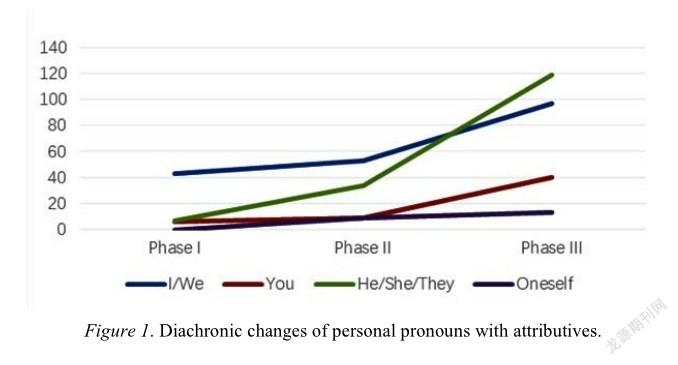
Entering the second and third stages, the use of personal pronouns with attributives increases, the ratio of the three stages is 56:96:269, and the increase is mostly in the examples of third person pronouns with attributives, see examples:
(8) 李發伯想呀想的,突然厂门外又传来一阵雄壮的歌声,使仍在担忧的他,又不得不走出车间来观望着。(《星洲周刊》, 1956)
Li Fa-bo thought and thought, but suddenly a majestic song came from outside the factory door, so that he, who was still worried, had to come out of the workshop to watch again. (Sin Chew Weekly, 1956)
(9) 奶奶哭红了双眼数落他的不是,不曾有过主意的她,面对着一个颓废的生命,更是无可奈何。(《马华文学大系》, 1994)
The grandmother cried her eyes red and counted his faults, and she, who had never had an idea, was even more helpless in the face of a decrepit life. (The Great Series of Mahua Literature, 1994) In addition, there are some new cases of “oneself” with attributives in the second stage, such as:
(10) 那熱恋着黄昏的女孩就在林里守着迷失的自己,久久不去。(《马华文学大系》, 1971)
The girl who was passionately in love with the dusk was guarding herself who was lost in the forest for a long time. (The Great Series of Malaysian Huayu Literature, 1971)
(11) 在漂浮里,他能寻回失落的自己么?(《写作人》, 1979)
In the floating, can he find himself who is lost? (The Writer, 1979) In the third stage, the use of “oneself” with attributive increases, and the ratio is 13:9 compared with the previous stage, e.g.
(12) 黄昏时回到书房,扭开灯火扭开一片书扉,常常感觉那才是原来的自己。(《马华文学大系》, 1981)
When I return to my study at dusk, I turn on the light and open a book, and often feel that I am the original myself. (The Great Series of Malaysian Literature, 1981)
(13) 真的画像因而再显见美丽,又怎么样?于是,老的美女对着画中过去年轻的自己自怜。(《南洋商报》, 1994)
So what if the real portrait reveals its beauty again? So, the old beauty pities herself on her past self who was young in the painting. (Nanyang Siang Pau, 1994)
It can be seen that the personal pronouns with attributives in Southeast Asia Huayu have been used more and more frequently and in a wider and wider range during the century, showing an “upward” development trend, and the specific changes of the three stages of usage are shown in Figure 1.
In addition, the following points should be noted about the phenomenon of personal pronouns with attributives:
First of all, the personal pronouns that can carry the attributives are mainly “I/we, you/you, he (she)/they(they), oneself”, etc. The literary personal pronouns and “others, everyone, everybody” rarely carry the attributives. In addition, we searched the corpus of other 5 million words of Kwong Wah Yit Poh and Sin Chew Daily (2015-2020) and found only one case of “everyone” with attributive:
(14) 在烈日下,参加工作坊的大伙儿都笑开了。(《星洲日报》, 2020)
Under the scorching sun, everyone who participated in the workshop laughed. (Sin Chew Daily, 2020)
The first and second stage personal pronouns with attributives are mainly “I/we”, the third stage is mainly“he (she)/they”, and the second personal pronouns are less frequent with attributives. Some studies have explained this phenomenon, such as Diao Yan-bin (2007, p. 52), who points out that “the reason why this type of usage is rare is that the expressions generally do not need to qualify the other party of the conversation or lay out the statement”; He Yang (2008, p. 86), on the other hand, argues that “This may indicate that the usage of personal pronouns subject to modification is more written and less applicable in dialogue, as second-person pronouns are commonly used in dialogue descriptions.” The fact that second-person pronouns in Huayu rarely carry attributives may be related to both of these factors.
Secondly, the syllable length of the attributives shows a decreasing trend. The specific changes in the average number of words used in the attributives in the three stages are 505/56 ≈ 9.018 in the first stage, 786/96≈ 8.188 in the second stage, and 2201/269 ≈ 8.182 in the third stage2, indicating that the structure shows a certain trend of simplification. In the first stage, the syllables of this structure are the longest, such as “I, who was in a ‘sad’ colony with all my cells on the way to wander, I, who lived in Singapore for four or five years, I, who was forced to come out from the lively world, we, who stood here with no way to go and no pursuers behind”, etc. The syllable length of the second and third stage of the attributives is shorter, especially in contemporary Huayu, and the attributives are more simple, such as “I outside the curtain, I in the photo, we in fun, you in tears, you in dexterity, him in front of me, him in restraint, them in front of the anchor, her beside me, her after marriage, her in unemployment”, etc. In this regard, the French linguist A. Martinet (1988) suggests that the “principle of linguistic economy” can provide a plausible explanation for the characteristics and causes of this structural evolution. A. Martinet (1988, p. 168) points to a set of contradictions in language change. “On the one hand, communication requires more and more specialized linguistic units, but each unit appears less frequently in utterances; on the other hand, there is human inertia, which leads to a decrease in actual linguistic units, but a generalization of meaning and an increase in usage.” This illustrates the relationship between the length of linguistic units and their frequency of use, i.e., generally the more frequently they are used, the shorter they are. In the case of personal pronouns with attributives, as the frequency of use of this form increases, there is a need for more concise and efficient expressions for ease of use, so the syllable length of attributives is compressed to a certain extent, which is in line with the trend of language simplification.As A. Martinet (1988, p. 169) puts it, “The principle of linguistic economy is the constant search for a balance between the conflicting needs that must be satisfied.”
Finally, the types of attributives also changed to some extent. We examined the most common “noun/noun phrase, verb/verb phrase, and adjective/adjectival phrase” and found that the ratio of the three types in the first stage was 19:15:17, with a more balanced distribution of the three types of stative. see examples:
(15) 他们公演过许多次,可惜他们的票价太高,穷光蛋的我,当然无法去光顾。(《新国民日报》, 1937)
They have performed many times, but unfortunately their ticket prices are too high for me, who is a poor man, to go to. (Sin Kuo Min, 1937)
(16) 泉下的母亲呀!在人世实在没有意味了,除了生我的你,和爱我的伊确实没有人能够安慰我,而令我快活呵!……
杂志排行
Journal of Literature and Art Studies的其它文章
- A Memoir of Beijing Opera Performers:Cheng Yanqiu’s Early Life and His Art
- IB Teacher’s Professionality in China and School Curriculum Reform:The Research on the Various Academic Background Teachers’ Performances in IB Classroom
- Semantic Analysis of the Chinese“Lao (old) +N”Construction
- Image-Processing in Translation of Chinese Idioms into English
- Posture and Strategy:Rethinking the Writing of Cultural Identity in Francophone Caribbean Literature from a Post-colonial Perspective
- Feminism Fighter or Patriarchy Victim—Taking Grass is Singing for Example