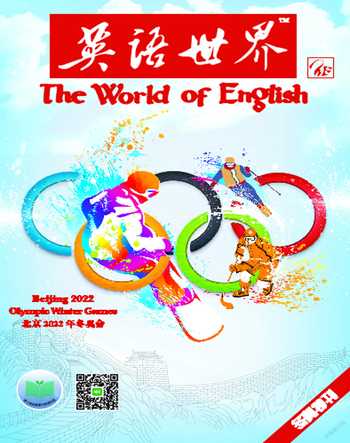
Three Competition Zones of the 2022 Olympic and Paralympic Winter Games 2022年北京冬奥会及冬残奥会三大赛区
2021-01-12张菊
张菊
Beijing, located on the north of the North China Plain, is the capital of the People’s Republic of China. Beijing Municipality is surrounded by Hebei Province with the exception of neighboring Tianjin Municipality to the southeast; together the three divisions form the Jing-jin-ji metropolitan region and the national capital region of China. It is an ever-changing megacity rich in history but also truly modern, exemplified in its global influence in politics, business and economy, education, history, culture, language, music, sport, architecture, civilization, fashion, art, entertainment, innovation, and technology.
[2] Beijing is a major hub for the national highway, expressway, railway, and high-speed rail networks. The Beijing Capital International Airport has been the second busiest in the world by passenger traffic since 2010, and, as of 2016, the city’s subway network is the busiest and second longest in the world, after Shanghai’s subway system.
[3] The city’s history dates back three millennia. As the last of the Four Great Ancient Capitals of China, Beijing has been the political center of the country for much of the past eight centuries. Beijing was the largest city in the world by population for much of the second millennium A.D. The city is renowned for its opulent palaces, temples, parks, gardens, tombs, walls and gates. Its art treasures and universities have made it center of culture and art in China. Encyclopedia Britannica notes that “few cities in the world have served for so long as the political headquarters and cultural centre of an area as immense as China.”
[4] Beijing has seven UNESCO World Heritage Sites—the Forbidden City, Temple of Heaven, Summer Palace, Ming Tombs, Zhoukoudian, as well as parts of the Great Wall and the Grand Canal, all popular locations for tourism.
[5] Beijing Municipality covers a total area of 16,411 km2 with 21.729 million permanent residents. Beijing has a typical monsoon-influenced semi-humid continental warm temperate climate, characterized by humid and hot summers, dry and cold winters and brief springs and summers. The average annual temperature is 12.1℃.
[6] Yanqing City is about 75 kilometers north-west of central Beijing. The area around the city is the Yanqing District, one of the 16 districts of Beijing. It has good communication to the capital, by railway and road, through Badaling. Yanqing is one of three sites for games of the 2022 Winter Olympics.
[7] Rich in natural resources, the picturesque natural landscape of Yanqing is a beautiful painting showcasing the versatile face of Beijing. The district boasts outstanding ecological environment and high forestation, and its air quality is the best in the city for many consecutive years. As a national ecological civilization pilot base and national ecological county, lush mountains, crystal-clear water and blue sky have become its model image.
[8] The district is a top tourist destination in suburban Beijing and has over three-dozen unique sights, including Badaling, Longqing Gorge and Mount Yudu. Many spectacular leisure activities take place in Yanqing District, such as the ice lantern and snow festival, attracting over 20 million visitors each year. Yanqing District is steep in history with profound culture. Its highly distinctive regional cultures such as that of the Yan and Yellow Emperors, Guichuan and Great Wall added to that of Beijing. For the 2022 Winter Olympics, the Beijing-Zhangjiakou Intercity Railway will serve Yanqing with a spur line for fast trains between the other Olympic cities being one hour either side of Yanqing.
[9] Yanqing District occupies a total surface area of 1,993.75 km2. It has a permanent population of 327,000. It is the ecological and resource development area of the capital, and is known as the summer city of Beijing. Yanqing is fully committed to becoming a “city of ice and snow”. It has a continental monsoon climate, between temperate to mid-temperate and from semi-arid to semi-humid zone. The weather is cold in winters and cool in summers, with an annual average temperature of 8℃ (4℃ lower than Beijing city).
[10] In recent years, Yanqing District has accelerated its connection to the world. It has successfully created Yanqing UNESCO Global Geopark in 2013 and hosted the World Car Camping Conference and the International Conference on Grapevine Breeding and Genetics in 2014, and the World Potato Congress in 2015. The International Horticultural Exhibition 2019 will take place in Yanqing Zone, while Alpine skiing plus the luge, bobsleigh, and skeleton competitions of Beijing 2022 will also take place here, plus a major Olympic Village and media centre.
[11] With 6 districts and 10 counties under its administration, Zhangjiakou is a prefecture-level city in the north of Hebei Province, bordering Beijing to the southeast, Inner Mongolia to the north and west and Shanxi to the southwest.
[12] Zhangjiakou is only 180 kilometers away from Beijing. Because of its strategic position above and northwest of Beijing, Zhangjiakou has been nicknamed “Beijing’s Northern Door”. It constitutes a key portal between Beijing and northwestern China, as well as a critical component of the Capital Economic Rim. Zhangjiakou has 4.68 million people with a total area of 37,000 km2.
[13] Zhangjiakou is steeped in history. The Nihe Bay is believed to be the birthplace of East Asians, while the Emperor Town in Zuolu County is said to be where the three ancestral tribes of Yan Emperor, Yellow Emperor and Chi You formed alliances. The city therefore upholds historical and cultural prominence as the place where East Asians and Chinese civilization emerged. Zhangjiakou has been a key inland trading port in northern China since the Ming and Qing dynasties, and along with Guangzhou, is known as the “dual ports”. The Zhangjiakou-Kulun (present-day Ulan Bator) Trade Route, which rivals the Silk Road, begins here.
[14] Zhangjiakou has a monsoon-influenced, continental semi-arid climate, with long, cold, dry, and windy winters due to the Siberian anticyclone, and hot, humid summers driven by the East Asian monsoon; in between spring and autumn are dry and brief. Conditions are much cooler than in Beijing due in part to the elevation. The monthly 24-hour average temperature ranges from ?8.3℃ in January to 23.7℃ in July, and the annual mean is 8.81℃.
[15] Zhangjiakou is well served by transport and highly accessible. It is home to 6 railways, 6 expressways, 9 national highways and 20 provincial highways. Its public road network spans a total of 21,000 kilometers, among which 926 kilometers are expressways, making it top of the country. Zhangjiakou Ningyuan Airport now operates flights to Shijiazhuang, Shanghai, Shenzhen, Shenyang and Haikou. Their three-dimensional transport system is gradually taking shape. Beijing-Zhangjiakou Intercity Railway is under construction. Once open, the Zhangjiakou Zone may be reached within 50 minutes from downtown Beijing, and its development will join that of Beijing.
北京是中华人民共和国首都,位于华北平原北部。整个北京市几乎由河北省环绕,只东南部与天津市接壤——这三部分共同形成京津冀城市群和国家首都区。北京是一座历史悠久、变化万千且极富现代感的大都市,它的全球影响力突出体现在政治、经贸、教育、历史、文化、语言、音乐、体育、建筑、文明、时尚、艺术、娱乐、创新与技术等方面。
[2]北京是国道、高速公路、铁路和高铁等交通网络的主要枢纽。自2010年以来,北京首都国际机场旅客吞吐量已达到世界第二;2016年,北京地铁已成为世界上最繁忙的城市轨道交通系统,路线长度世界第二,仅次于上海。
[3]北京城的历史可上溯3000年。北京是中国四大古都中时间最晚的一个,过去800年的大部分时间里,北京都是国家政治中心。20世纪的大部分时间里,北京都是世界上人口最多的城市。北京因其众多的宫殿、庙宇、公园、园林、陵墓、城墙和城门而闻名。艺术珍宝及高等学府使其成为中国的文化和艺术中心。《不列颠百科全书》如此记述:“全球没有几座城市像北京那样,能长时间作为像中国这样幅员辽阔之地的政治和文化中心。”
[4]北京拥有联合国教科文组织认定的七处世界文化遗产:故宫、天坛、颐和园、明十三陵、周口店北京猿人遗址、长城和大运河——这七处均是颇受欢迎的旅游观光地。
[5]北京市区总面积1 6411平方千米,常住人口2172.9万。气候为典型的暖温带半湿润大陆性季风气候,夏季高温多雨,冬季寒冷干燥,春、秋短暂,年平均气温12.1℃。……