二苯乙烯苷对AD模型小鼠Tau蛋白Thr205和Ser404位点磷酸化的影响
2020-12-28吴文雪苏彦兆刘超宇蒙婉莹李振中黄健朱晓莹廖艳花黄忠仕
吴文雪 苏彦兆 刘超宇 蒙婉莹 李振中 黄健 朱晓莹 廖艳花 黄忠仕
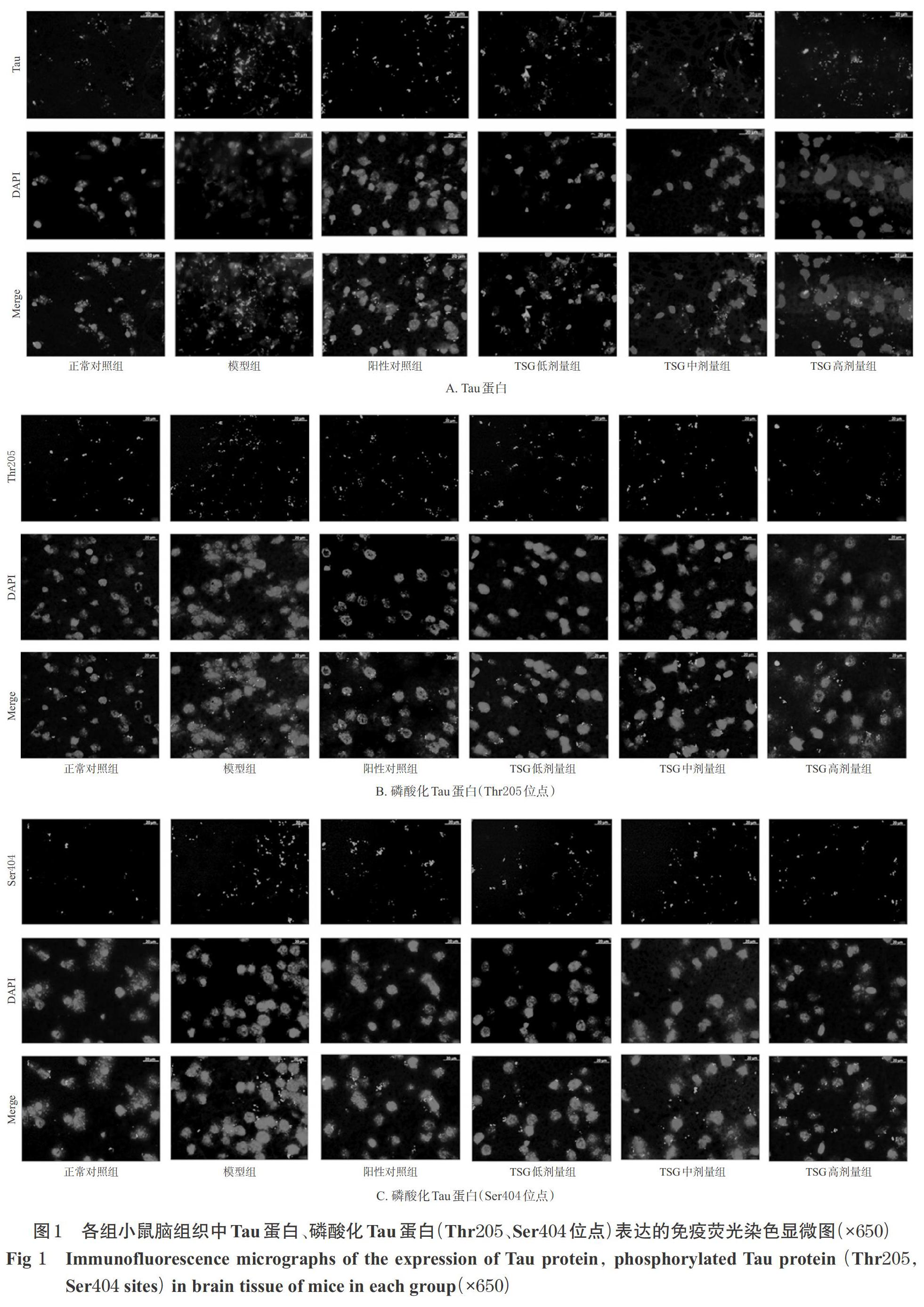

摘 要 目的:研究二苯乙烯苷(TSG)對阿尔茨海默病(AD)模型小鼠Tau蛋白Thr205、Ser404位点磷酸化的影响,探索TSG抗AD的可能机制。方法:将APP/PS1/Tau三转基因痴呆(3×Tg-AD)小鼠随机分成模型组、阳性对照组(石杉碱甲,0.15 mg/kg)和TSG 低、中、高剂量组(0.033、0.1、0.3 g/kg),每组6只;另取6只C57BL/6J小鼠作为正常对照组。各给药组小鼠灌胃相应药物,模型组和正常对照组小鼠灌胃等体积生理盐水,每天给药1次,连续给药60 d。末次给药结束后,采用免疫荧光染色法检测各组小鼠脑组织中Tau蛋白和磷酸化Tau蛋白(Thr205、Ser404位点)的分布和表达;采用Western blotting法检测各组小鼠脑组织中磷酸化Tau蛋白(Thr205、Ser404位点)的表达水平。结果:与正常对照组比较,模型组小鼠脑组织中Tau蛋白和磷酸化Tau蛋白(Thr205、Ser404位点)表达增多、容易聚集成团、分布更为广泛,相对表达量均显著升高(P<0.01),且Western blotting结果显示磷酸化Tau蛋白(Thr205、Ser404位点)的表达水平显著升高(P<0.01);与模型组比较,阳性对照组和TSG各剂量给药组小鼠脑组织中Tau蛋白和磷酸化Tau蛋白(Thr205、Ser404位点)表达和聚集减少、分布范围变窄,相对表达量均显著降低(P<0.01),且Western blotting结果显示磷酸化Tau蛋白(Thr205、Ser404位点)的表达水平也显著降低(P<0.01);与阳性对照组比较,TSG各剂量给药组小鼠脑组织中Tau蛋白和磷酸化Tau蛋白(Thr205、Ser404位点)的分布情况差别不大,相对表达量差异均无统计学意义(P>0.05),但Western blotting结果显示TSG中、高剂量组小鼠脑组织中磷酸化Tau蛋白(Thr205位点)的表达水平和TSG各剂量组小鼠脑组织中磷酸化Tau蛋白(Ser404位点)的表达水平均显著降低(P<0.05或P<0.01)。结论:TSG可能通过下调脑组织中磷酸化Tau蛋白(Thr205、Ser404位点)的表达,从而发挥其对AD模型小鼠的抗痴呆作用。
关键词 阿尔茨海默病;二苯乙烯苷;3×Tg-AD小鼠;Tau蛋白;磷酸化;Thr205位点;Ser404位点
ABSTRACT OBJECTIVE: To study the effects of stilbene glycosidec (TSG) on phosphorylation of Thr205,Ser404 sites of Tau protein in Aizheimers disease (AD) model mice, and to investigate the potential anti-AD mechanism of TSG. METHODS: APP/PS1/Tau three transgenes (3×Tg-AD) mice were randomly divided into model group, positive control group(huperzine, 0.15 mg/kg), TSG low-dose, medium-dose and high-dose groups(0.033, 0.1, 0.3 g/kg), with 6 mice in each group. In addition, 6 C57BL/6J mice were chosen as normal control group. Administration groups were given relevant medicine intragastrically. Model group and normal control group were given equal volume of normal saline intragastrically, once a day, for consecutive 60 days. After last medication, immunofluorescence staining was used to detect Tau protein and phosphorylated Tau protein (Thr205, Ser404 sites) distribution and expression in brain tissue of mice in each group. Western blotting assay was used to detect phosphorylated Tau protein (Thr205, Ser404 sites) expression level in brain tissue of mice in each group. RESULTS: Compared with normal control group, the expression of Tau protein, phosphorylated Tau protein (Thr205, Ser404 sites) in the brain tissue of mice were increased in model group, which were easy to aggregate and distributed more widely; their relative expression were increased significantly (P<0.01). Results of Western blotting assay showed that the expression levels of phosphorylated Tau protein (Thr205, Ser404 sites) were increased significantly (P<0.01). Compared with model group, the expression of Tau protein, phosphorylated Tau protein (Thr205, Ser404 sites) in the brain tissue of mice were decreased in positive control group and TSG groups; aggregation decreased, distribution narrowed and their relative expression were decreased significantly (P<0.01). Results of Western blotting assay showed that the expression levels of phosphorylated Tau protein (Thr205, Ser404 sites) were decreased significantly (P<0.01). Compared with positive control group, There was no significant difference in the distribution of Tau protein, phosphorylated Tau protein (Thr205, Ser404 sites) in the brain tissue of mice in TSG groups; the relative expression were not statistically significant (P>0.05); but Western blotting assay showed the expression levels of phosphorylated Tau protein (Thr205 site) in TSG medium-dose and high-dose groups as well as the expression levels of phosphorylated Tau protein (Ser404 site) in TSG groups were decreased significantly (P<0.05 or P<0.01). CONCLUSIONS:TSG can play an anti-AD effect on AD model mice by down-regulating the expression of phosphorylated Tau protein (Thr205, Ser404 sites) in brain tissue.
KEYWORDS Alzheimers disease; Stilbene glycoside; 3×Tg-AD mice; Tau protein; Phosphorylation; Thr205 site; Ser404 site
阿尔茨海默病(Alzheimers disease,AD)也称老年痴呆,是一种常见的不可逆转的中枢神经退行性疾病[1]。《2018年世界阿尔茨海默病报告》指出:AD在全球的患病人数已达5 000万,而且还在全球以每3秒就产生1名患者的速度不断增加;预计到2030年,仅用于治疗AD的总花费就将高达2万亿美元。然而,AD作为全球卫生医疗亟待攻克的一个重大疾病,其发病机制仍未完全阐释清楚,目前暂无药物可以有效预防或根治该病[2-3]。……