正己烷芳构化反应催化剂研究
2020-12-17杨玉滢吴文涛朱静
杨玉滢 吴文涛 朱静
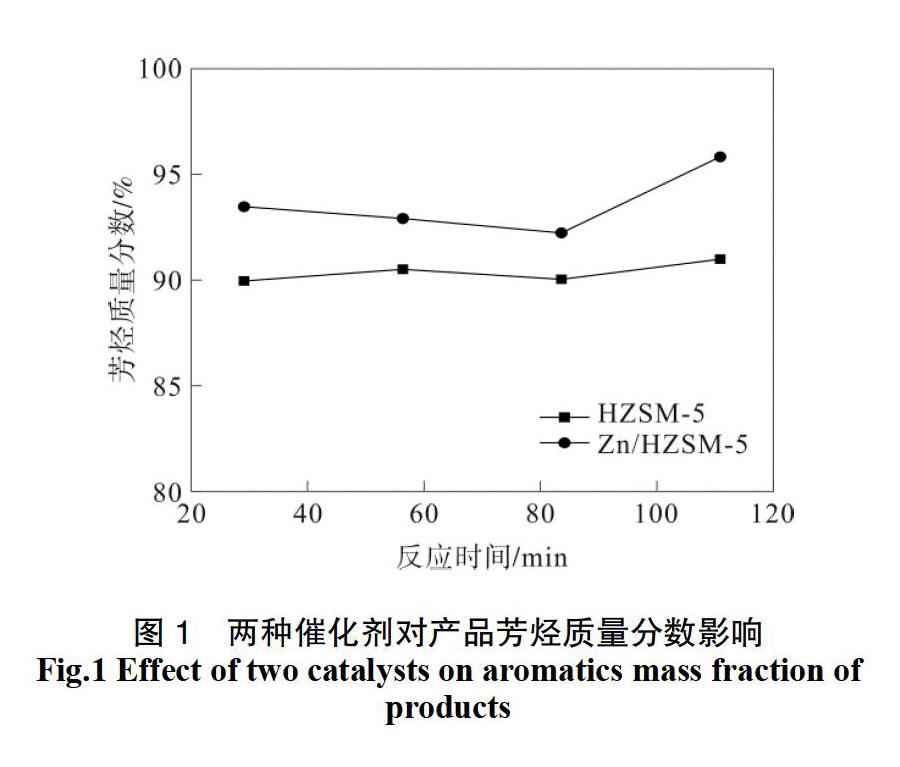
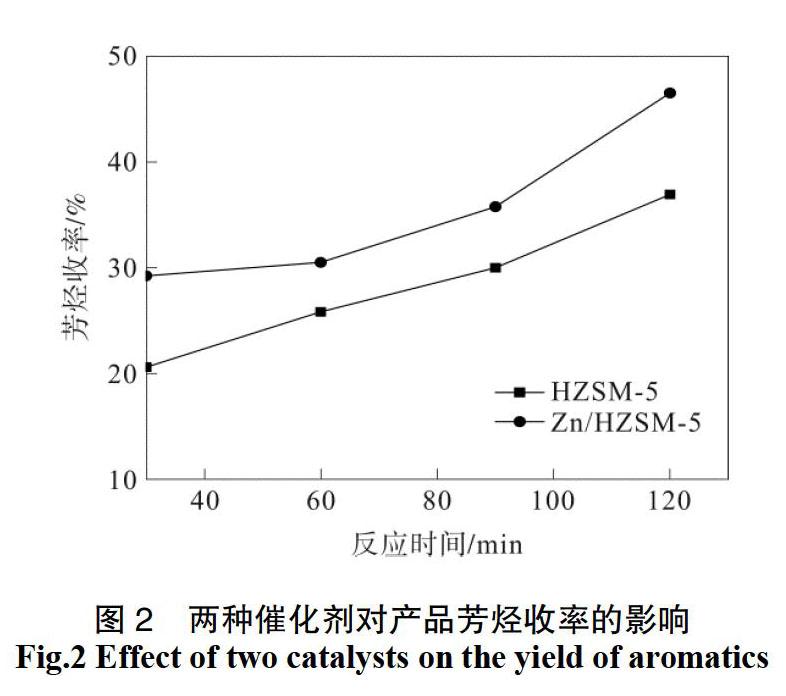
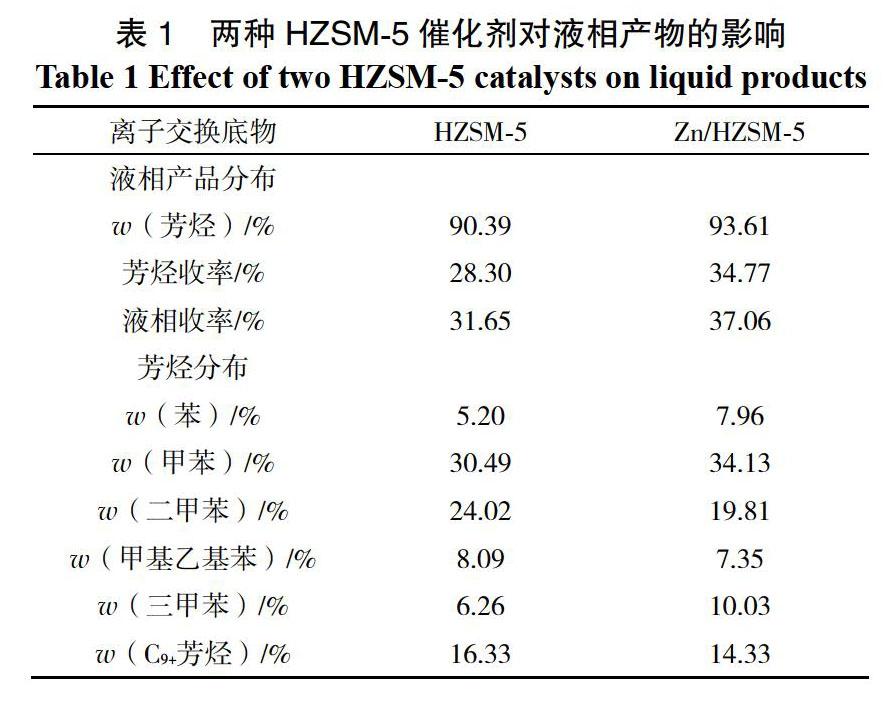
摘 要:主要研究了以正己烷为反应原料,采用HZSM-5与Zn/HZSM-5催化剂,在小型连续固定床催化剂评价装置上进行芳构化催化反应。探究了未改性的HZSM-5与使用醋酸锌改性后的HZSM-5催化剂对产品性能的影响。结果表明:在420 ℃、重时空速为2 h-1的操作条件下,使用Zn/HZSM-5为催化剂进行的芳构化反应,其液相产品中芳烃质量分数达到93.61%,芳烃收率为34.77%,均高于使用HZSM-5为催化剂进行的芳构化反应,这表明该催化剂芳构化性能更好。并通过热重及红外光谱对两种催化剂的酸密度和酸类型进行了表征。表征结果显示,HZSM-5与Zn/HZSM-5催化剂中均存在L酸和B酸,但是使用醋酸锌改性后的HZSM-5催化剂的弱酸、中强酸中心强度要低于未改性的HZSM-5催化剂,更有利于芳构化反应。
关 键 词:正己烷;HZSM-5催化剂;芳构化;芳烃质量分数;芳烃收率
中图分类号:TQ 032 文献标识码: A 文章编号: 1671-0460(2020)11-2499-04
Study on Catalysts for Aromatization of n-Hexane
YANG Yu-ying1, WU Wen-tao2, ZHU Jing*1
(1. School of Petrochemical Engineering, Shenyang University of Technology, Liaoyang 111003, China;
2. PetroChina Liaoyang Petrochemical Company, Liaoyang 111003, China)
Abstract: The catalytic aromatization reaction was carried out in a small continuous fixed-bed catalyst evaluation plant using n-hexane as raw material and HZSM-5 and Zn/HZSM-5 catalysts. The effect of unmodified HZSM-5 and HZSM-5 catalysts modified with zinc acetate on the performance of the products was investigated. The experimental results showed that under the operating conditions of 420 ℃ and 2 h-1, the aromatization reaction was carried out by using Zn/HZSM-5 as catalyst, the content of aromatics in the liquid phase product was 93.61%, and the yield of aromatics was 34.77%, which was higher than the aromatization reaction using HZSM-5 as a catalyst, indicating that the aromatization performance of the catalyst was better. The acid densities and acid types of the two catalysts were characterized by thermogravimetry and infrared spectroscopy. The characterization results showed that L-acid and B-Acid existed in HZSM-5 and Zn/HZSM-5 catalysts, but the strength of weak acid and medium strong acid centers in HZSM-5 catalyst modified by zinc acetate was lower than that in HZSM-5 catalyst, which was more favorable for aromatization.
Key words: N-Hexane; HZSM-5 catalyst; Aromatization; Aromatics content; Aromatics yield
轻质芳烃作为最基本的石油化工原料之一,被广泛应用于合成橡胶、合成纤维、合成树脂等化工产品和精细化学品。随着近些年现代化工业的迅猛发展以及国民经济的迅速增长,轻质芳烃的需求量也随之急剧增加。20世纪70年代以来,为了增加芳烃产量,轻烃芳构化技术作为一种新型石油加工技术逐步发展起来。轻烃芳构化过程是在催化剂的作用下,将轻烃组分通过裂解、脱氢、齐聚、氢转移、环化、异构化等一系列复杂反应转化为芳烃的过程[1-2]。
分子筛催化剂具有抗硫、抗氮能力较强,对原料要求較低,成本相对较低,对环境危害较小等优点[3],因此是轻烃芳构化催化反应中被应用最为广泛的催化剂。……
