溶剂热法合成锂钛复合氧化物的研究
2020-12-17孟祥坤贺帅刘银凤尹民董殿权
孟祥坤 贺帅 刘银凤 尹民 董殿权
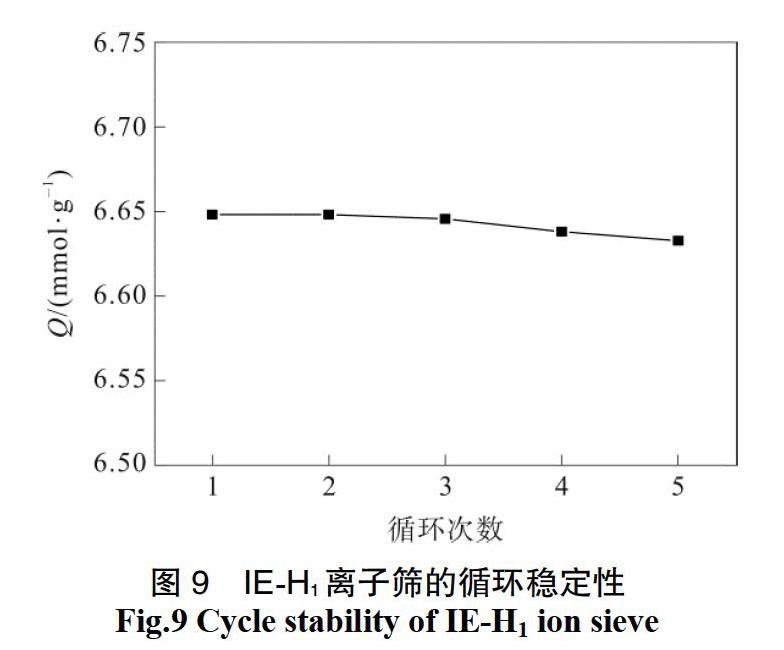
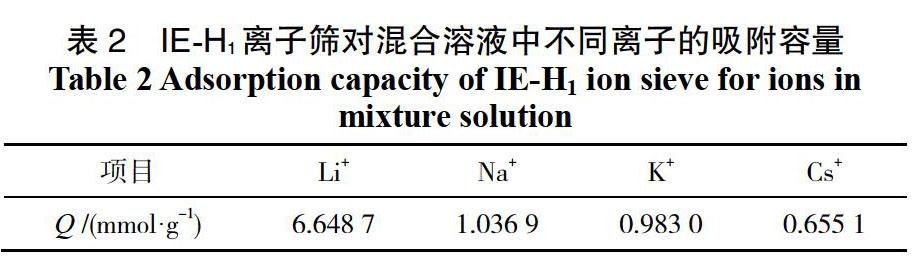
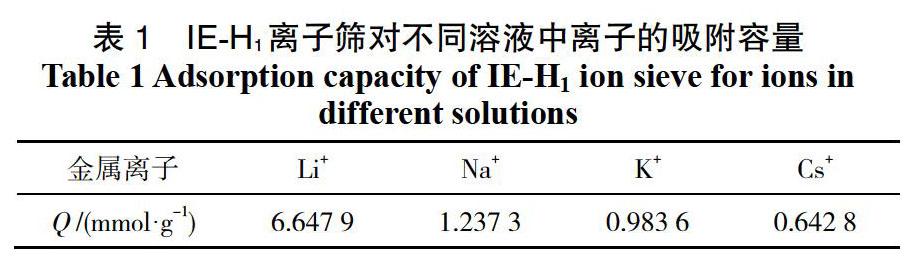
摘 要:选用溶剂热法,通过焙烧得到添加F127的锂钛复合氧化物(Li4Ti5O12),经0.1 mol·L-1盐酸浸渍酸改制备出锂离子筛。经TG-DTG、XRD、SEM及性能测试,考察了离子筛的晶相、形貌及选择稳定性。结果表明:在800 ℃下焙烧得到的离子筛为尖晶石结构,晶相较纯,颗粒大小均匀,盐酸浸渍后酸改率为88.60%,且酸改前后晶型及表面颗粒形貌保持不变;离子筛的饱和吸附容量为6.648 0 mmol·g-1,经过5次循环吸脱附试验后离子筛的饱和交换容量保持在6.632 4 mmol·g-1,在单一离子溶液中以及混合离子溶液中均表现出对Li+ 较高的吸附性能,说明IE-H1离子筛具有优良的稳定性及选择吸附性能。
关 键 词:溶剂热法;F127;锂离子筛;饱和吸附容量;选择性;循环稳定性
中图分类号:TQ424 文献标识码: A 文章编号: 1671-0460(2020)11-2388-05
Study on Synthesis of Lithium-Titanium Composite Oxide
by Solvothermal Method
MENG Xiang-kun, HE Shuai, LIU Yin-feng, YIN Min, DONG Dian-quan*
(College of Chemical Engineering, Qingdao University of Science and Technology, Qingdao 266042, China)
Abstract: Li4Ti5O12 (LTZO ) samples with addition of F127 were prepared by the solvothermal method. After leaching with 0.1 mol·L-1 HCl solution, these samples were transformed into lithium ion-sieves (IE-H). The crystal phase, morphology and selective stability of ion sieves were characterized by TG-DTG, XRD and SEM techniques. Moreover, the adsorption performance of ion sieves was tested. The results showed that the ion sieves calcined at 800 ℃ had the spinel structure with a relatively pure crystal phase and uniform particle sizes. The acid modification rate after immersion in hydrochloric acid was 88.60%, and the crystal form and surface particle morphology remained unchanged before and after acid modification. The saturated Li+ exchange capacity of the IE-H was up to 6.648 0 mmol·g-1, and remained at 6.6324 mmol·g-1 after 5 cycles of Li+ extraction tests. Besides, the IE-H had high adsorption capacity for Li+ in single ion solution and mixed ion solution, suggesting the high exchange capacity and stability of the prepared ion-sieve.
Key words: Solvothermal method; F127; Lithium ion sieve; Saturation adsorption capacity; Selectivity; Cyclic stability
锂是一种银白色金属,质地较软,自其被发现至今,锂及其化合物在社会生活的各方各面都表现出了积极的作用[1-3],其中以锂电行业尤为突出,成为各国研究的热点[4-6]。在世界上锂资源总储备量中,液态锂资源占了66%[7],因此液态提锂技术的发展成为促进锂及其化合物应用发展的关键因素之一[8]。
液态锂资源主要包括盐湖水、海水、油气田水以及一些核废液等[9],尽管海水中锂的总储量是最大的,但是其浓度太低,工业化前景不明朗;而盐湖卤水以其较高的锂含量[10],吸引了研究者的目光,并且有工业化实例[11]。盐湖卤水提锂技术包括膜法、电渗析法、萃取法、离子交换吸附法等方法,其中离子交换法是以特定的吸附剂在一定条件下对锂离子进行定向吸附,吸附剂一般由锂及其他金属氧化物通过不同方法合成具有特殊晶型的复合金属氧化物,在酸性条件下,将锂离子洗脱出来。……
