枸杞子中甜菜碱含量测定方法的建立和提取方法的优化
2020-09-02黄钰馨马玲李苗郑国保马小荣
黄钰馨 马玲 李苗 郑国保 马小荣


中圖分类号 R927.2 文献标志码 A 文章编号 1001-0408(2020)14-1700-04
DOI 10.6039/j.issn.1001-0408.2020.14.07
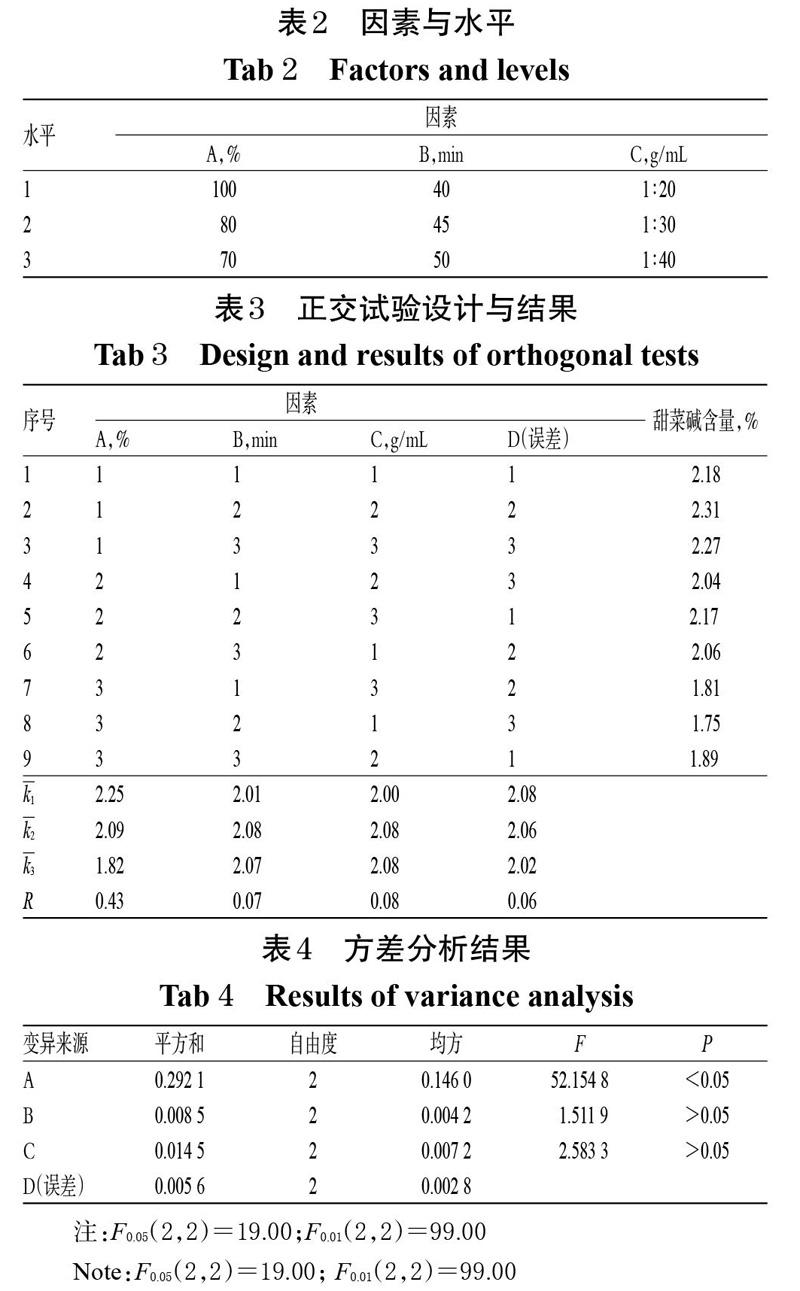
摘 要 目的:建立枸杞子中甜菜碱的含量测定方法,并优化其提取方法。方法:采用高效液相色谱法测定枸杞子中甜菜碱的含量,色谱柱为Waters Spherisorb NH2,流动相为乙腈-0.01 mol/L磷酸二氢钾水溶液(75 ∶ 25,V/V),流速为0.7 mL/min,检测波长为195 nm,柱温为30 ℃,进样量为10 μL。以甜菜碱含量为指标,在单因素试验的基础上,采用L9(34)正交试验设计对枸杞子中甜菜碱超声提取的甲醇体积分数、提取时间、料液比进行筛选并进行验证。测定10批枸杞子中甜菜碱的含量,并与2015年版《中国药典》收录的薄层色谱法测定结果进行比较。结果:甜菜碱检测质量浓度的线性范围为2.035~2 035.04 μg/mL(R 2=0.999 3);检测限、定量限分别为0.410、2.051 μg/mL,平均加样回收率为97.41%~98.86%(RSD为0.8%~1.4%,n=3),精密度、重复性、稳定性(24 h)试验的RSD均不大于1.2%。最优提取方法为料液比1 ∶ 30(g/mL)投料、甲醇超声提取45 min。3次验证试验所得提取液中甜菜碱的平均含量为2.30%(RSD=0.43%, n=3)。10批枸杞子中甜菜碱的含量为1.91%~2.55%,与薄层色谱法的测定结果(1.88%~2.60%)无明显差异(相对误差为-1.92%~2.7%)。结论:成功建立了枸杞子中甜菜碱的含量测定方法,并优化了其提取工艺。
关键词 枸杞子;甜菜碱;高效液相色谱法;含量测定;提取方法
Establishment of the Content Determination Method of Betaine in Lycium barbarum and Optimization of the Extraction Method
HUANG Yuxin1,MA Ling1,LI Miao2,ZHENG Guobao2,MA Xiaorong1(1. Ningxia Hui Autonomous Region Institute of Drug Control, Yinchuan 750002, China; 2. Agricultural Biotechnology Research Center of Ningxia Academy of Agricultural and Forestry Sciences, Yinchuan 750002, China)
ABSTRACT OBJECTIVE: To establish the content determination method of betaine in Lycium barbarum, and to optimize the extraction method. METHODS:HPLC method was used to determine the content of betaine in L. barbarum. The determination was performed on Waters Spherisorb NH2 column with mobile phase consisted of acetonitrile-0.01 mol/L monopotassiun phosphate aqueous solution (75 ∶ 25, V/V) at the flow rate was 0.7 mL/min. The detection wavelength was 195 nm, and column temperature was 30 ℃. The sample size was 10 μL. Using the content of betaine as index, on the basis of single factor tests, L9(34) orthogonal test design were used to select the methanol volume fraction, extraction time and solid-liquid ratio of betaine in L. barbarum by ultrasonic extraction. The contents of betaine in 10 batches L. barbarum were determined, and compared with the results of TLC included in 2015 edition of Chinese Pharmacopeia. RESULTS: The linear range of betaine was 2.035-2 035.04 μg/mL(R2=0.999 3). The limits of detection and quantification were 0.410 μg/mL and 2.051 μg/mL, respectively. The average recovery were 97.41%-98.86% (RSDs were 0.8%-1.4%, n=3). RSDs of precision, reproducibility and stability (24 h) tests were not higher than 1.2%. The optimal extraction method included solid-liquid ration of 1 ∶ 30 (g/mL), ultrasonic extraction with methanol for 45 min. The average content of betaine in the extract from the three validation tests was 2.30% (RSD=0.43%, n=3). The contents of betaine in 10 batches L. barbarum were 1.91%-2.55%, which was no significantly different from the results of TLC (1.88%-2.60%)(RE were -1.92%-2.79%). CONCLUSIONS: The content determination method of betaine in L. barbarum was established successfully, and the extraction process was optinized.
KEYWORDS Lycium barbarum; Betaine; HPLC; Content determination; Extraction method
枸杞子为茄科植物宁夏枸杞(Lycium barbarum L.)的干燥成熟果实[1],是我国传统中药材,具有治疗糖尿病[2]、保护视网膜[3]、抗氧化[4]等作用。甜菜碱是枸杞果实、叶、柄中主要的生物碱类成分,在人体内起甲基供体的作用[5],具有促进脂肪代谢、调节渗透压、抗应激等功效[6-8],被认为是枸杞子的主要活性物质之一[9]。目前,2015年版《中国药典》(一部)记载的枸杞子中甜菜碱含量测定方法为薄层色谱法[1],该方法操作繁琐、人为因素影响较大、灵敏度低、分离效果和重现性较差。……
