基于SVAR模型的我国农产品价格波动与CPI动态关系分析
2020-08-11邬心迪方益明胡彦蓉
邬心迪 方益明 胡彦蓉
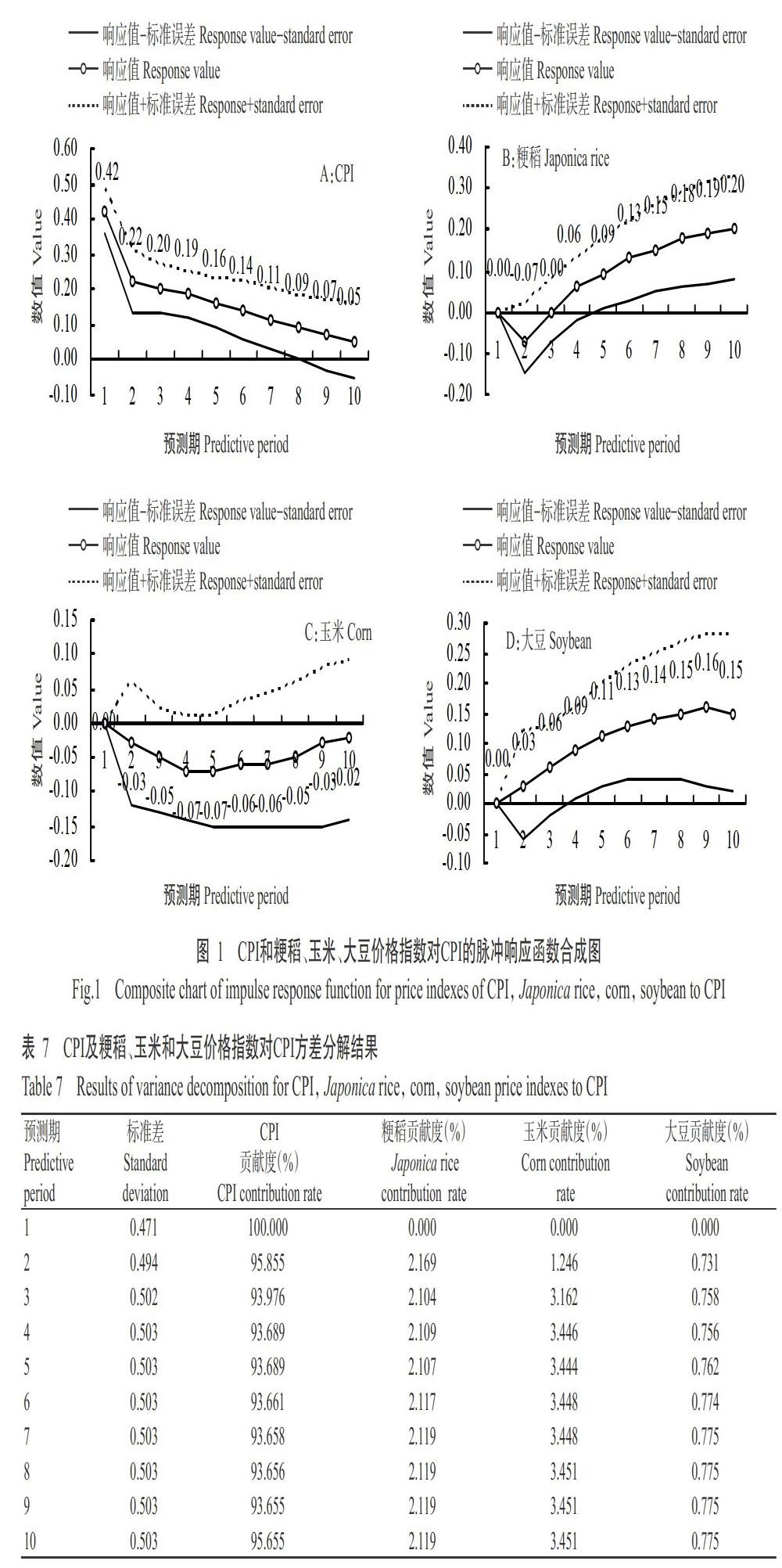

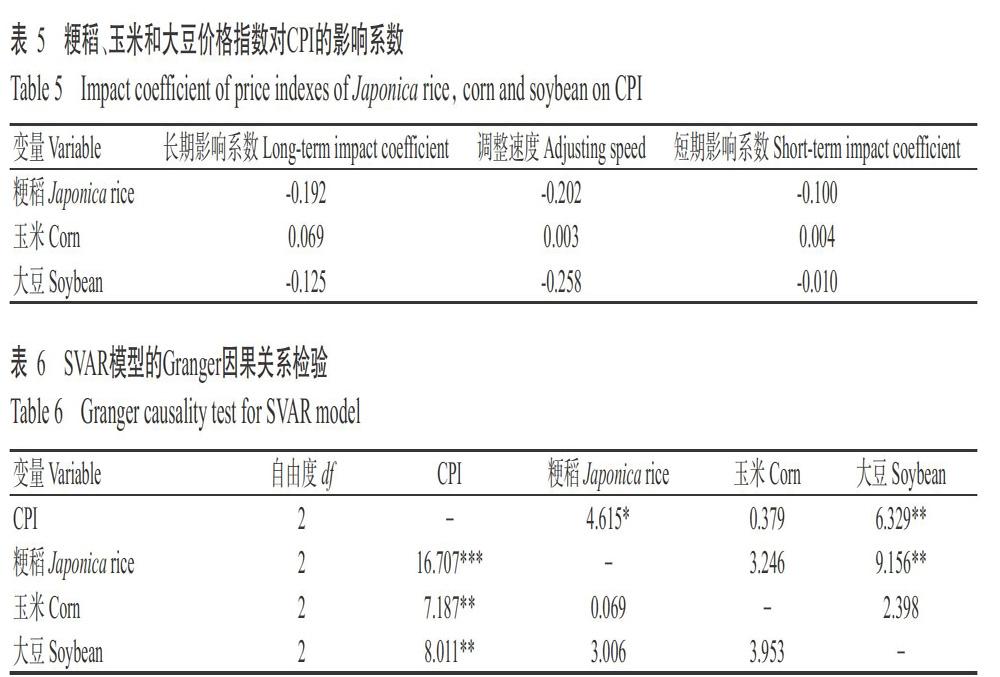
摘要:【目的】研究我國农产品价格与居民消费价格指数(CPI)的动态影响关系,为合理调控农产品价格和促进市场经济稳定发展提供依据。【方法】基于2010年1月—2019年5月的CPI及粳稻、玉米和大豆3种农产品市场价格指数,构建SVAR模型,采用协整检验、Granger因果检验、脉冲响应函数、方差分解方法,探究农产品价格指数与CPI的内在关系。【结果】描述性统计结果表明,农产品价格方差由大到小依次是玉米(9.274)、粳稻(7.328)、大豆(4.252),说明玉米价格波动最大,其次是粳稻价格,大豆价格较稳定。相关性分析结果表明,CPI分别受粳稻价格指数、玉米价格指数和大豆价格指数显著性正影响(P<0.01),相关系数分别为0.747、0.546和0.681。粳稻、玉米和大豆的价格指数与CPI均存在Granger因果关系和长期协整关系。粳稻、玉米和大豆的价格指数对CPI的长期影响系数分别为-0.192、0.069和-0.125,调整速度分别为-0.202、0.003和-0.258,短期影响系数分别为-0.100、0.004和-0.010,表明农产品价格与CPI偏离长期均衡状态时,通过误差修正作用进行有效调整。由脉冲响应函数结果可知,粳稻价格指数和大豆价格指数受外部冲击给CPI短期内带来正影响,玉米价格指数受外部冲击给CPI短期内带来负影响;方差分解结果表明,玉米价格指数对CPI波动产生正向的长期均衡作用,而粳稻价格指数和大豆价格指数对CPI产生负的长期均衡影响,但效果并不显著。【建议】生产者应以建设农业现代化为导向,对农产品进行系统的科学管制,打造产业化、规模化、数字化农业;政府应参与宏观调控农业贸易中的价格波动,制定战略性生产规划,提高定价水平、市场资源配置和整合能力。
关键词: SVAR模型;农产品价格指数;波动;动态关系;冲击
Abstract:【Objective】This paper studied the dynamic relationship between Chinas agricultural product prices and consumer price index(CPI) to provide a basis for rationally regulating agricultural product prices and promoting the stable development of the market economy. 【Method】Based on the CPI and the market price indexes of three agricultural pro-ducts such as Japonica rice, corn and soybean from January, 2010 to May, 2019, the SVAR model was constructed. The cointegration test, Granger causality test, impulse response function and variance decomposition method were used to explore the internal relationship between the agricultural product price index and CPI. 【Result】The descriptive statistical results showed that the variances of agricultural product prices from large to small were corn(9.274), Japonica rice (7.328), soybean (4.252). It showed that the price of corn was the most volatile, followed by the price of Japonica rice, and the price of soybean was relatively stable. The result of correlation analysis showed that CPI was extremely positively correlated with the price index of Japonica rice, corn and soybean(P<0.01). The correlation coefficients were 0.747, 0.546 and 0.681 respectively. There were Granger causality and long-term cointegration relationship between the price indexes of three agricultural products and CPI. The long-term influence coefficients of the price indexes of Japonica rice, corn and soybean on CPI were -0.192, 0.069 and -0.125. The adjustment speeds were -0.202, 0.003 and -0.258. The short-term impact coefficients were -0.100, 0.004 and -0.010. It showed that when the price of agricultural products deviated from the long-term equilibrium state of CPI, it was effectively adjusted through the error correction. The result of impulse response function showed that the external impact on the Japonica rice price index and soybean price index brought positive impact on CPI in the short term, while the external shocks of the price index of corn had a negative impact on the short-term CPI. The results of variance decomposition showed that corn price index had positive long-term equilibrium effect on CPI fluctuation, while Japonica rice price index and soybean price index had negative long-term equilibrium effect on CPI, but the effect was not significant. 【Suggestion】Producers should take the construction of agricultural modernization as the guidance, carry out systematic and scientific control on agricultural products, create industrialized, large-scale and digital agriculture. The government should participate in macro-control of price fluctuations in agricultural trade, formulate strategic production plans, improve pricing level, market resource allocation and integration capabilities.
Key words: SVAR model; agricultural products price index; fluctuation; dynamic relationship; shock
0 引言
【研究意义】农产品价格指数波动幅度大、涉及层面广,其在居民消费价格指数(CPI)的变化过程中发挥着重要作用。2016年以来通胀率处于偏低水平的背景下,我国农产品现货价格总体上呈现走低趋向。受鲜果、猪肉等价格上涨的推动,2019年5月CPI同比涨幅为2.7%,刷新了自2018年以来一年当中的最高涨幅,涨幅连续3个月处于“2时代”。由此可见,贸易市场结构体系不健全将导致农产品价格畸形浮动,而农产品价格异常波动不仅严重影响居民的日常消费惯性,还会增加农民生产收入的未知性,导致生产偏离平衡态、经济面临通货膨胀。因而,探究农产品价格波动对CPI的影响贡献率对于警示国民预防通货膨胀具有极为重要的前瞻性,对于稳定经济发展具有重要意义。……
