玻色-爱因斯坦凝聚与箱中自由粒子模型
2020-07-14李立本王赵武尹传磊郝世明
李立本 王赵武 尹传磊 郝世明

摘 要 在分析玻色-爱因斯坦凝聚现象时有两个基本前提:要求零能级存在和自由粒子模型成立,本文分析了这两个前提可能出现的矛盾。指出:严格的无限深势阱模型不容许存在零能级;有限体积的周期边界模型中的零能级违背不确定关系。对于势阱模型,若认为势阱势垒不是无限高,则不仅零能级可以存在且与不确定关系兼容;对于周期边界条件模型,若认为箱子体积趋于热力学极限,零能级也就兼容了不确定关系。同时还简单讨论了与此相关的简并态与不确定关系、多粒子波函数构建、两种模型的态密度一致性问题。
关键词 玻色-爱因斯坦凝聚 玻色子 自由粒子 能级
中图分类号:O414.13 文献标识码:A DOI:10.16400/j.cnki.kjdkz.2020.05.012
Abstract When analyzing the Bose-Einstein condensation phenomenon, there are two basic premises that a zero-level existence and a free particle model are required. This article analyzes the possible contradictions between these two premises. It is pointed out that the strict infinite deep well model does not allow zero energy levels; the zero energy levels in the periodic boundary model of finite volume violates the uncertainty relationship. If the potential well barrier is not considered to be infinitely high for the potential well model, not only the zero energy level can exist but be compatible with the uncertainty relationship; for the periodic boundary condition model, if the box volume is approached to the thermodynamic limit, the zero energy level is also compatible uncertainty relationship. At the same time, the related degenerate states and uncertainties, the construction of multi-particle wave functions, and the consistency of the state density of the two models are briefly discussed.
Keywords Bose-Einstein condensation; boson; free particle; energy level
1 問题提出
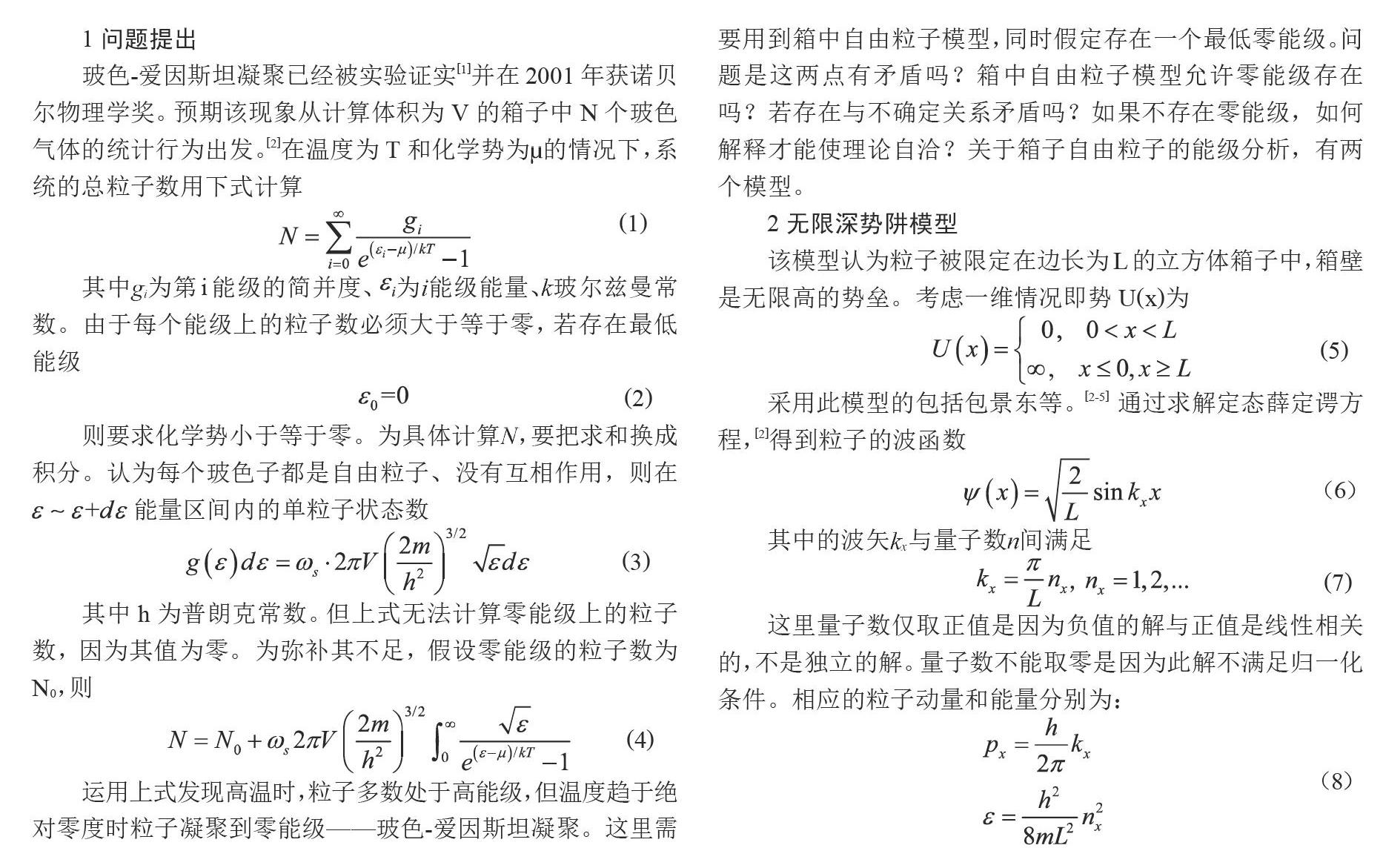
玻色-爱因斯坦凝聚已经被实验证实[1]并在2001年获诺贝尔物理学奖。预期该现象从计算体积为V的箱子中N个玻色气体的统计行为出发。[2]在温度为T和化学势为 的情况下,系统的总粒子数用下式计算
对于实际的箱子可以视为零。[8]然而按照汪志诚先生的表述,严格的零能级,才导致化学势不大于零,这是出现玻色-爱因斯坦凝聚的重要论据。任何一个小能量值,在温度趋于绝对零度时都会被放大为不能忽略。
4 问题解决
如果认为箱壁是很高的势垒,但仍有一定概率穿透,那么零能级解是存在的。[11]而且由于此时粒子原则上可以出现在无穷远处,所以零动量并不与不确定关系矛盾。
针对周期性边界条件情况,我们依然可以认为粒子活动区域趋于无穷,这符合热力学极限。……