高通量血液透析对糖尿病肾病血液透析患者预后影响分析
2020-06-12周晶
周晶

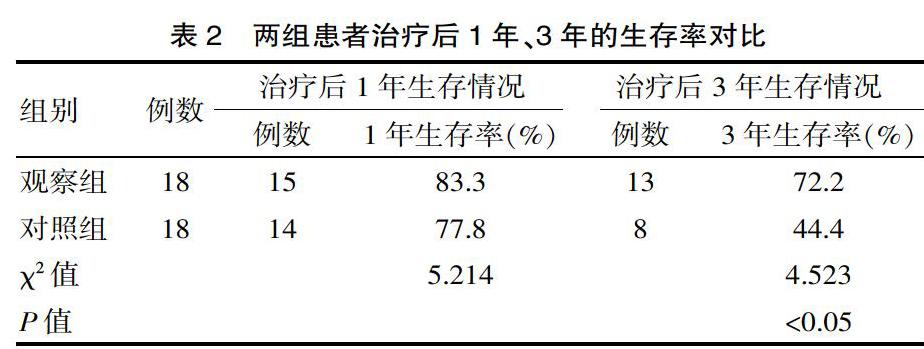
[摘要] 目的 分析糖尿病肾病血液透析患者应用高通量血液透析治疗的预后影响。 方法 选取该院自2015年10月—2016年10月收治的36例糖尿病肾病血液透析患者作为观察对象,随机分为两组,18例观察组患者给予高通量血液透析治疗,18例对照组患者给予低通量血液透析治疗。观察两组患者的心脑血管不良事件的发生率,对比两组患者治疗后1年、3年的生存情况。 结果 观察组患者不良事件发生率27.8%,对照组患者不良事件发生率38.9%(χ2=3.568,P<0.05)。观察组1年生存率83.3%及3年生存率72.2%,明显优于对照组的77.8%和44.4%(χ21=5.214,χ22=4.523,P<0.05)。 结论 高通量血液透析对糖尿病肾病血液透析患者预后效果好,可有效降低患者的心、脑血不良事件发生率,改善了患者的生存质量。
[关键词] 糖尿病肾病血液透析;高通量血液透析;预后影响
[中图分类号] R587.1 [文献标识码] A [文章编号] 1672-4062(2020)02(b)-0188-03
[Abstract] Objective To analyze the prognostic effects of high-throughput hemodialysis in patients with diabetic nephropathy and hemodialysis. Methods 36 patients with diabetic nephropathy and hemodialysis treated in our hospital from October 2015 to October 2016 were selected as observation objects and randomly divided into two groups. 18 patients in the observation group were given high-throughput hemodialysis treatment. 18 patients in the control group were given low-flux hemodialysis. The incidence of cardiovascular and cerebrovascular adverse events in the two groups of patients was observed, and the survival of the patients in the two groups after 1 year and 3 years of treatment was compared. Results The incidence of adverse events was 27.8% in the observation group and 38.9% in the control group(χ2=3.568, P<0.05). The one-year survival rate of the observation group was 83.3% and the three-year survival rate was 72.2%, which were significantly better than the 77.8% and 44.4% of the control group(χ21=5.214, χ22=4.523, P<0.05) Conclusion High-throughput hemodialysis has a good prognosis for patients with diabetic nephropathy and hemodialysis. It can effectively reduce the incidence of adverse events of heart and brain blood and improve the quality of life of patients.
[Key words] Diabetic nephropathy hemodialysis; High-throughput hemodialysis; Prognostic effect
隨人们饮食结构的改变、生活水平的提高,糖尿病的发病率正逐年升高。糖尿病患者的发病原因与遗传、环境因素有关[1]。随着糖尿病患者数量的增加,也增了其并发症糖尿病肾病的发病几率[2]。终末期糖尿病患者,极易出现肾衰竭情况,发生胰岛素抵抗等现象,严重影响了患者的生理功能,病情严重时,甚至危及患者生命[3]。治疗糖尿病肾病患者,临床多采用血液透析,血液透析主要包括高通量血液透析与低通量血液两种方式[4]。高通量血液透析可有效清除患者的大中分子物质,既节省医疗成本,又能有效降低患者不良事件的发生率[5]。为有效挽救患者生命,该文2015年10月—2016年10月选取该院36例糖尿病肾病血液透析患者进行研究,现报道如下。
1 资料与方法
1.1 一般资料
选取该院收治的36例DN血液透析患者作为观察对象,随机分为两组,观察组18例患者接受高通量血液透析治疗,对照组18例患者接受低通量血液透析治疗。……