LAMP芯片法检测下呼吸道感染性疾病病原体的价值
2020-06-08魏晓楠王娜伊茂礼弭苗苗张贵丽孙成铭
魏晓楠 王娜 伊茂礼 弭苗苗 张贵丽 孙成铭
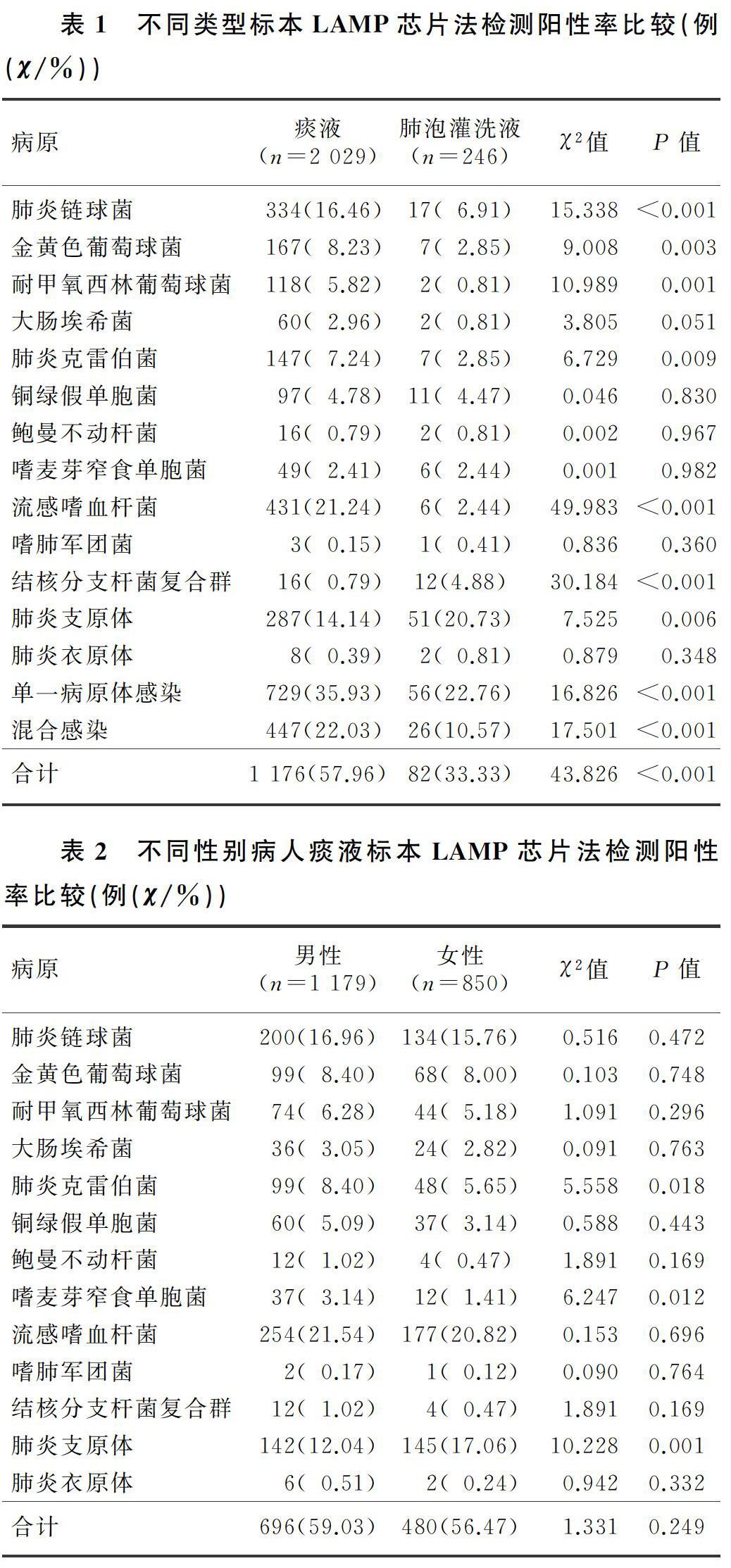
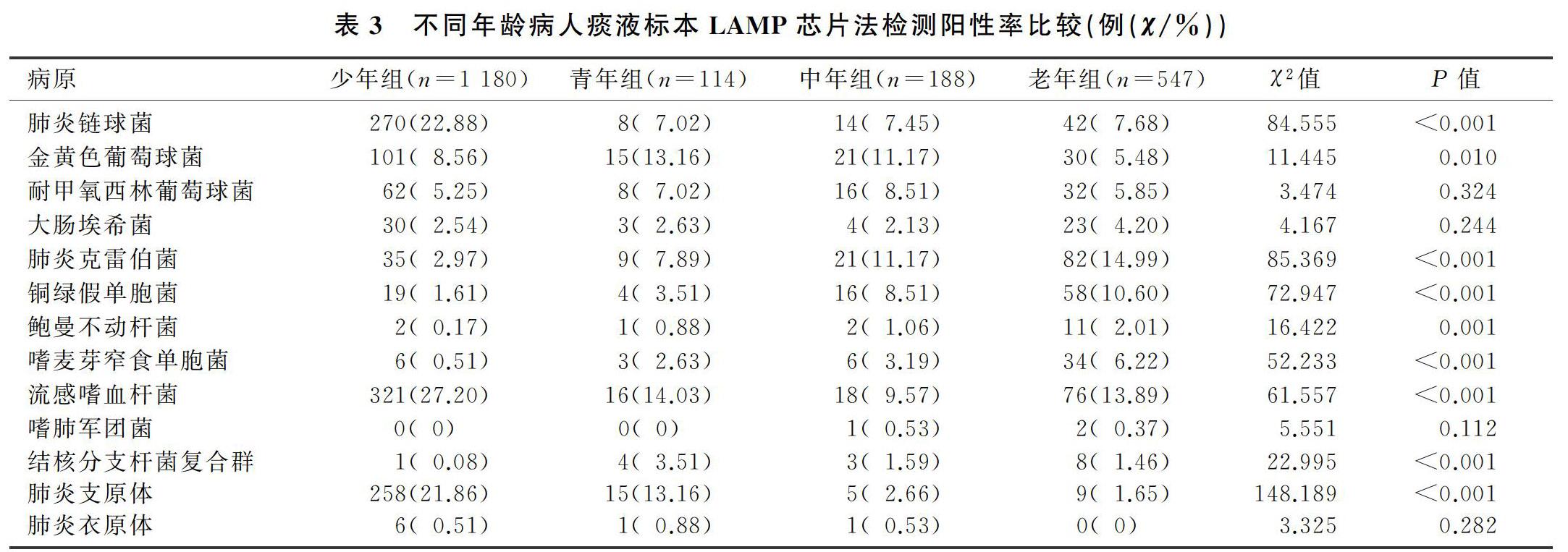
[摘要] 目的 利用環介导恒温扩增(LAMP)芯片法对疑似下呼吸道感染病人进行13种病原体检测,评价该方法的临床应用价值。方法 收集2017年就诊于我院的疑似下呼吸道感染病人的深部痰液标本2 029例及肺泡灌洗液标本246例,分别采用LAMP芯片法和分离培养技术对病原体进行检测。以培养法为“金标准”,对LAMP芯片法进行方法学评价。结果 在深部痰液标本中,LAMP芯片法和普通培养法检测的总阳性率分别为57.96%(1 176/2 029)和10.50%(213/2 029),差异具有统计学意义(χ2=101.511,P<0.01);两种方法对铜绿假单胞菌的检出一致性最高(Kappa=0.651,95%CI=0.561~0.741)。痰液标本中流感嗜血杆菌的检出率最高,为21.24%(431/2 029)。深部痰液和肺泡灌洗液检出的病原体种类及阳性率均存在明显差异。结论 LAMP芯片法可对下呼吸道感染病人痰液及肺泡灌洗液中的病原体,尤其是苛养菌和不可培养病原体进行快速检测,其检出阳性率明显高于传统培养法,且其检测快速可靠,适于在基层医院中推广。
[关键词] 呼吸道感染;病原;核酸扩增技术;芯片分析技术
[中图分类号] R446.5;R517.6 [文献标志码] A [文章编号] 2096-5532(2020)02-0207-05
doi:10.11712/jms.2096-5532.2020.56.053 [开放科学(资源服务)标识码(OSID)]
[网络出版] http://kns.cnki.net/kcms/detail/37.1517.R.20200325.1005.005.html;2020-03-026 11:30
[ABSTRACT] Objective To evaluate the clinical value of the on-chip loop-mediated isothermal amplification (LAMP) assay by testing patients with suspected lower respiratory tract infection (LRTI) for 13 pathogens using the LAMP assay. MethodsA total of 2 029 deep sputum specimens and 246 bronchoalveolar lavage fluid (BALF) specimens were collected from patients with suspected LRTI who attended our hospital in 2017. The patients were tested for pathogens using the on-chip LAMP assay and pathogen isolation and culture technique. The methodology of the on-chip LAMP assay was evaluated using the pathogen culture method as the “gold standard”. Results The overall positive rates of the on-chip LAMP assay and conventional culture method in sputum specimens were 57.96% (1 176/2 029) and 10.50% (213/2 029), respectively, with a significant difference observed between the two methods (χ2=101.511,P<0.01). The two methods had the highest detection consistency for Pseudomonas aeruginosa (Kappa=0.651,95% confidence interval: 0.561-0.741). The detection rate of Haemophilus influenzae in sputum specimens was highest (21.24%,431/2 029). There were significant differences in the type and positive rate of pathogens between deep sputum and BALF specimens. Conclusion The on-chip LAMP assay can be used for rapid detection of pathogens in sputum and BALF specimens collected from patients with LRTI, especially the fastidious bacteria and non-culturable pathogens, the positive detection rate for which is significantly higher than that with conventional culture method. The LAMP assay is fast and reliable, which makes it suitable for application in primary hospitals.
[KEY WORDS] respiratory tract infections; noxae; nucleic acid amplification techniques; microchip analytical procedures
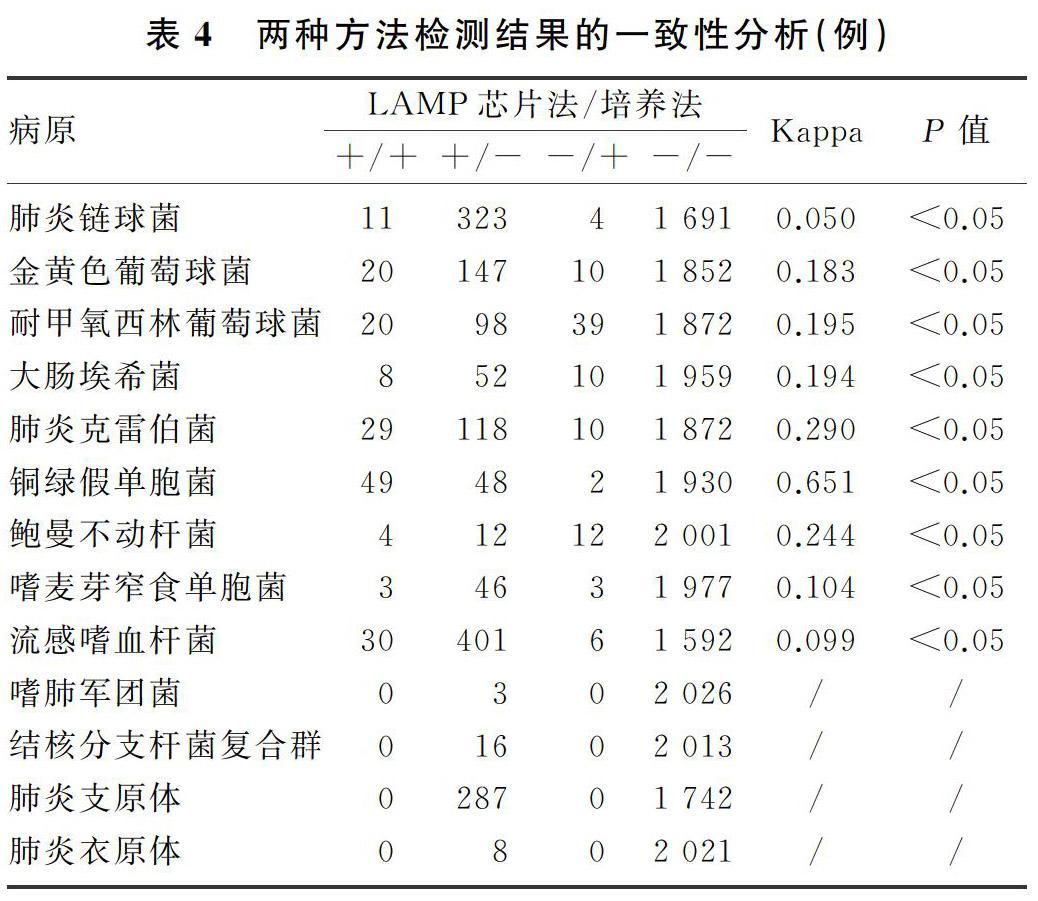
2.4 两种方法检测结果的一致性分析
在痰液标本中,普通培养法检测的总阳性率为10.50%(213/2 029),与LAMP芯片法比较差异具有统计学意义(χ2=101.511,P<0.01)。LAMP芯片法与培养法检出病原体共同阳性174例,LAMP芯片法检出阳性而培养法阴性1 559例,两种方法检测结果一致性见表4。在13种病原体中,两种方法检出铜绿假单胞菌的一致性最高(Kappa=0.651,95%CI=0.561~0.741)。
3 讨 论
下呼吸道感染是一个全球范围的严重公共卫生问题,它常为多种呼吸系统疾病的诱因,并涉及种类繁多的病原体。目前,在短時间内做出明确的病原学诊断并进行有针对性的治疗依然很困难,这也是该病死亡率高的主要原因[6]。实践证明,定期或者不定期地对呼吸道疾病的流行病学特征进行统计分析,可以为疾病预防控制提供干预依据[7]。预防为主、准确诊断、及时治疗,是防治该病的基本原则,而明确引起感染的病原体和针对性药物的选择配伍则是降低该病死亡率的重要保证。下呼吸道感染多由细菌、病毒、支原体、衣原体等病原体引起[8],受目前技术所限,除细菌外的其他病原体的常规培养,临床微生物室尚难以开展。……
