GHS-R1a缺失对Aβ1-42模型小鼠空间学习和记忆影响
2020-06-08弭雪隗闯张萌石海群陈娜周宇
弭雪 隗闯 张萌 石海群 陈娜 周宇
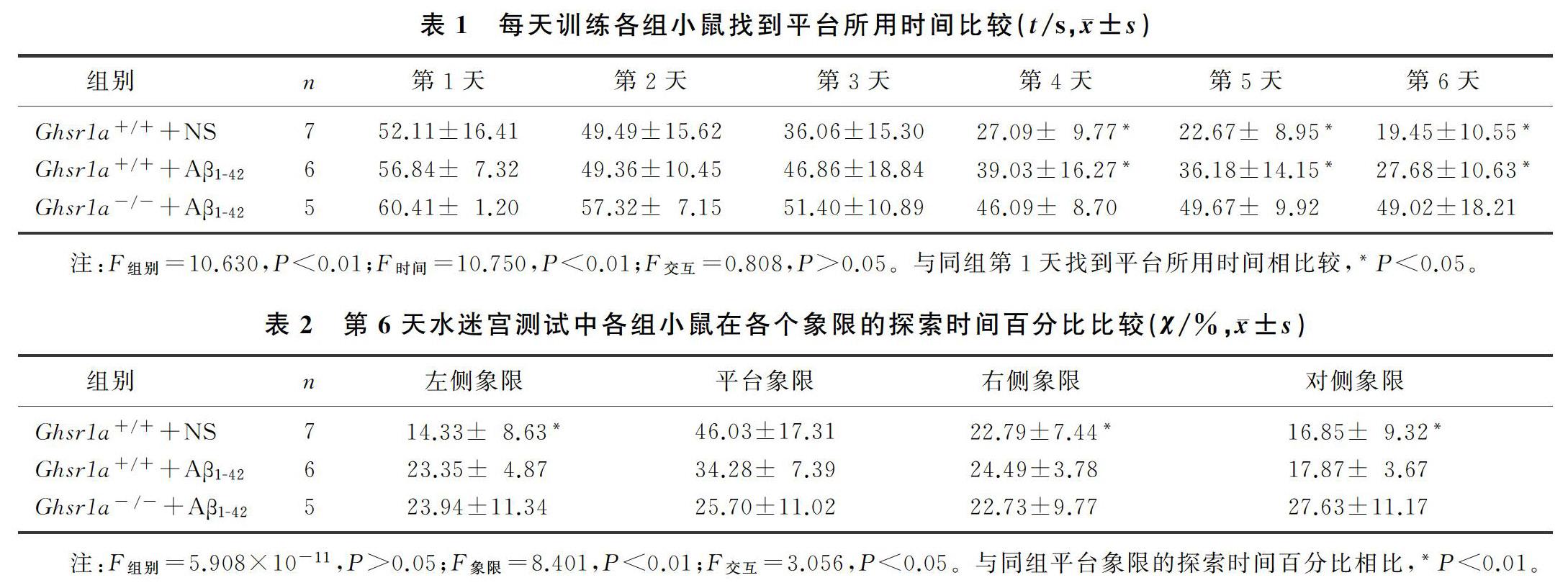
[摘要] 目的 探讨GHS-R1a缺失对Aβ1-42模型小鼠空间学习和记忆的影响。方法 借助脑立体定位注射技术,5只GHS-R1a敲除的Ghsr1a-/-小鼠及6只同窝对照野生型Ghsr1a+/+小鼠背侧海马CA1区注射Aβ1-42,另外7只野生型Ghsr1a+/+小鼠背侧海马CA1区注射等量生理盐水(NS)作为空白对照。1周后对3组小鼠同时进行Morris水迷宫训练和测试,检测小鼠的空间学习和空间记忆能力。结果 Ghsr1a+/++Aβ1-42组小鼠经过6 d的训练能够迅速找到水下隐匿平台,且找到平台所用的时间与Ghsr1a+/++NS组小鼠比较差异无显著意义(P>0.05),说明Aβ1-42注射不影响小鼠的空间学习。水迷宫测试显示,Ghsr1a+/++NS组小鼠在平台象限探索的时间百分比明显高于其他3个象限(F=8.401,q=5.603~7.642,P<0.01),说明训练后该组小鼠形成了正常的空间记忆;而接受Aβ1-42注射的两组小鼠在平台象限探索的时间百分比与其他3个象限相比,差异均无显著性(P>0.05),提示这两组小鼠存在空间记忆障碍。接受Aβ1-42注射的两组小鼠在平台象限探索的时间百分比比较,差异也无显著性(P>0.05)。结论 海马脑区Aβ1-42注射损害小鼠的空间记忆能力,对小鼠的空间学习能力无影响。GHS-R1a敲除不能改善Aβ1-42模型小鼠的空间记忆障碍。
[关键词] 受体,胃促生长素;淀粉样β肽类;CA1区,海马;空间学习;空间记忆;小鼠
[中圖分类号] R338.2 [文献标志码] A [文章编号] 2096-5532(2020)02-0169-04
doi:10.11712/jms.2096-5532.2020.56.070 [开放科学(资源服务)标识码(OSID)]
[网络出版] http://kns.cnki.net/kcms/detail/37.1517.R.20200417.0914.005.html;2020-04-17 16:16
[ABSTRACT] Objective To investigate the effects of GHS-R1a deficiency on spatial learning and memory in an Aβ1-42-injected mouse model. Methods Five GHS-R1a knock-out mice (Ghsr1a-/-) and six wild-type littermates (Ghsr1a+/+) received a stereotactic injection of Aβ1-42 into the CA1 region of the dorsal hippocampus. As a blank control, seven Ghsr1a+/+mice received an injection of an equal volume of normal saline (NS) into the dorsal hippocampal CA1 region. After one week, the Morris water maze task was simultaneously applied in the three groups to assess the spatial learning and memory capabilities of the mice. ResultsAfter 6 d of training, the Ghsr1a+/+ mice with Aβ1-42 injection quickly found the hidden platform, and there was no significant difference in time to the hidden platform between the Ghsr1a+/+ mice with Aβ1-42 injection and with NS injection (P>0.05), indicating that Aβ1-42 injection did not affect spatial learning. The probe test showed that the Ghsr1a+/+ mice with NS injection spent a significantly higher percentage of time in the platform quadrant than in the other three quadrants (F=8.401,q=5.603-7.642,P<0.01), indicating that these mice acquired normal spatial memory after training. However, for the mice with Aβ1-42 injection, there was no significant difference in the percentage of time between the four quadrants (P>0.05), suggesting that these mice had spatial memory impairment; and the percentage of time spent in the platform quadrant showed no significant difference between the Ghsr1a-/- mice and Ghsr1a+/+ mice with Aβ1-42 injection (P>0.05). Conclusion Injection of Aβ1-42 into the hippocampus impairs the spatial memory of mice but has no effect on the spatial learning. Knocking out the GHS-R1a fails to improve spatial me-mory deficits in Aβ1-42-injected mice.
[KEY WORDS] receptors, ghrelin; amyloid beta-peptides; CA1 region, hippocampal; spatial learning; spatial memory; mice
阿尔茨海默病(AD)是最常见的进行性、神经退行性疾病,主要以β淀粉样蛋白沉积和Tau蛋白过度磷酸化为标志性病理改变。记忆和认知功能减退是AD早期脑功能减退典型的临床表现。与学习记忆密切相关的海马是AD神经退变最敏感的脑区之一[1-4]。海马注射Aβ1-42作为一种简单的造模方法被广泛应用于AD的基础研究[5-7]。GHS-R1a是目前所知的乙酰化ghrelin发挥作用的唯一受体亚型,该受体在中枢神经系统有广泛分布,在下丘脑以及下丘脑以外、与记忆和情绪调节密切相关的脑区(例如海马、皮质和杏仁核等)均有较丰富的表达[8-10]。GHS-……
