血栓通治疗青光眼视神经萎缩的临床效果 ?
2020-04-27徐君勇赖均伟
徐君勇 赖均伟
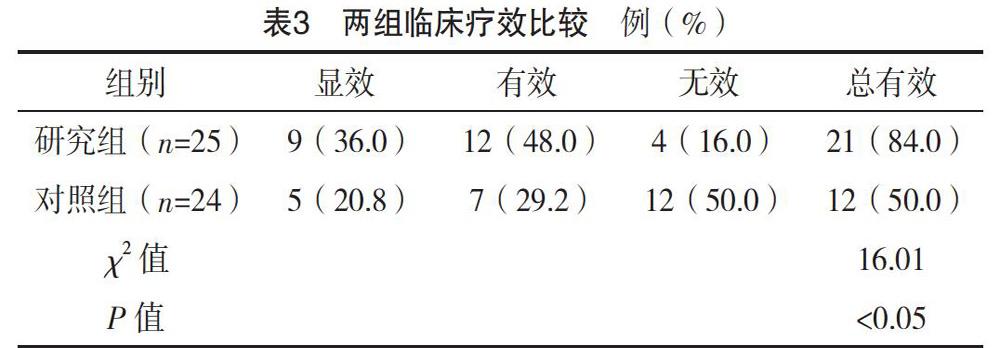
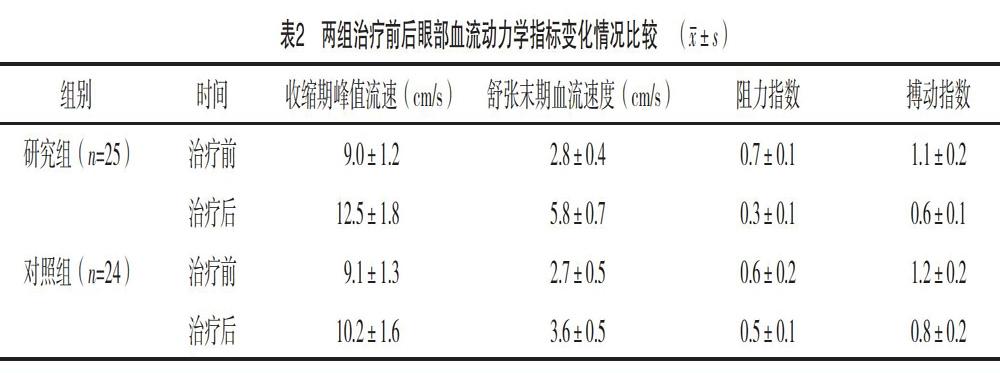
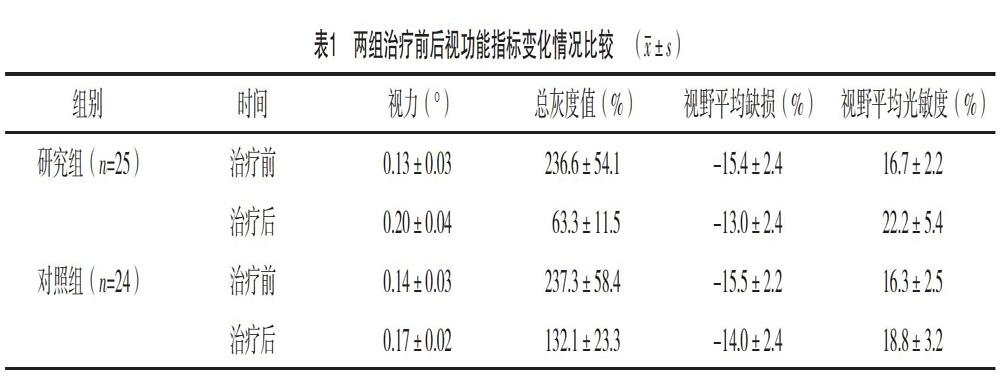
【摘要】 目的:探讨青光眼视神经萎缩血栓通治疗的临床效果。方法:随机选取2018年6月-2019年1月笔者所在医院收治的青光眼视神经萎缩患者49例,随机分为对照组(n=24,常规性治疗)和研究组(n=25,常规性治疗基础上血栓通治疗),分析两组视功能、眼部血流动力学指标、临床疗效。结果:治疗后两组视力、视野平均缺损、光敏度均高于治疗前,总灰度值均低于治疗前,且研究组各指标均优于对照组,差异均有统计学意义(P<0.05)。治疗后两组收缩期峰值流速、舒张末期血流速度均高于治疗前,阻力指数、搏动指数均低于治疗前,且研究组均优于对照组,差异均有统计学意义(P<0.05)。研究组治疗总有效率为84.0%,高于对照组的50.0%,差异有统计学意义(P<0.05)。结论:青光眼视神经萎缩血栓通治疗的临床效果好。
【关键词】 血栓通 青光眼视神经萎缩 临床效果
[Abstract] Objective: To investigate the clinical effect of Xueshuantong in treatment of glaucoma optic nerve atrophy. Method: A total of 49 patients with glaucoma optic nerve atrophy in our hospital from June 2018 to January 2019 were randomly divided into the control group (routine treatment, n=24) and the study group (Xueshuantong treatment based on routine treatment, n=25). The visual functions, ocular hemodynamics and clinical efficacy of the two groups were statistically analyzed. Result: After treatment, the vision, visual field average defect, light sensitivity of two groups were higher than those before treatment, the total gray value of two groups were lower than those before treatment, and the indexes of the study group were better than those of the control group, the differences were statistically significant (P<0.05). After treatment, the peak systolic flow velocity and end-diastolic blood flow velocity of the two groups were higher than those before treatment, the resistance index and pulsatility index were lower than those before treatment, and the indexes of the study group were better than those of the control group, the differences were statistically significant (P<0.05). The total effective rate of the study group was 84.0%, higher than 50.0% of the control group, the difference was statistically significant (P<0.05). Conclusion: Xueshuantong has good clinical effect in the treatment of glaucoma optic nerve atrophy.
青光眼属于一种眼科疾病,在临床较为常见,眼内压持续性或间断性升高是其主要临床表现,具有较为迅速的病情发展速度,极易损伤眼部组织,引发眼部功能障碍,从而引发失明[1]。神经生长因子、维生素B1、B12是临床通常采用的药物,但是缺乏理想的疗效,同时还会促进患者生理、心理及经济负担的加重[2]。本研究探讨了青光眼视神经萎缩血栓通治疗的临床效果,具体如下。
1 资料与方法
1.1 一般资料
随机选取2018年6月-2019年1月笔者所在医院收治的青光眼视神经萎缩患者49例。纳入标准:(1)均具有清晰的视乳头边界;(2)均符合青光眼的诊断标准[3]。排除标准:(1)有脊髓结核;(2)有颅内肿瘤;(3)有精神病史。随机分为对照组(n=24)和研究组(n=25)。研究组男16例,女9例,年龄36~57岁,平均(49.3±9.0)岁;病程0.6~4年,平均(2.3±0.7)年;青光眼类型:急性原发性闭角型13例,慢性原发性闭角型8例,原发性开角型3例,眼外伤继发性1例;眼压控制方法:手术22例,药物3例。对照组男15例,女9例……