脓毒症患者并发毛细血管渗漏综合征的危险因素分析
2020-04-16杨文韬林棱陈凝
杨文韬 林棱 陈凝
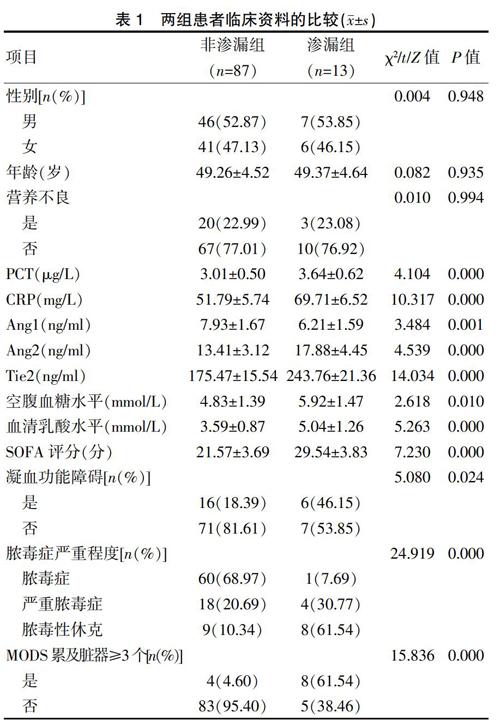
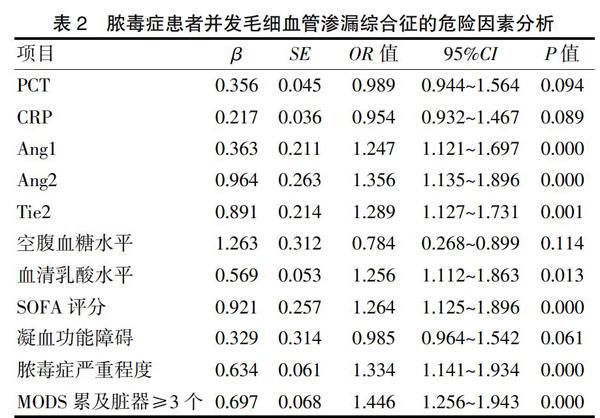
[摘要]目的 研究膿毒症患者并发毛细血管渗漏综合征的危险因素。方法 选取2017年10月~2018年9月我院收治的100例脓毒症患者作为研究对象,根据患者是否并发毛细血管渗漏综合征分为渗漏组(13例,并发毛细血管渗漏综合征)和非渗漏组(87例,未并发毛细血管渗漏综合征),统计并比较两组患者的临床资料,分析脓毒症患者并发毛细血管渗漏综合征的危险因素。结果 渗漏组患者的降钙素原(PCT)、C反应蛋白(CRP)、促血管生成素-2(Ang2)、血管生成素受体2抗体(Tie2)、空腹血糖、血清乳酸水平以及全身性感染相关性器官功能衰竭(SOFA)评分均高于非渗漏组,促血管生成素-1(Ang1)水平低于非渗漏组,凝血功能障碍及多器官功能障碍综合征(MODS)累及脏器≥3个的发生率高于非渗漏组,脓毒症严重程度重于非渗漏组,差异均有统计学意义(P<0.05);Logistic多因素分析结果显示,Ang1水平下降[β=0.363,OR=1.247,95%CI(1.121,1.697)]、Ang2[β=0.964,OR=1.356,95%CI(1.135,1.896)]及Tie2受体水平升高[β=0.891,OR=1.289,95%CI(1.127,1.731)]、高血清乳酸水平[β=0.569,OR=1.256,95%CI(1.112,1.863)]、高SOFA评分[β=0.921,OR=1.264,95%CI(1.125,1.896)]、脓毒症病情严重[β=0.634,OR=1.446,95%CI(1.141,1.934)]、MODS累及脏器≥3个[β=0.697,OR=1.446,95%CI(1.256,1.943)],均是脓毒症患者并发毛细血管渗漏综合征的危险因素(P<0.05)。结论 Ang1水平下降、Ang2及Tie2受体水平升高、高血清乳酸水平、高SOFA评分、脓毒症病情严重、MODS累及脏器≥3个,均是脓毒症患者并发毛细血管渗漏综合征的危险因素。
[关键词]脓毒症;毛细血管渗漏综合征;危险因素;乳酸;促血管生成素-1;促血管生成素-2;血管生成素受体2抗体
[中图分类号] R654.1 [文献标识码] A [文章编号] 1674-4721(2020)3(b)-0026-04
Analysis of risk factors for the occurrence of capillary leak syndrome in patients with sepsis
YANG Wen-tao LIN Leng CHEN Ning
Department of Internal Medicine, Fujian Provincial Jinshan Hospital, Fuzhou 350028, China
[Abstract] Objective To study the risk factors for the occurrence of capillary leak syndrome in patients with sepsis. Methods A total of 100 patients with sepsis treated in our hospital from October 2017 to September 2018 were selected as the subjects. According to whether suffering from the complication of capillary leak syndrome, the patients were divided into the leakage group (n=13, with the complication of capillary leak syndrome) and non-leakage group (n=87, without complication of capillary leak syndrome). The clinical data of the two groups were compared and analyzed. The risk factors of capillary leak syndrome in patients with sepsis were also analyzed. Results For patients in the leakage group, the levels of procalcitonin (PCT), C-reactive protein (CRP), angiopoietin-2 (Ang2), angiopoietin receptor 2 antibody (Tie2), fasting blood glucose and lactic acid, and the score of sepsis-related organ failure assessment (SOFA) were higher than those of the non-leakage group, and the angiopoietin-1 (Ang1) level was lower than that of the non-leakage group, the incidence of coagulation disorders and multiple organ dysfunction syndrome (MODS) involved with three organs or more was higher than that of non-leakage group, and the state of sepsis was more serious than that of the non-leakage group, the differences were statistically significant (P<0.05). Logistic multivariate analysis showed that the level of Ang1 decreased (β=0.363, OR=1.247, 95%CI [1.121, 1.697]), the levels of Ang2 (β=0.964, OR=1.356, 95%CI [1.135, 1.896]) and Tie2 receptor increased [β=0.891, OR=1.289, 95%CI [1.127, 1.731]), high lactic acid level (β=0.569, OR=1.256, 95%CI [1.112, 1.863]), high SOFA score (β=0.921, OR=1.264, 95%CI [1.125, 1.896]), the state of sepsis was severe [β=0.634, OR=1.446, 95%CI [1.141, 1.934]), the organs involved by MODS was three or more (β=0.697, OR=1.446, 95%CI [1.256, 1.943]) were risk factors for the occurrence of capillary leak syndrome in patients with sepsis (P<0.05). Conclusion The decreased Ang1 level, and elevated Ang2 and Tie2 receptor levels, high level of serum lactate, high score of SOFA, severe sepsis, three or more organs involved by MODS are all the risk factor for the occurrence of capillary leak syndrome in patients with sepsis.
[Key words] Sepsis; Capillary leak syndrome; Risk factors; Lactic acid; Angiopoietin-1; Angiopoietin-2; Angiopoietin receptor 2 antibody
脓毒症是由感染引起的全身炎症综合征,具有较高的死亡率,严重威胁着患者的生命健康[1]。由于多系统的、难以控制的毛细血管渗漏引起的多器官功能障碍是影响脓毒症患者预后,导致脓毒症患者死亡的主要原因,因此必须积极预防脓毒症患者发生毛细血管渗漏综合征,而目前关于脓毒症患者发生毛细血管渗漏综合征危险因素的研究较少,对于脓毒症患者发生毛细血管渗漏综合征防治措施的制定尚缺乏指导性依据[2-3]。……
