细菌培养与PCR在细菌性痢疾检测中的应用效果比较
2019-10-21李江
李江
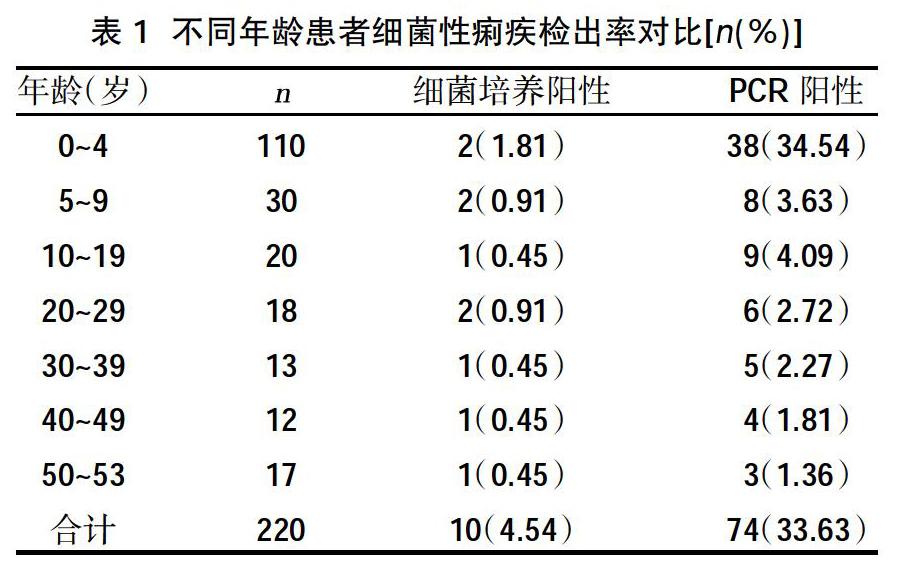
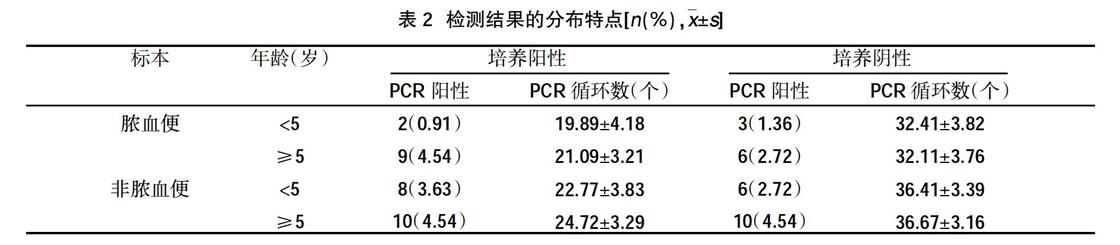
摘要:目的 对比细菌培养与聚合酶链反应(PCR)检测在细菌性痢疾检测中的应用效果。方法 选取2018年1月~2019年1月在我院诊治的220例腹泻患者作为研究对象,分别采用细菌培养与聚合酶链反应(PCR)对其粪便标本进行检测,对比两种方法检出率及患者基本情况对检出率的影响。结果 PCR检出率50.45%高于细菌培养4.54%,且不同年龄患者PCR的检出率均高于细菌培养法,差异有统计学意义(P<0.05);在PCR检测中,培养阴性、非脓血便、年龄≥5岁与培养阳性、脓血便、年龄<5岁病例PCR平均循环数对比,差异有统计学意义(P<0.05)。结论 在细菌性痢疾的检测中PCR检测与细菌培养对比具有更准确的评估作用,利于临床对细菌性痢疾人群的评估,具有临床应用的重要意义。同时不同年龄患者PCR检出率存在差异,且脓血便可作为判断志贺菌感染程度的指标之一。
关键词:细菌培养;聚合酶链反应;细菌性痢疾
Abstract:Objective To compare the effects of bacterial culture and polymerase chain reaction (PCR) detection in the detection of bacterial dysentery.Methods A total of 220 patients with diarrhea diagnosed in our hospital from January 2018 to January 2019 were enrolled in this study. Bacterial culture and polymerase chain reaction (PCR) were used to detect fecal specimens. Compare the detection rate of two methods and the impact of basic situation of patients on the detection rate.Results The PCR detection rate was 50.45% higher than that of bacterial culture 4.54%, and the detection rate of PCR was higher than that of bacterial culture method,the difference was statistically significant (P<0.05). In PCR detection, culture was negative and non-culture. There was a statistically significant difference in the average number of PCR cycles between pus and bloody stools, age≥5 years and culture-positive, pus and bloody stools, there was a statistically significant difference in the mean number of PCR cycles between the ages <5 years old (P<0.05).Conclusion PCR detection and bacterial culture in the detection of bacterial dysentery have a more accurate evaluation, which is conducive to clinical evaluation of bacterial dysentery, and has important clinical significance. At the same time, the PCR detection rates of patients of different ages are different, and pus and blood can be used as one of the indicators to judge the degree of Shigella infection.
Key words:Bacterial culture;Polymerase chain reaction;Bacterial dysentery
細菌性痢疾(bacterial dysentery)属于临床常见的多发病,是由志贺菌属细菌引起的肠道传染。患者主要伴有发热、腹泻、腹痛、黏液性脓血样便症状,严重影响患者的身体健康[1]。随着现代医疗水平的不断提高,卫生条件显著改善,细菌性痢疾发病率有所下降。但是志贺菌感染仍然是我国现下重要的公共卫生问题之一[2]。临床常用的检测方法有细菌培养、PCR检测。但有研究显示,细菌检测确诊细菌性痢疾诊断率不高,容易出现漏诊。因此,本研究选取2018年1月~2019年1月在我院诊治的220例腹泻患者作为研究对象,对比细菌培养与PCR检测在细菌性痢疾检测中的应用效果,为临床提供一定的参考依据,现报告如下。
1资料与方法
1.1一般资料 选取2018年1月~2019年1月在湖北省荆州市第三人民医院诊治的220例腹泻患者进行研究。纳入标准:①符合细菌性痢疾诊断标准;②粪便镜见均可见白胞每高倍视野15个以上,可见少量红细胞。③年龄0~53岁。排除标准:合并有心、肝、肾等严重系统疾病者。男性124例,女性96例;年龄0~53岁,平均年龄(35.17±2.11)岁。……