不同剂量下腹腔注射人脐带间充质干细胞对治疗2型糖尿病大鼠的有效性研究
2019-09-28李翰宇连晓芬孙天慧杨旸卢东晖张帆
李翰宇 连晓芬 孙天慧 杨旸 卢东晖 张帆

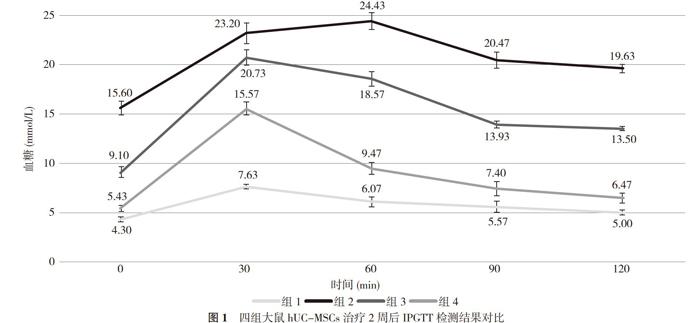

【摘要】 目的 評估腹腔注射不同剂量人脐带间充质干细胞(hUC-MSCs)对2型糖尿病(T2DM)大鼠治疗的有效性。方法 选取18只5~6周龄雄性SD大鼠, 随机选择3只分入组1, 予以正常饮食喂养;剩余15只予以高脂饮食喂养。8周后, 予15只大鼠按50 mg/kg剂量腹腔注射链脲佐菌素(STZ)1次, 注射STZ 1周后测空腹血糖, 达到组1的3倍则认为造模成功。将造模成功的9只大鼠随机分为组2、组3和组4, 每组3只。组3和组4立即腹腔注射1次hUC-MSCs, 注射细胞量为2×10⁶/kg, 组2进行腹腔注射等量磷酸盐缓冲液(PBS);1周后, 组4再次予以注射同等剂量hUC-MSCs, 测hUC-MSCs治疗2周后大鼠的空腹血糖、空腹胰岛素, 并行腹腔注射葡萄糖耐受试验(IPGTT), 比较分析四组大鼠血糖水平、胰岛素水平变化情况。治疗4周后, 留取四组大鼠胰腺组织行苏木精 — 伊红染色法(HE)染色和免疫组化, 并进行分析。结果 hUC-MSCs移植2周后, 四组的空腹血糖和HOMA-β水平组间两两比较差异均具有统计学意义(P<0.05);组2的空腹胰岛素(21.68±3.87)μIU/ml低于组1的(29.33±4.39)μIU/ml和组4的(28.95±2.41)μIU/ml, 差异均具有统计学意义(P<0.05);组1的HOMA-IR低于组2和组3, 组2的HOMA-IR高于组3和组4, 组3的HOMA-IR高于组4, 差异均具有统计学意义(P<0.05);组1的HOMA-IS高于组2和组3, 组2的HOMA-IS低于组3和组4, 组3的HOMA-IS低于组4, 差异均具有统计学意义(P<0.05)。hUC-MSCs移植后, 组3和组4的血糖水平均逐渐下降, 组4下降更明显, 但与组1比较差异具有统计学意义(P<0.01);IPGTT中, 组3和组4血糖高峰均在30 min出现, 与组1曲线特征相符合, 且组4更接近组1水平。hUC-MSCs注射后4周后取大鼠胰腺组织显微镜下观察, 组1大鼠胰腺组织形态完整, 胰岛内细胞排列整齐, 细胞界限清楚, 胰岛密度正常;组2大鼠胰岛形态不规则, 细胞排列紊乱, 胰岛数目减少;而组3和组4较组2有不同程度改善, 组4组织形态较组3胰腺组织形态完整, 细胞排列整齐。使用胰岛抗体免疫组化染色后可见, 组2大鼠胰岛细胞非常少, 组4组织形态较组3胰岛内胰岛细胞数目增多, 但较组1大鼠胰岛细胞少。结论 经腹腔途径注射hUC-MSCs可以有效的治疗T2DM大鼠, 且高剂量可以更好的修复胰腺组织, 改善β细胞功能, 增加β细胞数目, 改善胰岛素抵抗。
【关键词】 2型糖尿病;人脐带间充质干细胞;腹腔注射; 剂量;有效性
DOI:10.14163/j.cnki.11-5547/r.2019.24.108
Study on effectiveness of intraperitoneal injection of human umbilical cord mesenchymal stem cells at different doses in type 2 diabetes mellitus rats LI Han-yu, LIAN Xiao-fen, SUN Tian-hui, et al. Anhui Medical University, Hefei 230032, China
【Abstract】 Objective To evaluate the effectiveness of intraperitoneal injection of human umbilical cord-derived mesenchymal stem cells (hUC-MSCs) at different doses in type 2 diabetes mellitus (T2DM) rats. Methods A total of 18 male SD rats aged 5-6 weeks were selected. 3 rats were taken as group 1 and fed with normal diet, and the remaining 15 rats were fed with high-fat diet. 8 weeks later, 15 rats were intraperitoneally injected with streptozotocin (STZ) at a dose of 50 mg/kg once Fasting blood glucose was measured 1 week later, and 3 times of group 1 was considered to be successful. 9 rats with successful modeling were randomly divided into group 2, group 3 and group 4, with 3 rats in each group. Group 3 and group 4 were intraperitoneally injected with hUC-MSCs once immediately by 2×10⁶/kg. Group 2 was intraperitoneally injected with the same dose of phosphate buffered saline (PBS). 1 week later, group 4 was injected with the same dose of hUC-MSCs again. Fasting blood glucose and insulin were measured after 2 weeks of treatment. The changes of blood glucose and insulin levels were compared and analyzed by intraperitoneal glucose tolerance test (IPGTT). After 4 weeks of treatment, the pancreatic tissues of rats in four groups were taken for hematoxylin-eosin (HE) staining and immunohistochemistry. Results 2 weeks after hUC-MSCs transplantation, there was statistically significant differences in fasting blood glucose and HOMA-β levels among the four groups (P<0.05). Group 2 had lower fasting insulin as (21.68±3.87) μIU/ml than (29.33±4.39) μIU/ml in group 1 and (28.95±2.41) μIU/ml in group 4, and their difference was statistically significant (P<0.05). HOMA-IR in group 1 was lower than those in group 2 and group 3, HOMA-IR in group 2 was higher than those in group 3 and group 4, HOMA-IR in group 3 was higher than that in group 4. Their difference was statistically significant (P<0.05). HOMA-IS in group 1 was higher than those in group 2 and group 3, HOMA-IS in group 2 was lower than those in group 3 and group 4, and HOMA-IS in group 3 was lower than that in group 4. Their difference was statistically significant (P<0.05). After hUC-MSCs transplantation, the blood glucose levels of group 3 and group 4 gradually decreased, and that of group 4 decreased more significantly, but the difference was statistically significant compared with group 1 (P<0.01). In IPGTT, the blood glucose peaks of group 3 and group 4 appeared at 30 min, which was consistent with the curve characteristics of group 1, and group 4 was closer to the level of group 1. 4 weeks after hUC-MSCs injection, the pancreatic tissue of the rats was observed under microscope. The pancreatic tissue of group 1 was intact, the cells in the islets were arranged neatly, the cell boundaries were clear, and the islet density was normal. The islets of group 2 were irregular in shape, the cells were arranged disorderly, and the number of islets was decreased. Group 3 and group 4 were improved to different extents compared with group 2, and the morphology of group 4 was more complete than that of group 3, and the cells were arranged neatly. After immunohistochemical staining with islet antibody, there were very few islet cells in group 2, and the number of islet cells in group 4 was higher than that in group 3, but less than that in group 1. Conclusion Intraperitoneal injection of hUC-MSCs is effective in the treatment of T2DM rats. High dose of injection can better repair pancreatic tissue, improve the function of beta cells, increase the number of beta cells, and improve insulin resistance.
【Key words】 Type 2 diabetes mellitus; Human umbilical cord-derived mesenchymal stem cells; Intraperitoneal injection; Dose; Effectiveness
糖尿病是一类伴有不同程度胰岛素分泌缺乏或胰岛功能障碍的代谢性疾病, 2017年全球患病率为8.8%, 中国患病率为10.9%[1]。面对这如此庞大的患患者群, 现有的治疗手段却无法根治。根治糖尿病的关键就在于修复胰腺β细胞的功能。干细胞具有强大的分化潜能, 为修复胰腺提供了可能性。本研究拟用腹腔注射人脐带间充质干细胞(human Umbilical Cord-derived Mesenchymal Stem Cells, hUC-MSCs)途径, 探索hUC-MSCs对修复2型糖尿病(type 2 diabetes mellitus, T2DM)大鼠胰腺功能的有效性, 为临床干细胞治疗T2DM患者提供基础科研依据, 为T2DM患者寻求新的有效的临床治疗方法。……