基于贝塞尔曲线的无人车局部避障应用
2019-09-02高嵩张金炜戎辉王文扬郭蓬何佳
高嵩 张金炜 戎辉 王文扬 郭蓬 何佳
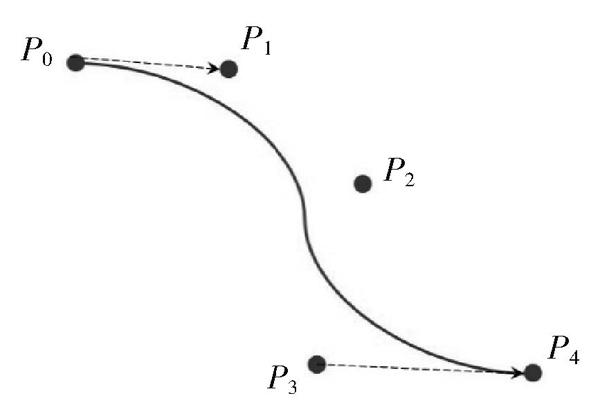
摘 要: 文中将基于贝塞尔曲线的路径规划方法应用在无人车局部避障中。首先通过最小化曲线的最大曲率与最小曲率之间的差值确定贝塞尔曲线所需的五个控制点,根据五个控制点确定贝塞尔曲线,再结合实验无人车和道路的实际情况从若干备选曲线中选择最优路线。实验仿真结果证明,该方法能够达到无人车局部避障的要求,能满足包括初始状态约束、目标状态约束、曲率连续约束等行驶条件。
关键词: 路径规划; 局部避障; 无人车; 四阶贝塞尔曲线; 控制点; 状态约束
中图分类号: TN99?34 文献标识码: A 文章编号: 1004?373X(2019)09?0163?04
Application of unmanned vehicle local obstacle avoidance method based on Bezier curve
GAO Song1, 2, ZHANG Jinwei3, RONG Hui1, 3, WANG Wenyang1, GUO Peng1, 2, HE Jia1
(1. Automotive Engineering Research Institute, China Automotive Technology & Research Center Co., Ltd., Tianjin 300300, China;
2. Tianjin University, Tianjin 300072, China; 3. Hebei University of Technology, Tianjin 300132, China)
Abstract: The path planning method based on quartic Bezier curve is applied to the local obstacle avoidance of unmanned vehicles. The difference between the maximum curvature and minimum curvature of the minimum curve is used to determine the five control points required by Bezier curve. The Bezier curve is determined according to the five control points, and the optimal path is selected from some alternative curves by combining the experimental unmanned vehicle with actual road situation. The experimental results show that the proposed method can meet the requirements of unmanned vehicles for local obstacle avoidance, and satisfy the driving conditions of initial state constraint, target state constraint and curvature continuous constraint.
Keywords: path planning; local obstacle avoidance; unmanned vehicle; quartic Bezier curve; control point; state constraint
0 引 言
無人车的软件层次一般由感知层、决策层和控制层三层组成[1]:感知层包括图像识别、激光雷达与毫米波雷达数据处理、卫星差分与惯性导航定位等算法;决策层包括全局路径规划和局部路径规划等内容;控制层则主要涉及通过模型预测控制、PID、滑模变理论等对车辆的转向、刹车、加速等底层执行单元进行控制。本文聚焦于无人车的局部路径规划,探讨无人车在道路行驶过程中遇到障碍物时如何规划出一条合理的曲线进行避障行驶的问题。
无人车的局部路径规划吸引了国内外的研究者进行了广泛的研究,现有的方法可以分为五大类,分别是:传统路径规划算法(模拟退火法、人工势场法等)[2]、启发式搜索算法(Dijkstra算法、A*算法及其变种等)[3]、离散优化算法(模型预测算法、几何轨线算法等)[4]、随机采样算法(随机路图法、快速随机拓展树法等)[5?6]和智能仿生算法(遗传算法、蚁群算法、神经网络等)[7]。……