护理风险管理在呼吸科危重症患者护理中的应用与效果评价
2019-06-13秦莉莉
秦莉莉
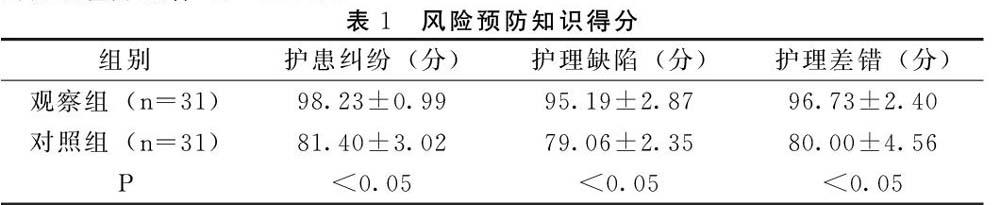

【摘 要】 目的:评价护理风险管理在呼吸科危重症患者护理中的应用与效果。方法:随机分组,对照组采用常规方法管理,观察组实施分层管理模式。结果:观察组护患矛盾预防知识(98.23±0.99)分、护理缺陷预防知识(95.19±2.87)分、护理差错预防知识(96.73±2.40)分、发生护理风险者占3.23%,无人投诉,93.55%的患者对护理满意,与对照组差异显著(P<0.05)。结论:实施分层管理模式,对护理风险进行管理,有助于提高护理人员的风险预防能力,降低风险发生率,减少投诉患者的数量,提高患者满意度。
【关键词】 护理风险管理;呼吸科;危重症患者
【中图分类号】R373.2
【文献标志码】B
【文章编号】1005-0019(2019)12-035-01
Abstract Objective:to evaluate the application and effect of nursing risk management in critically ill patients in respiratory department. Methods: the control group was randomly divided into two groups, the control group was managed by routine method, and the observation group was treated with stratified management model. Results: in the observation group, the scores of preventive knowledge of nurse-patient contradiction were (98.23 ±0.99), that of nursing defect prevention was (95.19 ±2.87), and that of nursing error prevention was (96.73 ±2.40). 93.55% of the patients were satisfied with nursing care, which was significantly different from that of the control group (P<0.05). Conclusion:implementation of hierarchical management model The management of nursing risk will help to improve the risk prevention ability of nurses, reduce the incidence of risk, reduce the number of complaints and improve the satisfaction of patients.
Key words:nursing risk management; respiratory department; critically ill patients
前言
呼吸科危重症患者病情特殊,非计划性拔管、护患纠纷等风险的发生几率高,需加强护理风险管理,方可为患者提供优质的护理服务,提高患者满意度。有研究指出,实施分层管理模式,可有效提高护理风险管理质量。本文于本院呼吸科2016年10月~2017年10月的收治的危重症患者中,随机选取62例作为样本,阐述了分层管理模式的应用方法,观察了应用效果:
1 資料与方法
1.1 一般资料 随机分组,观察组性别:男/女=15/16,年龄(61.70±4.21)岁,疾病类型:重症肺炎10例、COPD9例、呼吸衰竭10例、其他2例。对照组性别:男/女=16/15,年龄(61.88±4.30)岁,疾病类型:与观察组一致。两组患者具有可比性(P<0.05)。
1.2 方法 对照组采用常规方法管理,观察组实施分层管理模式。呼吸科护理人员需成立风险预防小组,由护士长作为组长,带领组员预防护理风险。组员应通过民主选举,选出责任护士。小组中,组长、责任护士及护士均应执行不同的护理任务,共同对护理风险进行预防。(1)护士长:护士长需负责带领组员拟定风险预防计划,把控管理风险,评估管理效果。……