间歇曝气强化人工湿地低温脱氮研究
2019-06-07康晓荣刘亚利周友新苏瑛
康晓荣 刘亚利 周友新 苏瑛


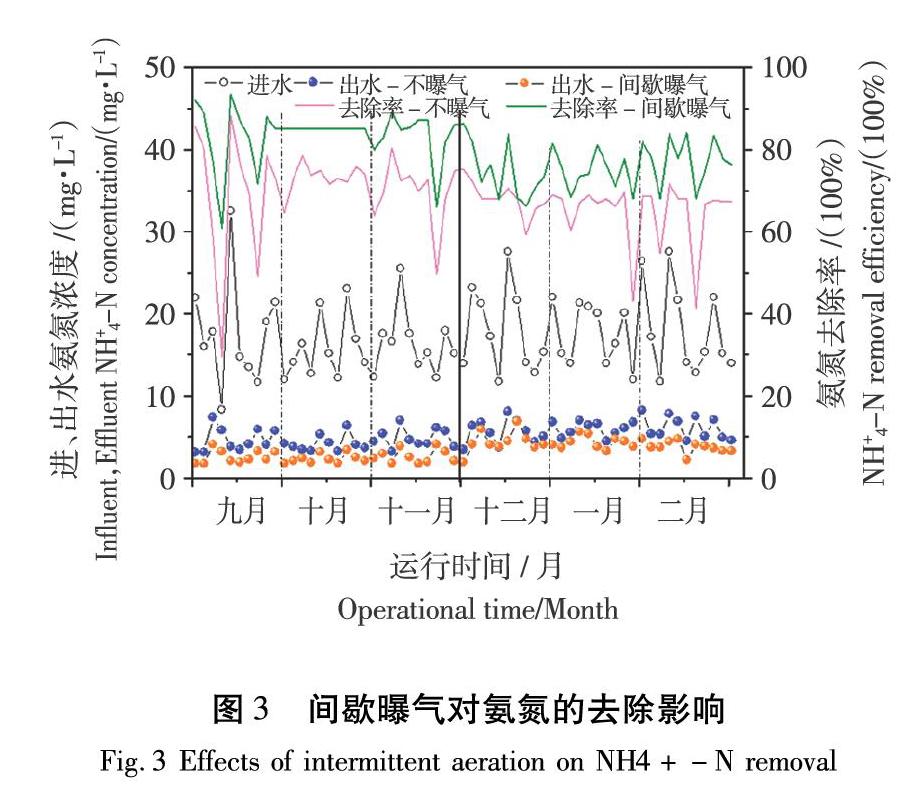
摘要:为了提高秋、冬季节人工湿地的去污效果,本研究采用间歇曝气方式强化人工湿地对营养盐的处理。研究结果表明:间歇曝气有效提高了人工湿地对有机物、氨氮和总氮的去除效率,即使在低温季节(12月-2月)下,COD、氨氮和总氮的平均去除率分别达到67.6%、76.4%和63.9%。采用聚合酶链式反应-变性梯度凝胶电泳(PCR-DGGE)技术对根系微生物进行分析发现:具有氨氮氧化和反硝化能力的Actinobacteria和β-proteobacteria在间歇曝气方式下得到更好的生长,同时有机物降解菌属Bacteroidetes和Firmicutes是人工湿地中的优势菌属。
关键词:人工湿地;间歇曝气;氨氮;微生物群落
中图分类号:X703文献标识码:A文章编号:1006-8023(2019)03-0074-04
Studies on Intermittent Aeration Enhancing Nitrogen Removal
of Constructed Wetland at Low Temperature
KANG Xiaorong1, LIU Yali2, ZHOU Youxin3, SU Ying3
(1. School of Environmental Engineering, Nanjing Institute of Technology, Nanjing 210037;
2.School of Civil Engineering, Nanjing Forestry University, Nanjing 210037;
3.School of Civil Engineering, Yancheng Institute of Technology, Jiangsu Yancheng 224002)
Abstract:In order to improve the removal performances of constructed wetlands in autumn and winter, in this paper, intermittent aeration was used to strengthen the treatment of nutrient in constructed wetlands. The results showed that intermittent aeration effectively improved the removal efficiencies of organic matter, ammonia nitrogen and total nitrogen. Even in low temperature environment (December-February), the removal rates of COD, ammonia nitrogen and TN reached 67.6%, 76.4% and 63.9%, respectively. Microorganisms at the roots of plants were analyzed by PCR-DGGE. The microbial analysis suggested that Actinobacteria and β-proteobacteria, which were mainly involved in ammonia oxidation and denitrification, were promoted by intermittent aeration model. Meanwhile Bacteroidetes and Firmicutes, which were responsible for removal of organic matters, were dominant group in constructed wetlands.
Keywords:Constructed wetland; intermittent aeration; ammonia nitrogen; microbial community
0引言
人工湿地具有处理效果好、成本低和运行维护简单等优点,被广泛应用于污水处理、河道净化、生态修复以及海绵城市建设等领域[1-3]。人工湿地利用植物吸收、底部填料吸附,以及微生物的生命活动来降解水中的氨氮(NH+4-N)等营养物质[4-5]。然而,人工湿地的脱氮效果受温度影响较大,特别是在我国北方地区,有机物、氨氮和总氮(TN)的去除率相较其他季节更低[6]。由此可见,在秋冬低温环境下脱氮效率低下是影响人工湿地技术应用的难题。
为了提高人工湿地低温脱氮效果,国内外学者除了采用覆盖植物和地膜等保温措施外[7],还筛选耐低温的微生物、填料和植物[8-9],甚至优化并开发适合低温地区的新工艺[10]。最近研究认为:湿地植物对氮的吸收作用相對较弱,微生物的硝化和反硝化作用对总氮的去除则至关重要[11-13]。……
