肾结石患者治疗中运用输尿管软镜及经皮肾镜碎石术的临床对比及其系统评价
2019-04-21肖锬林超禄钟德文
肖锬 林超禄 钟德文
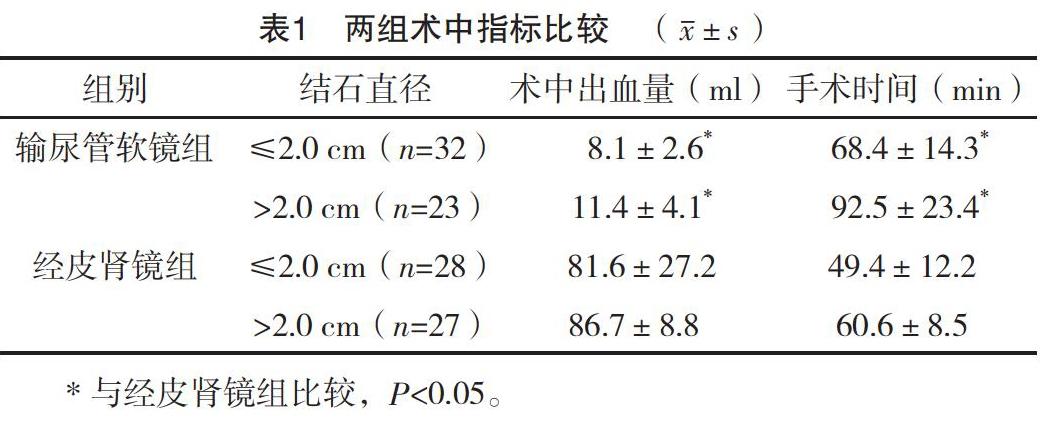
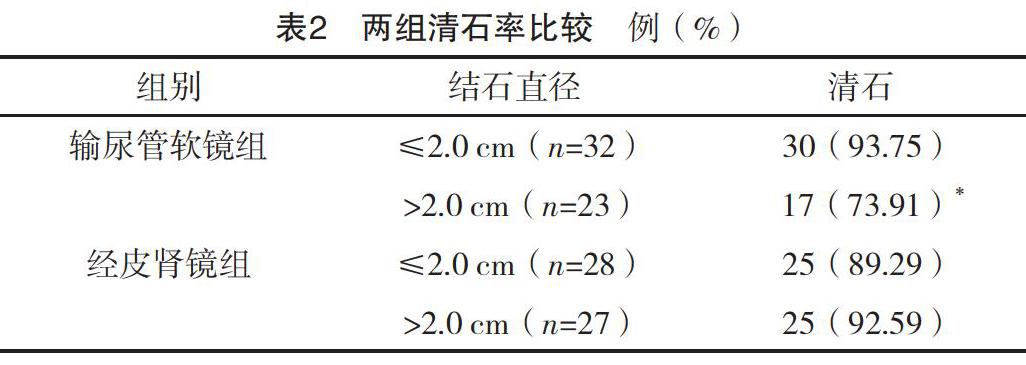

【摘要】 目的:對比分析肾结石患者治疗中运用输尿管软镜及经皮肾镜碎石术的临床效果及其系统评价。方法:选取笔者所在医院2016年3月-2019年1月收治的110例肾结石患者,按照不同治疗方法将其分为输尿管软镜组与经皮肾镜组,各55例。分别选择经输尿管软镜碎石术、经皮肾镜碎石术治疗,比较两组临床效果。结果:输尿管软镜组术中出血量明显少于经皮肾镜组,但手术时间明显长于经皮肾镜组,差异均有统计学意义(P<0.05)。在对直径≤2.0 cm的肾结石患者进行治疗时,两组清石率比较差异无统计学意义(P>0.05);在对直径>2.0 cm的肾结石患者进行治疗时,经皮肾镜组清石率明显高于输尿管软镜组,差异有统计学意义(P<0.05)。输尿管软镜组术后并发症发生率明显低于经皮肾镜组,差异有统计学意义(P<0.05)。结论:在对直径≤2.0 cm肾结石患者进行治疗时,可以将经输尿管软镜碎石术作为首选治疗方案;在治疗直径>2.0 cm肾结石患者时,则可以选择经皮肾镜碎石术治疗。
【关键词】 肾结石 输尿管软镜 经皮肾镜 碎石术
doi:10.14033/j.cnki.cfmr.2019.28.054 文献标识码 B 文章编号 1674-6805(2019)28-0-03
Clinical Comparison and Systematic Evaluation of Flexible Ureteroscopy and Percutaneous Nephrolithotomy in the Treatment of Patients with Renal Calculi/XIAO Tan, LIN Chaolu, ZHONG Dewen. //Chinese and Foreign Medical Research, 2019, 17(28): -131
[Abstract] Objective: To compare and analyze the clinical effect of flexible ureteroscopy and percutaneous nephrolithotomy in the treatment of of patients with renal calculi and its systematic evaluation. Method: A total of 110 cases of renal calculi admitted in our hospital from March 2016 to January 2019 were selected and divided into the flexible ureteroscopy group and the percutaneous nephroscopy group according to different treatment method,with 55 cases in each group. The clinical effects of the two groups were compared. Result: The amount of bleeding in the flexible ureteroscopy group was significantly less than that in the percutaneous nephroscopy group, but the operation time was significantly longer than that in the percutaneous nephroscopy group, the differences were statistically significant (P<0.05). In the treatment of patients with renal calculi ≤2.0 cm in diameter, there was no significant difference in the stone clearance rate between the two groups (P>0.05). The stone clearance rate of the percutaneous nephroscopy group was significantly higher than that of flexible ureteroscope group in the treatment of patients with renal calculi >2.0 cm in diameter, the difference was statistically significant (P<0.05). The incidence of complications in the flexible ureteroscopy group was significantly lower than that in the percutaneous nephroscopy group, the difference was statistically significant (P<0.05). Conclusion: Transureteral flexible ureteroscopic lithotripsy is the first choice for the treatment of of patients with renal calculi ≤2.0 cm in diameter, and percutaneous nephrolithotripsy can be used for the treatment of patients with renal calculi >2.0 cm in diameter.
[Key words] Renal calculi Flexible ureteroscopy Percutaneous nephroscopy Lithotripsy
First-authors address: The First Hospital of Longyan City, Longyan 364000, China
临床中在对肾结石患者进行外科手术治疗时,常用的手段为经皮肾镜碎石术、输尿管软镜碎石术、腹腔镜下取石术、开放取石术、体外冲击波碎石术等[1]。如果患者结石较大,选择体外冲击波碎石术进行碎石的效果并不理想,需要反复、多次碎石;开放手术则会对患者造成较大创伤,现阶段微创手术开始逐渐取代了开放手术[2]。现阶段临床中在对肾结石患者进行治疗时,常用的微创手术包括经皮肾镜碎石术、输尿管软镜碎石术等[3]。本研究通过对比分析肾结石患者治疗中运用输尿管软镜及经皮肾镜碎石术的临床效果,以期为肾结石的治疗提供指导,现报道如下。
1 资料与方法
1.1 一般资料
本研究所选110例肾结石患者均为笔者所在医院2016年3月-2019年1月收治,纳入标准:经静脉肾盂造影、超声、腹部X线片等影像学检查证实;存在手术治疗的指征。排除……