食管癌患者术后院内感染的危险因素分析与护理干预研究
2019-01-16石际杰弓洁张文静赵玮
石际杰 弓洁 张文静 赵玮
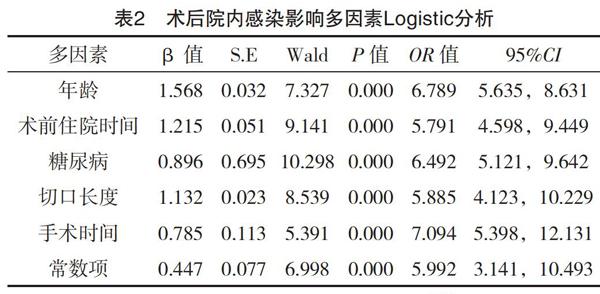
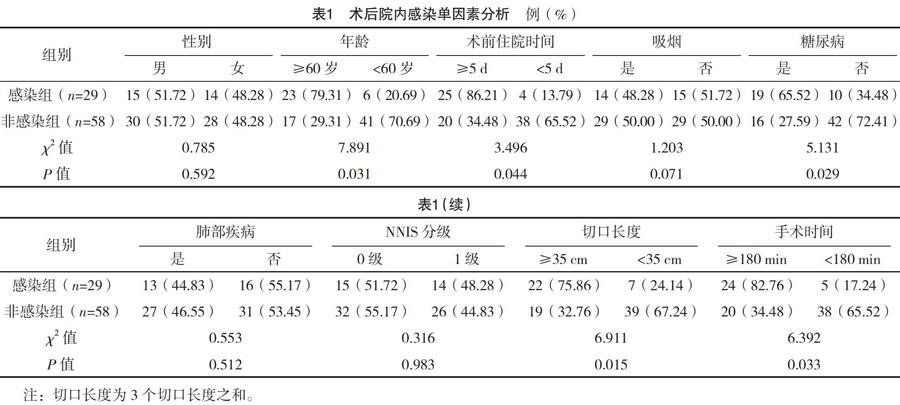
【摘要】 目的:探讨食管癌患者术后院内感染的危险因素及护理干预措施。方法:选择2017年5月-2018年11月治疗的食管癌手术患者87例,根据患者术后是否发生院内感染分为感染组(n=29)与非感染组(n=58)。所有患者入院后均查阅患者病例资料,记录患者性别、年龄、术前住院时间、是否吸烟、糖尿病、肺部疾病、NNIS分级、切口长度、手术时间,并对上述危险因素进行单因素及多因素Logistic分析,针对上述危险因素制定有效的护理措施进行干预。结果:87例患者中29例术后发生院内感染,感染率为33.33%。两组性别、是否吸烟、肺部疾病、NNIS分级比较,差异均无统计学意义(P>0.05),年龄、术前住院时间、糖尿病、切口长度、手术时间为术后院内感染危险因素(P<0.05)。结论:食管癌患者术后院内感染率较高,年龄、糖尿病、切口长度及手术和住院时间为术后院内感染危险因素,应加强危险可控因素干预,降低院内感染率。
【关键词】 食管癌; 院内感染; 危险因素; 多因素Logistic分析
Analysis of Risk Factors and Nursing Intervention of Postoperative Nosocomial Infection in Patients with Esophageal Cancer/SHI Jijie,GONG Jie,ZHANG Wenjing,et al.//Medical Innovation of China,2019,16(25):-165
【Abstract】 Objective:To investigate the risk factors and nursing interventions for postoperative nosocomial infection in patients with esophageal cancer.Method:87 patients with esophageal cancer surgery treated from May 2017 to November 2018 were selected.They were divided into the infection group(n=29) and the non-infected group(n=58).Data of all of the patients were consulted after admission,and the gender,age, preoperative hospital stay,smoking status,diabetes,pulmonary disease,NNIS grade,length of incision and operation time were recorded.The above risk factors were analyzed by single and multiple Logistic analysis,and effective nursing measures were formulated for the above risk factors for intervention.Result:Of the 87 patients,29 cases developed nosocomial infection after surgery,the infection rate was 33.33%.There was no significant difference in gender,smoking status,pulmonary disease,and NNIS grade between the two groups(P>0.05).Age,preoperative hospitalization time,diabetes mellitus,incision length and operation time were all risk factors for nosocomial infection after surgery(P<0.05).Conclusion:The postoperative in-hospital infection rate of patients with esophageal cancer is high,and the age,diabetes,length of incision and operation and hospitalization time are risk factors for nosocomial infection.It is necessary to strengthen the intervention of risk controllable factors and reduce the infection rate in hospital.
【Key words】 Esophageal cancer; Nosocomial infection; Risk factors; Multivariate Logistic analysis
First-authors address:Taian City Tumor Prevention and Cure Hospital,Taian 271000,China
doi:10.3969/j.issn.1674-4985.2019.25.041
食管癌是臨床上常见的恶性肿瘤,好发于40岁以上人群中,且不同国家、地区发病率及死亡率存在明显的差异性[1]。患者发病早期临床症状缺乏典型性,随着病情的不断发展,多表现为难以咽干的食物、继而半流质食物,甚至连水或唾液均无法下咽,影响患者健康、生活[2-3]。手术治疗是食管癌首选方法,能切除病灶组织,延缓病情发展[4-5]。但是,食管癌手术风险性较高,导致患者术后院内感染率较高,影响患者手术预后[6]。因此,本文采用随机对照方法进行研究,探讨食管癌患者术后院内感染的危险因素及护理干预措施,现报道如下。
[3]谢琴,莫占端,华润,等.老年食管癌患者术后肺部感染影响因素……
