20种风药中7种无机元素含量及其相关性研究
2018-06-20萨日娜王丽霞陈雯朱书强赵志正潘新波
萨日娜 王丽霞 陈雯 朱书强 赵志正 潘新波
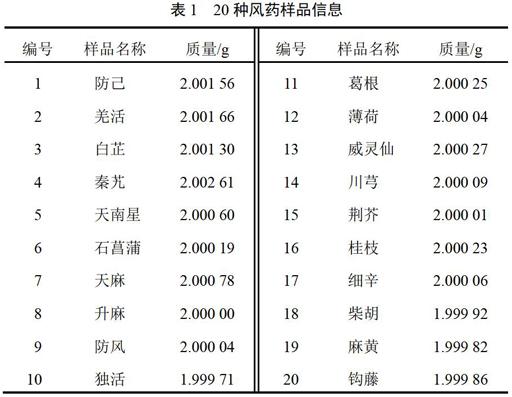
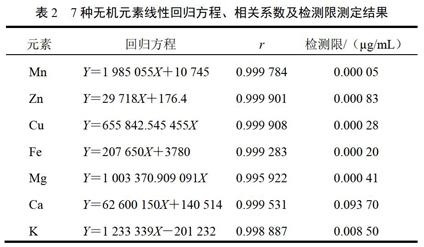
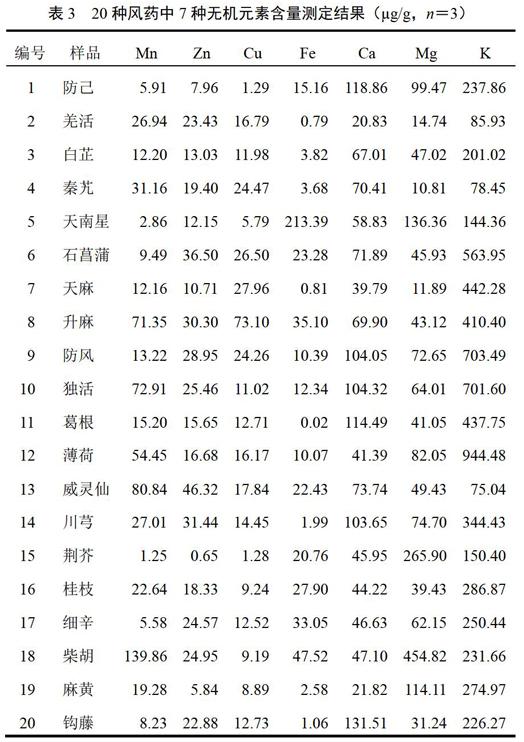
摘要:目的 探討风药中7种无机元素的分布及其相关性。方法 采用电感耦合等离子体发射光谱仪(ICP-OES)测定20种风药中锰(Mn)、锌(Zn)、铜(Cu)、铁(Fe)、钙(Ca)、镁(Mg)、钾(K)7种元素的含量,采用Spearman相关分析、主成分分析和系统聚类法进行分析和评价。结果 20种风药中微量元素Mn平均含量明显高于Zn、Cu、Fe;Zn含量与Mn、Cu具有显著正相关性(P<0.05,P<0.01);Mg含量与Cu、Fe具有显著相关性(P<0.05,P<0.01)。主成分分析结果表明,20种风药中7种无机元素受3个主成分因子影响,Zn、Cu、Ca、K在各风药中分布较为广泛,Mn和Mg在各风药中分布差异较大。系统聚类分析可将20种风药分为4类,第Ⅰ类包含12种风药,其中以解表药为多(6种),性味以辛、温为主;第Ⅱ类为单味药柴胡,Mn元素含量最高;第Ⅲ类6种风药中,解表药有3种;第Ⅳ类为单味药薄荷,性味为辛、凉。20种风药中,寒凉药中Mn、Ca、Mg、K平均含量高于温热药和平性药,温热药中Zn、Fe平均含量高于寒凉药和平性药,平性药中Cu平均含量高于温热药和寒凉药。结论 20种风药中7种无机元素分布及其与中药寒热药性具有一定的相关性。
关键词:风药;无机元素;电感耦合等离子体发射光谱仪;Sperman相关分析;主成分分析;系统聚类法
DOI:10.3969/j.issn.1005-5304.2018.05.020
中图分类号:R284.1 文献标识码:A 文章编号:1005-5304(2018)05-0090-06
Study on Correlation of Contents of 7 Kinds of Inorganic Elements
in 20 Kinds of Wind-expelling Medicine
SA Ri-na1, 2, WANG Li-xia2, CHEN Wen2, ZHU Shu-qiang3, ZHAO Zhi-zheng2, PAN Xin-bo4
1. Gansu Provincial Hospital, Lanzhou 730000, China; 2. Guang'anmen Hospital of China Academy of Chinese Medical Sciences, Beijing 100053, China; 3. Gansu Province Food Inspection Institute, Lanzhou 730000, China;
4. The Second People's Hospital of Lanzhou, Lanzhou 730000, China
Abstract: Objective To investigate the distribution and correlation of different inorganic elements in wind-expelling medicine. Methods The contents of Mn, Zn, Cu, Fe, Ca, Mg and K from 20 kinds of wind-expelling medicine were determined by inductively coupled plasma - optical emission spectrometry (ICP-OES) method. Spearman correlation analysis, principal component analysis and systematic cluster analysis were used for analysis and evaluation. Results The average content of Mn element in trace elements was significantly higher than that of Zn, Cu and Fe. Zn was positively correlated with Mn and Cu (P<0.05, P<0.01). Mg was significantly correlated with Cu and Fe (P<0.05, P<0.01). The results of principal component analysis showed that the seven inorganic elements in the 20 kinds of wind-expelling medicine were affected by three principal component factors. Zn, Cu, Ca, and K elements were widely distributed in the wind-expelling medicine. The distribution of Mn and Mg elements in each wind-expelling medicine was significant. The results of systematic cluster analysis showed that the medicine were clustered into four different groups. Group Ⅰ contained 12 kinds of wind-expelling medicine, and 6 kinds of these were the diaphoretics which property and flavor were pungent and warm. Group Ⅱ was Bupleuri Radix, which contained the highest content of Mn. Group Ⅲ contained 6 kinds of wind-expelling medicine, of which 3 kinds were the diaphoretics. Group Ⅳ was Menthae Haplocalycis Herba, which property and flavor were pungent and cool. The average contents of Mn, Ca, Mg, and K elements in cool-cold nature medicine were higher than those in the warm-hot
通讯作者:潘新波,E-mail:sinpo_pan@163.com
natural and the neutral medicine. The average contents of Zn and Fe in warm-hot natural medicine were higher than those in the cool-cold nature and the neutral medicine. The average content of Cu in the neutral medicine was higher than in the warm-hot natural and the cool-cold nature medicine. Conclusion The distribution of inorganic elements in 20 kinds of wind-expelling medicine has correlation with the cold-heat natural plants-based medicine.
Keywords: wind-expelling medicine; inorganic elements; inductively coupled plasma - optical emission spectrometry; Spearman correlation analysis; principal component analysis; systematic cluster analysis
风药作为中药传统分类的一大类别,其历史悠久、临床应用广泛,具有十分重要的治疗作用。古今众多医家对“风药”均有较多且经典的论述,最早见于金代张元素《医学启源》一书,其弟子李东垣的《脾胃论》则进一步较为详尽论述了风药对治疗脾胃病具有的发散郁热、升发阳气等功效,并依据张元素对药物的五类归纳法[1],将“风升生”类药物(约20味)加以归纳阐述。但后世医家对风药的定义都未给予明确的界定,随着近代对风药的著述专论逐渐增多,对风药这一原为“法象药理”名称的药物研究日趋系统完善。依据历代文献记载,风药具有风木属性,“在天为风,在地为木”,作用趋向为向上、向外。目前关于风药概念定义主要有2种:①祛风药,即祛除外感风邪类药物;②治风药,即祛除外风、平熄内风类药物[2]。目前关于风药与无机元素方面的研究较少,本研究参照古今文献,依据具有“风升生”特性……