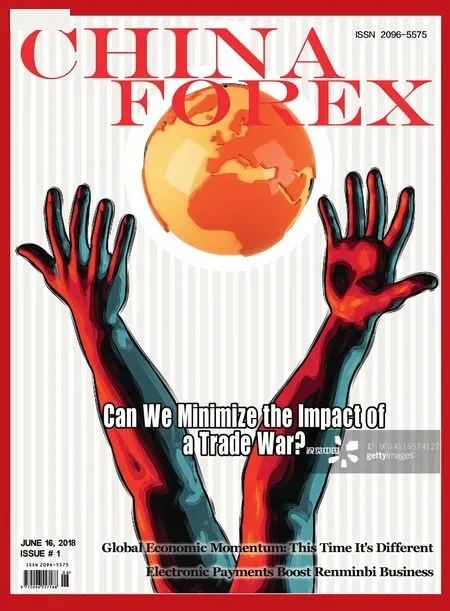
Can We Minimize the Impact of a Trade War?
2018-05-28ByGaoZhanjun
By Gao Zhanjun
T he US has risked setting off a trade war with China by threatening to impose import tariffs on a wide range of goods. China announced its own counter threats before a temporary truce was reached. But then the US responded with a new threat of tariffs and that could upset a fragile peace. Meanwhile,the US has picked fi ghts with the European Union,Japan, Canada and Mexico, demonstrating a decisive shift in America"s global trade policy. It shows new concerns in Washington about free trade. The new theme is "fair trade," and at heart this is a rejection of globalization. After Donald Trump assumed the presidency, he quickly ordered a withdrawal from the Trans-Paci fi c Partnership,a trade accord that was painstakingly hammered out after years of negotiation. President Trump has embraced bilateral negotiations in place of multilateral talks and he has threatened to pull out of the North American Free Trade Agreement despite America"s long-term special relationship with Canada and Mexico. These all underscore this policy shift.
Trade disputes between China and the US will only intensify. This is not just economics and trade but has much to do with politics. We need to remain alert to this and develop a long-term strategy to minimize the negative impact of what looks like an unavoidable trade war.
In order to discuss the roots and implications of the US trade policy change, two basic facts should be recognized.
For one, the declining numbers of US manufacturing jobs have only a tenuous link to the trade de fi cit.
The decline in manufacturing jobs in the US is not new; it started in the 1960s (when international trade was less-developed), and that trend has continued.In particular, the reduction in manufacturing jobs is not unique to the US, as it is generally common to the developed industrial countries. Even major manufacturers such as Germany, Italy and Japan have been forced to deal with this situation. This fully demonstrates that the decline in manufacturing employment in the US has a limited connection with trade. Otherwise, why is there a decline in manufacturing employment in countries with a trade surplus?
So, why did the manufacturing jobs in major industrial countries decline? The two main reasons are as follows: fi rst, because of the progress of science and technology, labor productivity has been signi fi cantly improved. Second, the demand for manufacturing products is relatively inadequate. Robert Lawrence, a famed American trade expert and professor at Harvard University, has made a solid case for this argument.
So even if the United States had a trade surplus like Germany instead of a de fi cit, its manufacturing jobs would be in decline as well. At present, it is an impossible task to try to improve employment through trade policy in the US, where full employment has been reached.
Secondly, the root of the US trade de fi cit is obscured.
Economic theory shows that in the long run, a country"s balance of trade is related to its saving gap(the difference between savings and investment).Savings greater than investment will produce a trade surplus while lower levels of savings result in a de fi cit.Since the middle of the 1970s, savings have continued to fall short of investment in the US, and a long-term trade de fi cit has emerged.
Trade between Japan and the US is a prominent case. Because of Japan"s large trade surplus with the US, the US has been negotiating with Japan for many years. Under the 1985 Plaza Accord, Washington managed to force the yen sharply higher but that still failed to solve the trade problem. Paul Volcker, the former Fed chief, wrote in his book Changing Fortunes(as translated by Yu Jie, CITIC Publishing House and published in October 2016): "One of the many ironic things that I had experienced and recorded in this book was that since 1971, the US dollar depreciated repeatedly until dropping 60% against the Japanese yen and 53% against the deutsche mark, but the US trade and current account de fi cits were much higher than they had been in the 1960s. In contrast, the major industrialized countries which had strong currency appreciation, higher savings, greater productivity and more competitive industries, ended up with sizable surpluses.”
I predict that regardless of whether President Trump stays in of fi ce for eight years or is turned out after the fi rst term, America"s trade de fi cit will remain because it is very dif fi cult to change the situation of savings falling short of investment. In fact, the shortfall could actually increase as tax cuts and increased infrastructure investment will expand the fi scal de fi cit. That will result in an even wider gap in savings,leading to a bigger trade de fi cit. I also expect a further decline in manufacturing employment in the US due to technological advances and reduced demand for manufactured goods.
Based on the above prediction the US trade de fi cit with China will increase and US manufacturing jobs may fall further. Hence trade disputes between China and the United States will only intensify even without considering other non-economic issues.
Lessons from Trade Wars of the Past
The trade friction between the Washington and Beijing was initiated by the US. Washington’s extreme unilateralism is contrary to existing international rules. If we turn to history for signs of what we might expect, we should note that there have been at least three failed cases of unilateral American-initiated trade disputes.
The fi rst was the "voluntary export restraints"imposed by the Reagan administration in the 1980s on the Japanese auto industry. At that time, the World Trade Organization had not yet been established and could not restrain American unilateral action. Analysis showed that the measure amounted to a 60% tariff on Japan. The measure was eventually abandoned as it proved to be bene fi cial to Japanese companies and produced only minimal gains for US auto makers.Japanese producers shifted to higher value cars --which had higher prices and pro fi ts -- and they set up plants in the US to avoid the restraints. The end of the VERs bene fi ted American consumers, and ultimately had a positive effect on the American auto industry.
The second instance was in early 2002 when President George W. Bush imposed tariffs of up to 30%on imported steel to support domestic companies competing with low-cost imports. The move was controversial both in the US and abroad. It helped US steel makers, but it squeezed the pro fi ts of steel users,especially those in the auto industry. In the end, the WTO ruled that the policy was illegal.
The Bush administration withdrew the measure in December 2003, but the cost was very high. According to an analysis of William Hauk, professor at the University of South Carolina, the US lost 200,000 jobs in the manufacturing industry as a result of this. The entire steel industry had only had 197,000 employees.
During his presidential campaign, Trump accused China of manipulating its currency, keeping its value down to boost exports. But Jeff Frankel, a professor at Harvard University, points out that facts show the opposite is true. China spent large amounts of foreign exchange reserves in 2015 and 2016 to stabilize the renminbi to keep it from weakening. When Trump was elected president, he conceded that accusations of currency manipulation were out of date.
It is said that it is not easy for Trump to change his views, regardless of the available data. But at some point, data may prevail. We hope that the trade wars of the past will have an impact on Trump’s actions.
Three Rounds of Sino-US Negotiations
First Round in Beijing
On May 3-4, 2018, the US trade delegation led by Secretary of the Treasury Steven Mnuchin spent two days in Beijing as trade talks got under way.
The trade talks between China and the US attracted considerable attention. For the meeting in Beijing,the US trade team almost swarms out: apart from Mnuchin, others include Secretary of Commerce Wilbur Ross, US Trade Representative Robert Lighthizer, Assistant to the President for Economic Policy Larry Kudlow, and Assistant to the President for Trade and Manufacturing Policy Peter Navarro. Among them, Mnuchin and Kudlow are more sympathetic to free trade while Lighthizer and Navarro are hardline protectionists. For Navarro, the local media ridiculed the 68-year-old trade consultant as someone who could not speak Chinese, hadn’t dealt with China"s policy makers, and may not have spent much time in China, but had written several books on the country.
The Chinese delegation was led by Vice Premier Liu He.
The achievements of the talks seem modest indeed,particularly considering the expectations. In view of the lack of sincerity and the unrealistic demands the US presented to China ahead of the trade talks -- which were described by the Economist"s Simon Rabinovitch as having "a very aggressive opening position from the US" -- it’s easy to see why.
The list of demands was released by Western media such as the Wall Street Journal and Bloomberg before the talks began, suggesting that it might have been purposefully leaked by the American delegation. The demands include reducing the trade surplus with the US by $200 billion and having China promise to increase its imports of US goods in two years. They also called for the abandonment of some of the policies under the "Made in China 2025" strategic plan,an insistence that China not retaliate against actions the US has taken or will take, a call for restricted investment in sensitive technologies as well as the withdraw of a request for WTO consultations on the US Tariff Measures on Speci fi c Chinese Goods submitted by China and a requirement that China withdraw its WTO claim that it should be treated as a market economy.
Making excessive demands may be seen as a good negotiating tactic, but there are limits. As Martin Wolf,chief commentator of the Financial Times, says that there is no trade agreement that requires both sides to control trade surpluses, which is not in line with general trade rules. Looking at the list of American demands, I cannot help but think of the unequal dealings between the US and Japan of the past.
From the statements issued by the US and China,we can see very clearly that the trade talks achieved almost nothing. There was little more than an exchange of ideas and an agreement to hold more negotiations in the future.
Second Round in Washington
Two days of the US-China trade talks ended on May 4 in Beijing merely with an agreement to keep on talking. It seemed that a trade war was brewing.On May 7, a White House spokesman announced Chinese Vice Premier Liu would visit the United States the following week to continue the bilateral talks. As mentioned above, the failure of the talks in the fi rst week of May in Beijing was inevitable. But signs were more positive when Liu He was invited to the US to talk again. The establishment and normalization of such a high-level dialogue mechanism is very important.Avoiding a trade war is not easy, but minimizing the negative impact of a trade war is a critical goal that can only be achieved through talks.
On May 17-18, the US and China engaged in constructive consultations regarding trade in Washington. According to the joint statement issued after the negotiations, a consensus was reached on taking effective measures to substantially reduce the US trade de fi cit in goods with China. China will signi fi cantly increase purchases of US goods and services.
There was also consensus on increasing US agriculture and energy exports, expanding trade in manufactured goods and services, boosting intellectual property protections, encouraging twoway investment and striving to create a fair, level playing fi eld for competition.
The joint statement also emphasized that both sides agreed to continue to engage at high levels on these issues and to seek to resolve their economic and trade concerns in a proactive manner. Vice Premier Liu told the of fi cial Xinhua News Agency that the biggest achievement of the trade talks was that both parties reached agreed on not resorting to a trade war and on not levying more import tariffs.
Third Round in Beijing - "Concrete Progress" vs."Useful Topics"
As mentioned above, the joint statement issued after the second round of negotiations said, “Both sides agreed on meaningful increases in United States agriculture and energy exports. The United States will send a team to China to work out the details.”So a team headed by US Commerce Secretary Ross arrived in Beijing on June 1 to hold a third round of negotiations.
The talks of June 2-3 ended without a settlement and no joint statement was issued.
On China"s side, the Xinhua News Agency released a statement saying that though details had not been hammered out, the two sides had achieved "concrete progress" in areas including agriculture and energy. "If the US introduces trade sanctions including tariffs," the statement added,any results from the negotiations "won’t go into effect."
There was no immediate statement from the US side. It seems that the only message Mr. Ross gave was "our meetings so far have been friendly and frank,and covered some useful topics about speci fi c export items." He said this to Mr. Liu in front of reporters before he left Beijing.
The next day, the White House issued a very brief statement which said almost nothing "The meetings focused on reducing the United States’trade de fi cit by facilitating the supply of agricultural and energy products. The United States of fi cials conveyed President Donald J. Trump"s clear goal for achieving a fair trading relationship with China.The delegations will now report back to receive guidance on the path forward."
According to a report on June 5 in the Wall Street Journal, during the third round of talks, China offered to purchase nearly $70 billion of US farm and energy products on condition that Washington would not proceed with its plan to impose tariffs on $50 billion of China-made products. "But the offers didn’t include a signed deal. Nothing has fi rmed up yet. It would require additional rounds of discussions between the two sides."

Table1: Trump"s tariffs compared

Table2: US imports/exports of passenger cars, SUVs, and minivans (HS8703) in 2017 All numbers are in billions of US dollars
Considering that just days before the June 2-3 U.S.-China trade talks, the Trump administration unexpectedly announced that it plans to issue on June 15 the fi nal list of $50 billion worth of products to be targeted by tariffs. In a statement that created a great deal of suspense, it said the tariffs would be imposed shortly thereafter.
Trade Disputes on Many Fronts
It seems that the US is very close to"succeeding" in triggering a multi-front trade war.It could be facing a confrontation with China while levying taxes on steel and aluminum imports from the EU, Canada and Mexico, and mulling a 25 percent levy on auto imports. (See Table1, Table2,and Chart 1)
The US announced tariffs on steel and aluminum from the European Union, Canada and Mexico just ahead of the meeting of the Group of Seven Finance Ministers and Central Bank Governors" Meeting in Whistler, British Columbia, Canada from May 31-June 2. Before these trade actions took effect, the EU and Canada had been granted temporary exemptions.Japan had already been subject to the tariffs. The EU has threatened to retaliate with duties on everything from American motorcycles to bourbon.
After the discussions, it was determined by the other six members of the G7 that "concerns were expressed that the tariffs imposed by the United States on its friends and allies, on the grounds of national security, undermine open trade and con fi dence in the global economy." They went on to say that"Finance Ministers and Central Bank Governors requested that the United States Secretary of the Treasury communicate their unanimous concern and disappointment," according to Canadian Finance Minister Bill Morneau, who provided a "chair"s summary" of the meeting. "Many of the Ministers and Governors highlighted the negative impact of unilateral trade actions by the United States," and have agreed to continue the conversation at the Leaders’ Summit in Charlevoix (Quebe) in the hope of promoting "free, fair, predictable and mutually bene fi cial trade."
The annual G7 summit was scheduled to be held on June 8-9 in Charlevoix and Trump was slated to attend.
Morneau also conveyed the Ministers and Governors" regret over the "uncertainty caused by trade actions” which could stunt economic growth and present the international community with"signi fi cant economic and security issues." Morneau emphasized the value of “a united front from G7 countries,” but recognized that “this collaboration and cooperation has been put at risk by trade actions against other members.”
This “chair’s summary” in which America’s allies protested strongly against President Trump’s decision to levy tariffs on steel and aluminum from them, is said by Bloomberg triggering "one of the biggest crises in the G-7 since the group’s formation in the 1970s." And French Finance Minister Bruno Le Maire put it as “a tense and tough G-7. I would say it has been far more a G-6 plus one than a G-7.”
It’s precisely this "G-6" which issued a rare rebuke of a member nation, singling out the US. It is unclear whether the US and its allies will ultimately avoid an escalation of its trade frictions. The G-7 summit of June 8-9 appears to be critical.
Minimizing the Impact of a Trade War
As the above analysis shows, at least in the eyes of the Trump administration, trade frictions will only worsen and trade disputes may become a tug of war. Perhaps we can say that a trade war has already started, and it’ll be very dif fi cult to backtrack and reverse course. We need to have a clear understanding and formulate long-term strategies to deal with trade disputes.
First, a targeted counterattack against the US trade actions should be made. Besides tariff and non-tariff measures, it is essential that China takes full advantage of WTO rules to prevent the situation from slipping out of control.
Second, China needs to reduce the trade surplus with the US without damaging its own bene fi ts. China"s trade surplus with the US has been exaggerated because of the processing trade which distorts China’s role in the bilateral trade picture. The fact is China is the world’s factory, sometimes just assembling materials for re-export. Can China"s trade de fi cit be shifted to others in the global supply chain?That would de fl ect some of the pressure.
Third, China should adhere to its reform and opening up policy, and lead the way in globalization and free trade. This is also an opportunity for China to realize its trade strategy and economic transformation.Under the framework of the WTO, although China"s retaliation against the US is legitimate, it can only be used as a strategy. Our country has made great progress in opening up its economy, abiding by rules and protecting intellectual property rights. But we can do better and this should also be our stated goal.Recent and forthcoming policies re fl ect this direction.Fourth, China needs to try to resume the highlevel US-China economic talks which were suspended in 2017. It should establish a corresponding work mechanism. At the same time, China needs to cooperate closely with the EU, the UK, Canada, Japan and other counties which are also being drawn into fi erce trade disputes with the US.

Source: Kruzel, John. “How Much Steel Does the U.S. Import from China?”@Politifact, 8 Mar. 2018, www.politifact.com/truth-o-meter/statements/2018/mar/08/angus-king/does-much-steel-does-us-import-china/.
Finally, we must realize that the WTO system needs updating. Efforts have to be made to enact reforms. What can China contribute to this rebuilding of the framework? China can play a very positive role in this process. Negotiations have been stalled for many years. WTO member countries should begin to negotiate a revision of multilateral trade to incorporate contemporary challenges.
The US seems to have a very strong distaste for multi-party free-trade accords, as Commerce Secretary Wilbur Ross made clear at an Organization for Economic Cooperation and Development conference in Paris on May 30. "Multilateral tends to negotiate everything down to the lowest common denominator and since we are the main target, we end up getting eaten away," he said. Signs also indicate that the US is trying to block WTO judicial nominations which might render its appellate body useless as early as 2019. In this sense, only through effective negotiations and reforms could the WTO survive and weather the US aggressive trade policy.
Globalization and free trade were once considered a re fl ection of American leadership. But the Trump administration has seriously undermined these values. This illustrates that the global economic and political structure is undergoing major changes. This is not only economic and trade relations, but a political game. While it is not easy to avoid a trade war, it should be a goal to minimize the negative impact.
The author is a visiting scholar at Harvard University, and a former managing director at CITIC Securities Carnegie Mellon University’s Gao Lingfeng also contributed to this article
杂志排行
China Forex的其它文章
- Preventing Money Laundering Risks in Cross-border Mergers and Acquisitions
- Electronic Payments Boost Renminbi Business
- How a Trade Dispute Between China and the United States Might Evolve
- Sino-US Trade Disputes and US Protectionism
- Exchange Rate Choices and China"s Managed Float
- Global Economic Momentum:This Time It"s Different