TLR4/NF—κB信号通路在切口痛作用机制中的实验研究
2018-04-26刘德华王建高志强邹连生徐鹰
刘德华 王建 高志强 邹连生 徐鹰
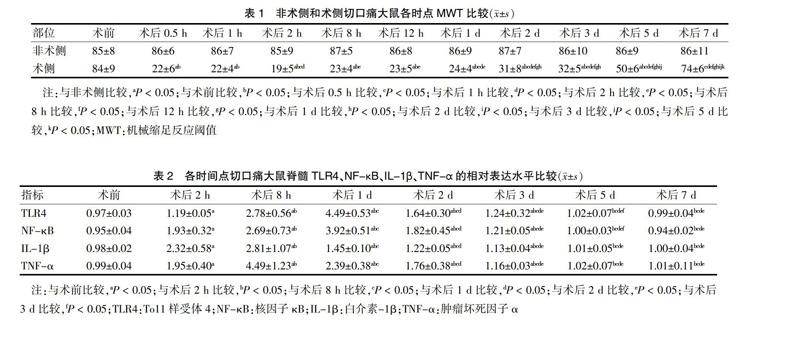
[摘要] 目的 探討脊髓Toll样受体4(TLR4)/核因子κB(NF-κB)信号通路在切口痛大鼠中的作用机制。 方法 选取20周龄的SD健康成年雄性SPF级大鼠100只,建立大鼠切口痛模型,于术前和术后0.5 h、1 h、2 h、8 h、12 h、1 d、2 d、3 d、5 d、7 d,采用电子von Frey压力测痛仪检测大鼠非术侧和术侧的机械缩足反应阈值(MWT);于术前和术后2 h、8 h、1 d、2 d、3 d、5 d和7 d采用实时荧光定量PCR(Real-time PCR)法检测脊髓TLR4、NF-κB、白介素1β、(IL-1β)、肿瘤坏死因子α(TNF-α)的表达水平。 结果 术后,大鼠术侧的MWT较术前降低,术后2 h时最低,之后逐渐升高,且显著低于非术侧(P < 0.05)。术后,大鼠脊髓TLR4、NF-κB、IL-1β、TNF-α的表达水平较术前升高,且术后2 h、8 h、1 d、2 d和3 d与术前比较差异有统计学意义(P < 0.05),术后5 d和7 d与术前比较差异无统计学意义(P > 0.05),术后1 d脊髓TLR4、NF-κB表达水平达到最高,术后8 h脊髓IL-1β、TNF-α表达水平达到最高。采用Pearson相关性分析结果显示,大鼠术侧MWT与TLR4和NF-κB表达水平呈负相关(r = -0.473,P < 0.05;r = -0.398,P < 0.05),大鼠脊髓TLR4与IL-1β和TNF-α表达水平呈正相关(r = 0.302,P < 0.05;r = 0.538,P < 0.05);大鼠脊髓NF-κB与IL-1β和TNF-α表达水平呈正相关(r = 0.283,P < 0.05;r = 0.467,P < 0.05)。 结论 切口痛大鼠脊髓TLR4/NF-κB信号通路被激活,TLR4、NF-κB表达水平升高,并上调下游炎性因子IL-1β、TNF-α的表达水平,参与切口痛的调控过程。
[关键词] Toll样受体4;核因子κB;切口痛;大鼠
[中图分类号] R619.6R [文献标识码] A [文章编号] 1673-7210(2018)02(a)-0023-04
Experimental study of TLR4/NF-κB signal pathway in the mechanism of incisional pain
LIU Dehua1 WANG Jian2 GAO Zhiqiang1 ZOU Liansheng1 XU Ying3
1.Deaprtment of Neurosurgery, First Affiliated Hospital of Gannan Medical University, Jiangxi Province, Ganzhou 341000, China; 2.Department of Pathology, Ganzhou People′s Hospital, Jiangxi Province, Ganzhou 341000, China; 3.Scientific Research Center, Gannan Medical University, Jiangxi Province, Ganzhou 341000, China
[Abstract] Objective To investigate the mechanism of Toll like receptor 4 (TLR4)/ nuclear factor κB (NF-κB) signal pathway in rats with incisional pain. Methods One hundred healthy adult male Sprague-Dawley (SD) SPF rats of 20 weeks old were selected to establish incision pain models. Before operation and after operation for 0.5 h, 1 h, 2 h, 8 h, 12 h, 1 d, 2 d, 3 d, 5 d, 7 d, the mechanism withdraw threshold (MWT) in non-operative side and operative side of rats were detected by electronic von Frey pressure pain threshold detector. Before operation and after operation for 2 h, 8 h, 1 d, 2 d, 3 d, 5 d and 7 d, the expression of TLR4, NF-κB, interleukin 1β (IL-1β) and tumor necrosis factor α (TNF-α) in the spinal cord were detected by real-time fluorescence quantitative PCR (real-time PCR). Results After operation, the MWT in the operative side of rats was lower than that before operation, which was the lowest after operation for 2 h, then increased gradually, and they were significantly lower than those of non-operative side (P < 0.05). After operation, the expression levels of TLR4, NF-κB, IL-1β and TNF-α in spinal cord of rats were increased compared with those before operation, which of postoperative 2 h, 8 h, 1 d, 2 d and 3 d had statistically significant differences compared with those before operation (P < 0.05), which of postoperative 5 d and 7 d had no statistically significant differences compared with those before operation (P > 0.05). The expression levels of TLR4 and NF-κB in the spinal cord reached the highest after operation for 1 d, and the expression levels of IL-1β and TNF-α reached the highest after operation for 8 h. Pearson correlation analysis showed that there was a negative correlation of MWT in operative side with the expression of TLR4 and NF-κB (r = -0.473, P < 0.05, r = -0.398; P < 0.05), the TLR4 levels in spinal cord of rats were positively correlated with the expression levels of IL-1β and TNF-α (r = 0.302, P < 0.05; r = 0.538, P < 0.05), and the NF-κB levels in spinal cord of rats were positively correlated with the expression levels of IL-1β and TNF-α (r = 0.283, P < 0.05; r = 0.467, P < 0.05). Conclusion The signal pathway of TLR4/NF-κB in spinal cord of rats with incisional pain is activated, the expression levels of TLR4 and NF-κB are increased, and the expression levels of downstream inflammatory cytokines IL-1β and TNF-α are up-regulated, which is involved in the regulation process of incisional pain.
[Key words] Toll like receptor 4; Nuclear factor κB; Incisional pain; Rat
术后疼痛指术后即刻发生的急性疼痛,严重影响患者的术后治疗及恢复[1]。免疫应答和炎性反应参与术后疼痛的发生和发展[2-3]。Toll样受体4(TLR4)属于Toll样受体家族,介导后天免疫和天然免疫[4]。核因子κB(NF-κB)是一种具有多向性转录激活功能的调节因子,参与调控机体炎性反应、免疫应答等多种生理过程[5]。白细胞介素1β(IL-1β)和肿瘤坏死因子α(TNF-α)作为重要的促炎细胞因子,能够诱发炎性反应[6-7]。本研究选取大鼠切口痛模型,探讨脊髓TLR4/NF-κB信号通路在切口痛大鼠中的作用机制。
1 材料与方法
1.1 实验动物
选取20周龄的Sprague-Dawley(SD)健康成年雄性SPF级大鼠100只,体重200~220 g,购于北京维通利华实验动物技术有限公司[合格证号:SCXK(京)2007-0001号]。实验前8 h禁食,自由饮水,室温(21±2)℃,湿度30%~70%,光照每昼夜12 h。实验全程严格按照国家有关实验动物的规定执行,经生物医学研究伦理委员中心批准。……