宫颈刮板和宫颈刷筛查宫颈癌的对比分析
2018-03-19陈秀华张敏杨青陈伟
陈秀华 张敏 杨青 陈伟
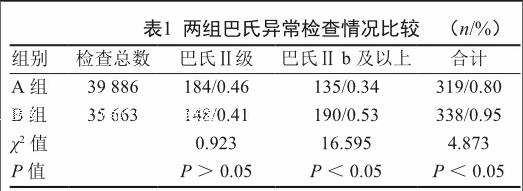

摘 要 目的:比較用宫颈刮板和用宫颈刷采集样品筛查宫颈癌的效果。方法:将2012年采用宫颈木制刮板采集宫颈脱落细胞的39 886例筛查妇女作为A组,将2013年采用宫颈刷采集宫颈脱落细胞的35 663例妇女作为B组。比较巴氏涂片异常检出率,对巴氏Ⅱb及以上患者进行阴道镜和病理学检查,比较两组宫颈癌前病变及宫颈癌的检出率。结果:B组巴氏异常的检出率为0.95%(338/35 663),明显高于A组的0.80%(319/39 886),差异有统计学意义(P<0.05);B组的巴氏Ⅱb及以上检出率为0.53%(190/35 663)也明显高于A组的0.34%(135/39 886),差异有统计学意义(P<0.05);对于巴氏Ⅱb及以上的患者进行阴道镜和病理检查,A组检查的符合率为77.7%(108/135),B组检查的符合率94.7%(180/190),差异有统计学意义(P<0.05)。B组宫颈癌前病变LSIL和HSIL的检出率为0.22%和0.19%,均明显高于A组的0.08%和0.13%,差异有统计学意义(P<0.05);B组宫颈低级别病变的占比(39.80%)高于A组(22.22%)差异有统计学意义(P<0.05)。结论:在宫颈癌筛查中使用宫颈刷采集宫颈脱落细胞筛查效果优于宫颈刮板。
关键词 宫颈癌;筛查;宫颈刷;宫颈刮板;宫颈脱落细胞
中图分类号:R737.33 文献标志码:A 文章编号:1006-1533(2018)04-0059-04
Comparative analysis of the effects of cervical scraper and cervical brush in screening for cervical cancer
CHEN Xiuhua, ZHANG Min, YANG Qing, CHEN Wei
(Maternal and Child Health Care Center of Songjiang District, Shanghai 201620, China)
ABSTRACT Objective: To compare the effects of cervical scraper and cervical brush to collect samples for screening cervical cancer. Methods: The Pap smear examination was performed to the collected female cervical exfoliative cells to compare the detection of cervical lesions and the early diagnosis. In 2012, 39 886 cases of cervical exfoliative cells collected by cervical wood scraper were screened as group A, and in 2013 35 663 women who used cervical brush to collect cervical exfoliative cells were treated as group B. With Pap smear abnormal detection rate, the patients with pasteurized II B and above were examined with the colposcopy and pathological examination. The detection rates of the two groups of cervical precancerous lesions and cervical cancer were compared. Results: The detection rate of pasteurized abnormality in group B was 0.95%(338/35 663), which was significantly higher than that in group A 0.80%(319/39 886), and the difference was statistically significant(P<0.05). The detection rate of Pasteur II B and above in group B was 0.53% (190/35 663), which was significantly higher than that in group A 0.34%(135/39 886), and the difference was statistically significant(P<0.05). Colposcopy and pathological examination were performed for patients with Pasteur II B or above. The coincidence rate of group A was 77.7%(108/135), that of group B was 94.7%(180/190), and the difference was statistically significant(P<0.05). The detection rates of LSIL and HSIL for cervical precancerous lesions in group B were 0.22% and 0.19%, which were significantly higher than those in group A 0.08% and 0.13%, and the difference was statistically significant(P<0.05). The proportion of low grade cervical lesions in group B accounted for 39.80%, which was higher than that in group A 22.22%, and the difference was statistically significant(P<0.05). Conclusion: The effect of collecting cervical exfoliative cells by cervical brush in screening cervical cancer is better than that by cervical wood scraper.
KEY WORDS cervical cancer; screening; cervical brush; cervical scraper; cervical exfoliative cell
我国每年宫颈癌新发病例约15万,占世界宫颈癌新发病例的总数的28.2%[1]。因此,怎样从众多的无自觉症状的妇女中筛查出潜在宫颈癌变的患者,使她们能得到早期正规的治疗,降低宫颈癌的发病率,是妇女保健工作者面前的一个重要课题。本文旨在比较不同宫颈脱落细胞采集工具筛查宫颈病变的效果。
1 材料与方法
1.1 一般资料
松江区妇保所普查队于2012年和2013年对辖区内15个街镇自愿参加妇女病普查的已婚妇女进行宫颈癌筛查。2012年采用宫颈木制刮板采集宫颈脱落细胞,2013年采用宫颈刷(细胞刷)采集宫颈脱落细胞。将2012年的受检者作为A组,共39 895人,年龄20~70岁,平均(54.62±8.97)岁;将2013年的受检者为B组,共35 674人,年龄20~70岁,平均(55.11±8.51)岁。两年参与采样、阅片、阴道镜检查和病理学检查的医生都相对固定。两组检查对象都是各乡镇退休、生活困难及公益岗位上的妇女,文化层次和经济条件相近。……