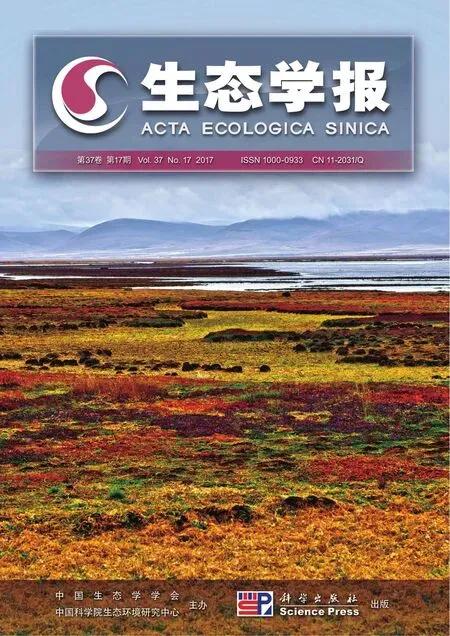
基于像元三分模型的锡林郭勒草原光合植被和非光合植被覆盖度估算
2017-10-13王光镇王静璞邹学勇王周龙
王光镇,王静璞,*, 邹学勇,王周龙,宗 敏
1 鲁东大学资源与环境工程学院, 烟台 264025 2 北京师范大学地表过程与资源生态国家重点实验室, 北京 100875
基于像元三分模型的锡林郭勒草原光合植被和非光合植被覆盖度估算
王光镇1,王静璞1,*, 邹学勇2,王周龙1,宗 敏1
1 鲁东大学资源与环境工程学院, 烟台 264025 2 北京师范大学地表过程与资源生态国家重点实验室, 北京 100875
定量的估算草原光合植被覆盖度(fPV)和非光合植被覆盖度(fNPV)对草原畜牧业和土地荒漠化具有重要的意义。以锡林郭勒盟西乌珠穆沁旗为研究区,以MODIS 500 m分辨率地表反射率产品MOD09GHK为数据源,采用干枯燃料指数(DFI)指数构建NDVI-DFI像元三分模型估算了锡林郭勒草原的fPV和fNPV,并分析了锡林郭勒草原fPV和fNPV的动态变化。研究结果表明:锡林郭勒草原NDVI-DFI特征空间表现为三角形,与理论上的概念模型基本一致,符合像元三分模型的基本假设;NDVI-DFI像元三分模型适用于对草原黄枯期NPV的监测,对草原生长期NPV监测并不十分敏感;利用NDVI-DFI像元三分模型估算的fPV和fNPV动态变化与牧草物候发育特征相吻合,可以有效的估算典型草原地区fPV和fNPV值,进一步将其应用于长时间序列的典型草原fPV和fNPV动态变化分析。
NDVI-DFI模型;光合植被;非光合植被;动态分析
Abstract: The quantitative estimation of fractional cover of photosynthetic vegetation (fPV), non-photosynthetic vegetation (fNPV), and bare soil (fBS) is critical for grassland animal husbandry and land desertification. Remote sensing is an important tool for estimating the fractional cover of vegetation as a key descriptor of grassland ecosystem function. Developing tools that allow for monitoring of vegetation in space and time is a key step needed to improve management of grassland. The present study describes a method for resolvingfPV,fNPV, andfBSin the Xilingol steppe region with MODIS-Terra daily surface reflectance data at 500 m resolution (MOD09GHK). Fractional cover offPV,fNPV, andfBSwas quantified with MOD09GHK data by calculating the Normalized Difference Vegetation Index (NDVI) and the Dead Fuel Index (DFI) and applying a linear unmixing technique. We concurrently analyzed the dynamic change of Xilingol typical grassland offPVandfNPV. Five MODIS images were acquired on April 5, May 30, July 31, August 21, and November 26 in 2014. The approach assumes that cover fractions are made up of a simple mixture of photosynthetic vegetation, non-photosynthetic vegetation, and bare soil. In the present study, one important assumption in our method is that the mixing of fractional cover in NDVI and DFI is linear. DFI is a four-band index that takes into account the differences in spectral features among DFI, photosynthetic vegetation, and bare soil in the VIS-NIR and SWIR wavelength regions, in which the slope of NPV from MODIS band 6 to 7 lies between those of photosynthetic vegetation and bare soil. The correlation between fraction of NPV and DFI was linear. Different end-member extraction methods, including the Pixel Purity Index (PPI) method and 2D scatter plot, were adopted to retrieve the end-member values of photosynthetic vegetation, non-photosynthetic vegetation, and bare soil from NDVI and DFI. The NDVI-DFI feature space follows a triangular distribution, where the vertices represent photosynthetic vegetation, non-photosynthetic vegetation, and bare soil, meeting the essential requirements of the linear unmixing model. NDVI and CAI were calculated for each image and the pixels located close to the vertices of the triangle were located. The spatial location of the pixels identified as pure by the PPI operation and located close to the vertices of the NDVI/DFI triangle was examined by using high resolution imagery (Landsat- 8 OLI). Subsequently, we found that vegetation fractional cover can be successfully resolved with MODIS data by combining the NDVI-DFI model. The NDVI-DFI model is suitable for dry season grassland period monitoring of NPV, whereas the grassland growing NPV monitoring is not very sensitive. Additionally, the temporal dynamic offPVandfNPVwas confirmed to be consistent with the phonological seasonal change in natural grasslands. The NDVI-DFI model can be applied to the quantitative estimation of fractional cover of non-photosynthetic vegetation (fNPV) that is critical for grassland desertification monitoring, soil erosion, and grassland grazing. Therefore, the NDVI-DFI model can be used to monitor the temporal and spatial variations offPVandfNPVin the Xilingol steppe regions.
KeyWords: NDVI-DFI model; photosynthetic vegetation (PV); non-photosynthetic vegetation (NPV); dynamic changes
草地是全球分布最广的陆地生态系统类型之一,占到全球陆地表面积的26%[1]。草地植被可以分为光合植被(PV)和非光合植被(NPV),PV和NPV在草原生态系统中扮演着重要的角色,影响着生态系统的碳储存、CO2交换量、植被生产力和地表能量平衡,是衡量地表植被覆盖状况的重要指标[2-3]。……