2008~2013年—2013年上海市售海产品中副溶血性弧菌污染的监测和毒力基因分析小结
2017-07-12田明胜彭少杰陈波厉曙光
田明胜+彭少杰+陈波+厉曙光

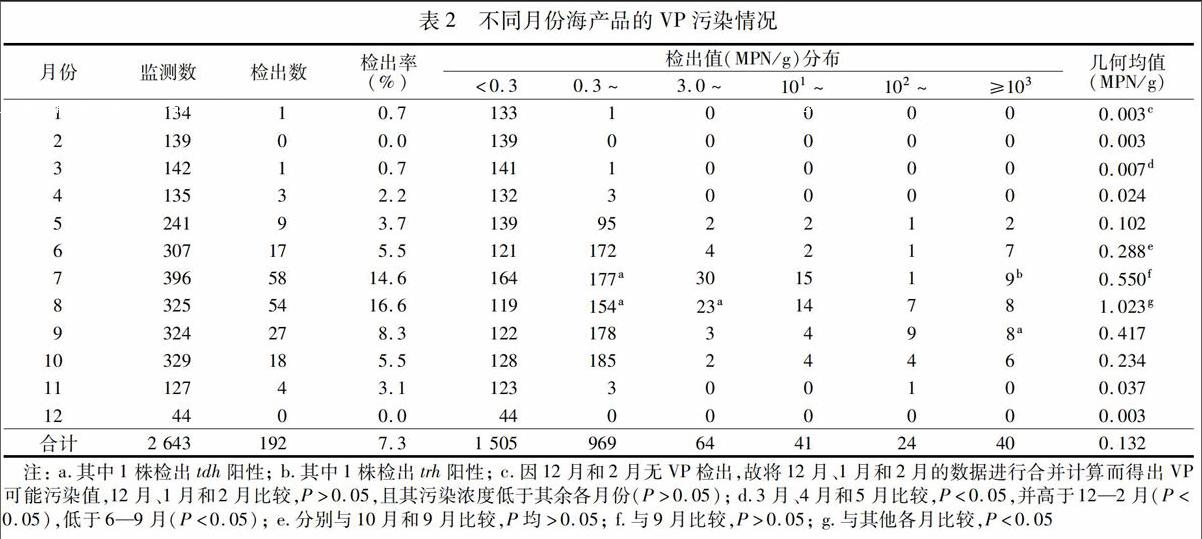

摘要: 目的了解上海市市售海产品中副溶血性弧菌的污染水平和特征。方法2008~2013年,采用GB/T 4789.7-2008《食品衛生微生物学检验副溶血性弧菌检验》方法,对上海市批发市场、集贸市场、卖场超市、餐饮环节和网购环节等污染物监测点采集的市售海产品进行副溶血性弧菌污染的定量检测,对副溶血性弧菌食品分离株采用PCR方法对其进行毒力基因耐热直接溶血素(tdh)、耐热直接溶血素相关溶血素(trh)的检测。结果 共监测市售海产品2643件,共在192件样品中检出副溶血性弧菌,总体检出率7.3%;2.6%(5/192)的菌株tdh或trh阳性,tdh和trh的携带率分别为2.1%(4/192)和0.5%(1/192)。不同监测月份、不同食品类别和不同采样地点的海产品,其副溶血性弧菌污染水平总体上存在差异( P<0.05)。其中6~10月份海产品副溶血性弧菌检出率和样品平均浓度显著高于其他月份(P<0.05);海产鱼类的副溶血性弧菌检出率(8.4%)和几何平均浓度(0.209 MPN/g) 显著高于其他种类海产品(P<0.05);批发市场、集贸市场和卖场超市采集海产品副溶血性弧菌浓度显著高于其他场所( P<0.05)。结论上海市售海产品中副溶血性弧菌在夏秋季节污染较高,部分食品分离株携带有tdh或trh基因,应继续开展海产品中副溶血性弧菌污染的风险监测和探索其环境影响因素,并针对副溶血性弧菌污染的高风险节点开展风险评估和管理。
关键词: 海产品; 副溶血性弧菌; 监测; 毒力基因
Analysis of contamination and virulence genes of Vibrio parahaemolyticusin seafoodsduring 2008~2013 in Shanghai markets
MingshengTiana,b,ShaojiePengb,Bo Chena,ShuguangLia*,
(a Department of Nutrition and Food Hygiene, School of Public Health, Fudan University, 130Dong An Road, Shanghai, China.b General Enforcement Team of Shanghai Food and Drug Administration, 615Liu Zhou Road, Shanghai, China.)
Abstract: ObjectiveTo investigate and characterize the contamination ofVibrio parahaemolyticus in seafoods inShanghai markets.MethodsBased on the method of GB /T 4789. 7-2008 Microbiological Examination of Food
Hygiene:Examination of V.parahaemolyticus,the contamination of V. parahaemolyticus in seafoods from
different predeterminedmonitoring sites in Shanghai was quantitatively determined and the occurrence of virulence genesthermostable direct hemolysin (tdh) and TDH-related hemolysin (trh), in 192 seafoodssepalatedVibrio parahaemolyticusstrains was detectedby PCR.ResultsA total of 2643 seafoodsamples from wholesale markets,retail markets,supermarkets,catering industries and online shoppingswere collected from January to December in the years of 2008 to 2013.V.parahaemolyticuswas found in 192 samples ( 7.3% ) .Among 192 separated strains, 2.6% (5/192) carry tdh or trh. 2.1%(4/192)were positive for tdh, and 0.5% (1/192) were positive for trh;The geometricmean densities of V. parahaemolyticuswere different significantly in varied seafoodsspecies,sampling monthes,as well aslocations( P<0. 05) .Especially,geometricmean densitiesof V.parahaemolyticusin June to October were significantly higher than those in othermonths ( P<0. 05) .the detection rate ( 8.4% ) andgeometricmean densities(0.209 MPN/g ) of V.parahaemolyticusin fishes was significantly higher than other seafoods( P<0. 05 ). The geometricmean densitiesof V.parahaemolyticus in seafoodsfrom wholesale markets,retail markets,supermarketswere higher than those from other sampling
resources ( P<0. 05).ConclusionThe contamination ofV.parahaemolyticus inseafoods during summer and fall was relatively high from Shanghai markets .some separated Vibrio parahaemolyticusstrains take virulence genestdh and trh. Thus the contamination of V.parahaemolyticus in seafoodsneeds to be intensively monitored and environmental impact factor should be searched for implementing risk assessment and management on high risk points for Vibrio parahaemolyticuscontamination.
Key words: Seafoods; Vibrio parahaemolyticus;Contaminant Monitoring; Virulence Genes
副溶血性弧菌( Vibrio parahaemolyticus,以下简称VP) 是一种重要的食源性致病菌,广泛存在于近海岸的海水、海底沉积物和海产品中,主要引起急性胃肠炎和原发性败血症。国家食源性疾病监测网1992~2001年的数据显示,VP食物中毒居微生物食源性疾病之首,占31.1%,中毒食品主要是海产品[1];2003~2007 年食源性疾病监测网报告的细菌性食源性疾病暴发资料中,由VP导致的中毒事件数报告数为308起,涉及发病人数8234人,分别占同期细菌性食源性疾病报告起数和人数的29.1%和25.5%[2];上海2000~2007 年期间报告的集体性食物中毒事件中由VP引起的起数和患者人数分别占同期起数和人数的57.4% 和56.0%[3]。
为了解上海市售海产品中VP的污染水平和毒力基因特征,2008-2013年对上海市售海产品的VP污染情况进行了连续监测。……
