小切口并美容缝合在人工全髋关节置换术的研究
2017-06-13叶义平马家富李耀辉刘凯顺郭俊辛
叶义平+马家富+李耀辉+刘凯顺+郭俊+辛彩虹+覃雪萍
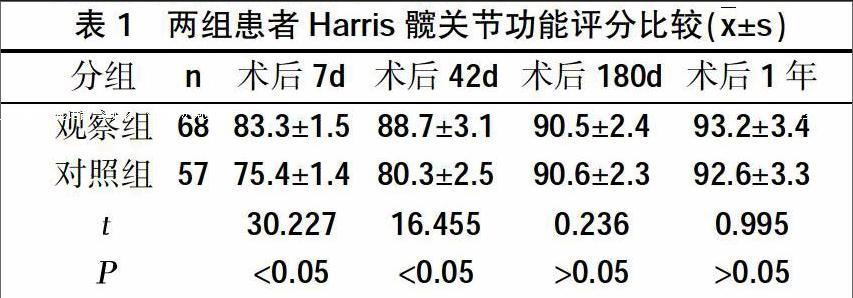
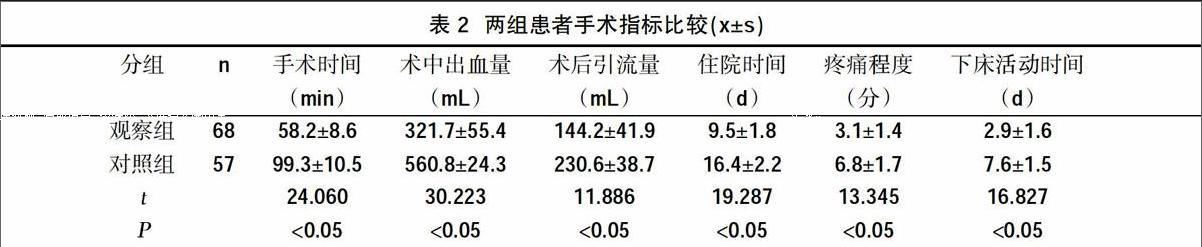
摘要:目的 探讨小切口并美容缝合在人工全髋关节置换术中的应用效果。方法 将2014年1月~2016年12月于我院行人工全髋关节置换术的患者125例作为研究对象,将患者分为对照组与观察组,前组在术中应用常规切口与丝线缝合,后组应用小切口并美容缝合,比较两组患者的临床效果。结果 观察组在切口长度、术中出血量、术后引流量、手术时间、住院时间、术后疼痛程度及下地活動时间等诸多临床指标均优于对照组(P<0.05);观察组术后7d、42d的Harris评分高于对照组(P<0.05)。结论 在人工全髋关节置换术中应用小切口并美容缝合,创伤小、术中出血量少、疼痛程度轻、手术切口美观、预后佳,深受患者认可,值得推广。
关键词:人工全髋关节置换术;小切口;微创;美容缝合
Study on Small Incision and Cosmetic Suture in Total Hip Arthroplasty
YE Yi-ping,MA Jia-fu,LI Yao-hui,LIU Kai-shun,GUO Jun,XIN Cai-hong,QIN Xue-ping
(Department of Lower Cerebral Surgery,Wuzhou Traditional Chinese Medicine Hospital,Wuzhou 543002,Guangxi,China)
Abstract:Objective To explore the clinical effect of small incision and suture in total hip arthroplasty.Methods In January 2014~2016 year in December in our hospital underwent total hip arthroplasty in 125 patients as the research object,the patients were divided into control group and observation group.The former group was treated with conventional incision and suture,the latter group was treated with small incision and cosmetic suture.The clinical effect of the two groups was compared.Results In the observation group,incision length,intraoperative bleeding,postoperative drainage,operative time, hospitalization time,postoperative pain and ambulation time and other clinical indicators are better than the control group(P<0.05);the patients in the observation group 7d,42d Harris score higher than the control group(P<0.05).Conclusion In total hip arthroplasty using small incision and suture, small trauma,less bleeding,light pain,incision appearance,good prognosis by recognition of patients,is worthy of promotion.
Key words:Artificial total hip arthroplasty;Small incision;Minimally invasive;Cosmetic suture
医学技术的突飞猛进,让人工全髋关节置换术逐渐在临床普及,尤其是小切口微创技术,近年来日趋完善与成熟[1]。小切口技术包括三种入路方式:正前方、前外侧以及后外侧,该技术是以熟练应用人工全髋关节置换术为前提,尽可能地使手术切口更小,以此来达到减轻患者痛苦、促进患者术后恢复以及术后切口美观的效果[2]。我院对行人工全髋关节置换术的患者采用小切口并美容缝合,现作出如下报告。
1资料与方法
1.1一般资料 本研究对象为2014年1月~2016年12月于我院行人工全髋关节置换术的患者125例,排除标准:①体质量指数(BMI)≥30 kg/m2的肥胖者;②髋臼发育不良、伴有严重的骨质疏松者;③糖尿病、合并严重心、肺、脑、肾功能障碍者;④有髋臼与股骨近段骨缺损、髋关节手术史需要植骨重建者[3]。将患者分为对照组与观察组,对照组57例,男性25例、女性32例;年龄45~73岁,平均年龄(57.2±6.8)岁;……
