宫颈癌螺旋断层和容积旋转调强治疗剂量学研究
2017-06-01潘林飞王彬冰单国平陈维
潘林飞+++王彬冰+++单国平+++陈维军+++杨双燕+++袁淑惠
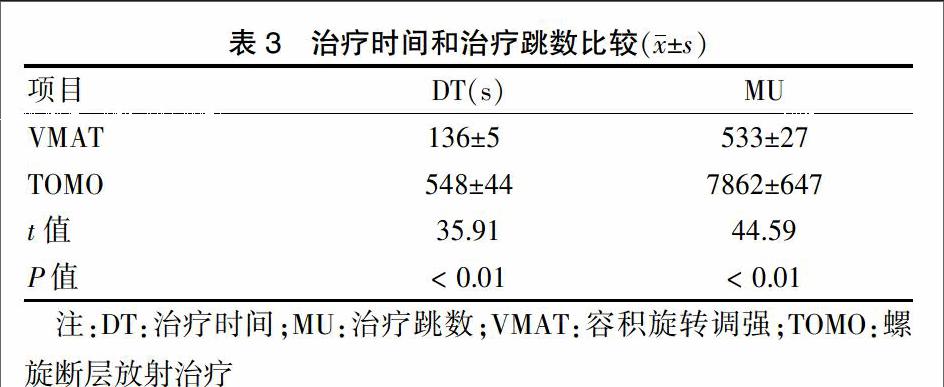
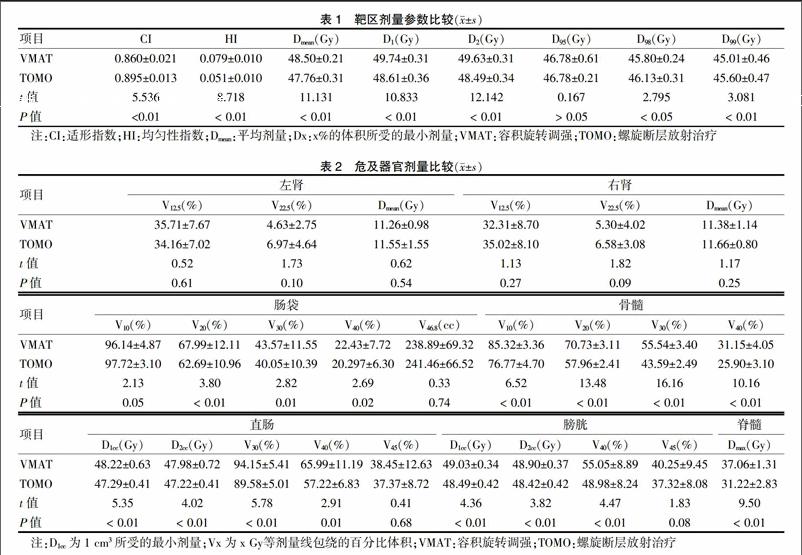
[摘要] 目的 评估螺旋断层放射治疗(TOMO)和容积旋转调强(VMAT)对于宫颈癌剂量学的影响。 方法 选取2015年5月~2016年2月在浙江省肿瘤医院治疗的20例宫颈癌患者,分别应用TOMO和VMAT两种照射技术,比较两种照射技术之间的靶区和危及器官之间的剂量学参数、有效治疗时间以及治疗跳数。 结果 应用TOMO治疗技术患者,肿瘤靶区的适形指数为(0.895±0.013),均匀性指数为(0.051±0.010),均优于应用VMAT[(0.860±0.021)、(0.079±0.010)](P < 0.01)。对于正常组织,TOMO同样具有剂量学优势,但是TOMO所需要的平均治疗时间为(548±44)s,远大于VMAT所需要的平均时间[(136±5)s](P < 0.01);同时,TOMO需要更多的治疗跳数(7862±647),而应用VMAT的平均治疗跳数为(533±27),差异有高度统计学意义(P < 0.01)。 结论 TOMO技术能获得更好的靶区适形性和均匀性以及对正常组织的保护,但是实施TOMO技术的有效治疗时间和治疗跳数多于VMAT技术。
[关键词] 宫颈癌;螺旋断层放射治疗;容积旋转调强;剂量学
[中图分类号] R737.31 [文献标识码] A [文章编号] 1673-7210(2017)04(b)-0095-04
[Abstract] Objective To investigate the influence of helical tomotherapy (TOMO) and volumetric modulated arc therapy (VMAT) on the dosimetry of cervical cancer. Methods Twenty cases of patients with cervical cancer treated in Zhejiang Cancer Hospital from May 2015 to February 2016 were selected, they were taken radiotherapy techniques of TOMO and VMAT respectively. The dosimetry parameters, effective deliver time and monitor unit of target region and organ at risk between two radiotherapy techniques were compared. Results For the patients applying TOMO technique, the conformity index was (0.895±0.013), homogeneity index was (0.051±0.010), which were all better than those applying VMAT [(0.860±0.021), (0.079±0.010)] (P < 0.01). For normal tissue, TOMO also has dosimetry advantage. However, the average delivery time of TOMO was (548±44) s, which was significantly longer than that of VMAT [(136±5) s] (P < 0.01); at the same time, TOMO needed more monitor unit (7862±647), while the average monitor unit of VMAT was (533±27), the difference was highly statistically significant (P < 0.01). Conclusion TOMO technique can obtain better conformity and homogeneity of target region and protection for the normal tissue, but the effective deliver time and monitor unit of performing TOMO are more than those of VMAT.
[Key words] Cervical cancer; Helical tomotherapy; Volumetric modulated arc therapy; Dosimetry
宮颈癌是现代妇女较为常见的恶性肿瘤,放射治疗是宫颈癌的主要治疗方式之一。随着技术的发展,放射治疗已经从固定射野调强放疗技术发展成旋转调强的照射方式,如容积旋转调强(volumetric modulated arc therapy,VMAT)、螺旋断层放射治疗(helical tomotherapy,TOMO)等[1-4]。与传统的固定野调强技术相比,弧形调强放射治疗技术使用的射野方向自由度高,从而更有利于保护正常组织受照剂量,同时也能保证肿瘤靶区产生较高的剂量适形度。TOMO和VMAT是两种不同的弧形调强放射治疗,由于两者的治疗技术实行方式不同,因此产生的剂量学结果存在差异。已有较多文献报道了两种放疗技术分别和固定野放疗技术剂量学的比较研究[5-7],但是对于TOMO和VMAT两者之间直接剂量学的比较较少,关于宫颈癌的文献仅有零星报道[8-9]。本研究比较和分析了20例宫颈癌患者TOMO和VMAT之间的剂量学差异以及治疗跳数(monitor unit,MU)和治疗时间(deliver time,DT)。
1 资料与方法
1.1 一般资料
