涤/棉平纹交织织物工艺参数设计及其性能研究
2017-05-30田伟姚怀祥
田伟 姚怀祥
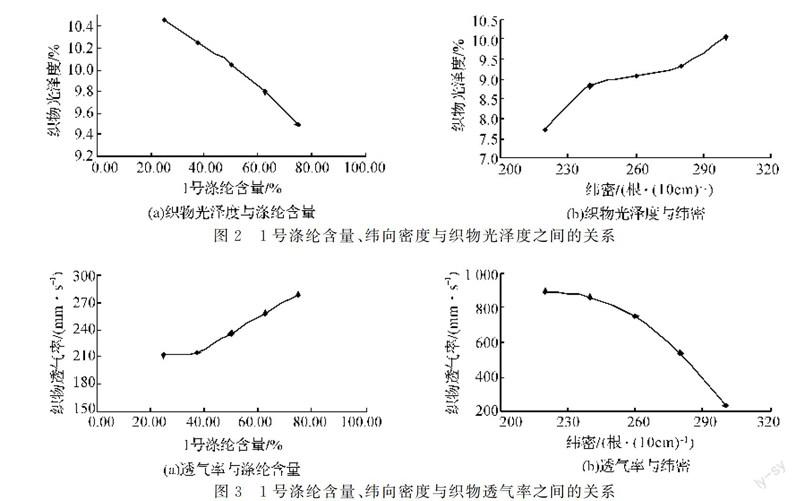
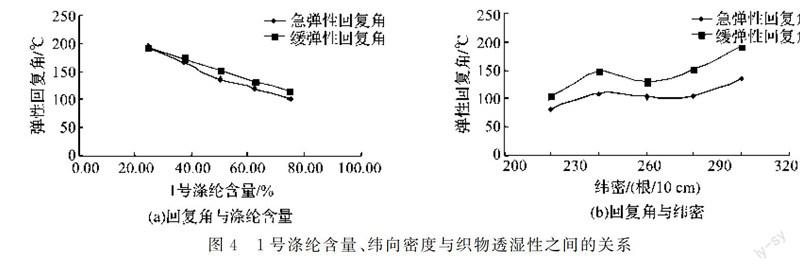
摘要:为了研究涤纶含量及织物纬向密度对涤/棉交织产品性能的影响,本文以棉纱为经纱,两种POY/FDY为纬纱,设计并制备了两组织物,并对其光泽度,透气性和折皱回复性进行了测试与分析。结果表明:当织物纬向密度一定时,织物光泽度随着1号涤纶含量的增加而减小,在9.5%~10.5%之间,织物透气率随着1号涤纶含量的增加而增加,在200~300 mm/s之间,织物弹性回复角随着1号涤纶含量的增加而降低,在100°~200°之间,使织物的弹性回复性趋于棉型织物且不失挺括;当1号涤纶含量一定时,织物光泽度随织物纬向密度的增加而增加,織物透气率随织物纬向密度的增加而降低,织物弹性回复角随织物纬向密度的增加而增加。
关键词:涤/棉;交织物;光泽度;透气性;折皱回复性
中图分类号:TS101.8
文献标志码:A
文章编号:1009-265X(2017)06-0054-04
Technological Parameter Design for Polymer/CottonInterwoven Fabric and Study on the Performance
TIAN Wei1, DING Yi1, YAO Huaixiang2
(1.National Engineering Lab for Textle Fiber Materials and Processing Technology(Zhejiang) ZhejiangSciTech University, Hangzhou, 310018; 2.Zhejiang Changxin Differential Fiber Co. Ltd., Jiaxing, 314001)
Abstract:In order to study the influence of polymer content and weft density on the performance of polymer/cotton interwoven fabric, two groups of fabrics were designed and woven by taking cotton yarn as the warp and two kinds of POY/FDY as the weft yarn. And the glossiness, air permeability and wrinkle recoverability of the fabrics were tested and analyzed. The results show that when the weft density is fixed, the glossiness decreases with the rise in the content of polymer I (9.5%~10.5%). The air permeability of the fabric increases with the rise in the content of polymer I (200~300 mm/s). The elastic recovery angle reduces with the rise in the content of polymer I (100~200°). The elastic recovery angle of the fabric tends to that of cotton fabric. When the content of polymer I is certain, the glossiness increases with the rise in the weft density; the air permeability decreases with the rise in the weft density; the elastic recovery angle increases with the rise in the weft density.
Key words:polymer/cotton; interwoven fabric; glossiness; air permeability; wrinkle recoverability
棉花是关乎国计民生的重要物资,是纺织工业的重要原料。棉织物具有优异的服用性能,作为传统的服装原料,棉织物受到消费者的广泛青睐。然而,中国纺织加工原料中棉纤维的供给严重不足,几乎每年都要从国外大量进口[1]。而聚酯以及聚酯纤维发展速度迅猛,整个产业附加值却较低、利润不高、同质化竞争严重。仿棉技术的研究在于克服聚酯纤维的共同缺点,融合棉的一些优良属性,最终实现产品的高品质和高附加值,同时又降低生产成本,实现利润的最大化,因而仿棉技术的公关和推广具有很大的市场空间,研究工作意义重大[2]。
国内聚酯仿棉产品的研发,主要在纺纱[3]、织造[4]、后整理[5]、纤维改性[6]4个环节,而产品性能研究相对缺失。……