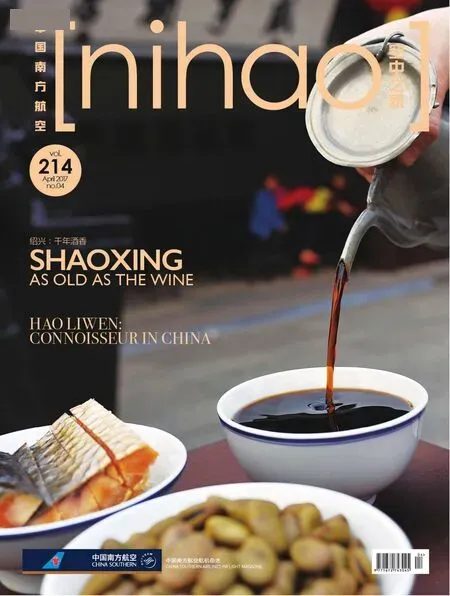
HAO LIWEN: CONNOISSEUR IN CHINA
2017-04-13ChenYuqiang,ChenHe,ZhengYing
HAO LIWEN: CONNOISSEUR IN CHINA
Connoisseur is what people call Hao Liwen. But strictly speaking, this occupation is not offlcially recognised as a job in China. For now, Hao’s job is wine taster, commenter and trainer.
Text by Chen Yuqiang Photos by Chen He Translation by Zheng Ying
March 10th, a little cold in Shanghai. In a winery in Changning District, Hao Liwen took a bottle of wine out of the rack originally from Burgundy, France. Hao cut the seal with a wine knife, took out the cork and held the bottom of the bottle, moving it closer to the glass. The bottle inclined gently, and the liquid, which was clean as ruby, flew into the glass.
Hao Liwen lifted the glass up, swished it gently, sniffed the joyful smell before taking a sip.“Elegant” was Hao's comment.
Connoisseur is what people call Hao Liwen. But strictly speaking, this occupation is not offlcially recognised by the country, and there is no professional certiflcate for this job. For now, Hao's job is wine taster, commenter and trainer, but people will normally call him just connoisseur. “I think connoisseur is like an epicure, there is no high criteria for this. As long as somebody loves wine and is able to analyse it rationally, that's enough. If someone could know deeper and get more fun from this, then they will open the door of the world of the wine.”
As a rare connoisseur in China with WSET 4 grad diploma, Hao Liwen tastes and comments on nearly 1000~2000 wines every year, rating and reviewing them. There's a saying that connoisseurs swallow no wine when they taste. This is verifled by Hao.
“It's wasteful to just spit so much good wine. The wine sent to be tasted should have been treasured. It's their best fate to be tasted.” Said Hao. But when he tastes about more than 100 kinds of wine everyday, to keep the taste bud pure, most are spat out. Tasting too much wine could even hurt the nose. So in order to balance the smell, Hao will smell the back skin of the hand to recover his smell.
郝利文:品酒师在中国
品酒师,是外界对郝利文的称呼。在葡萄酒圈,郝利文更为人熟知的名字是“胡子马丁”,那是他为自己取的化名。严格来说,国内并没有品酒师这一职业,郝利文的身份目前是葡萄酒品评人、讲师,但是大众媒体依然习惯称郝利文为品酒师。

In this circle, Hao is famous for “Beard Martin”, that's an alias he made for himself. However, he didn't have a chaotic beard when we met him. When Hao was little, he loved the hotel manager with the beard in the TV series Grand Hotel, and he thought that was cool and wanted one for himself. But he was not allowed by his parents when he was little, and later not allowed by his wife. The beard he wants is never on his face, but becomes his alias.
Just like the story about his alias, Hao has a temperament mixed by western and eastern cultures. When he appears, he is always dressed up, regardless of whether he holds a glass in his hand or not. It's also a Shanghai style, appropriate and decent. During the process of more than 10 years' research for wine chateaus, he comes back and forth between two kinds of cultures and absorbs the best parts from both.
Since the flrst time he had stepped into the industry and tasted his flrst sip in 2004, he travelled in Chateaus in France, Italy, Spain, Portugal, Chile and other countries in South America, and pilgrimed in the Holy Lands in the world of wine, such as Bordeaux and Burgundy. So many years' travel and taste makes Hao realise how broad is this world of wine. “Every place has its own culture and its own style of wine. The wine is also restricted by the region even in the same area, yet there can be something different in details. For example, in Burgundy, there are more than 600 different regions. When you taste carefully, every region is so different. For now I only know the rough traits of Burgundy, and iflwant to master all the differences of every area, it would take more than my whole life.”
After travelling to the chateaus of the old and new world, Hao Liwen found out surprisingly that there are also good quality chateaus in China, where the culture of wine has been popular for only a short time. In Helan Mt in Ningxia and Tian Mt in Xinjiang, the wine from these exquisite chateaus have been gradually recognised and approved. In the coming years, Hao will be engaged in making more people realise that there are also competitive wine products in China.
3月10日,上海微冷。
在长宁区的一家酒坊,郝利文从酒架上挑出一支来自法国勃艮第红葡萄酒。用酒刀小心割开瓶封,取出软木塞,郝利文手握瓶底,将酒瓶平稳靠近酒杯。瓶身轻轻倾斜,带着红宝石般透彻的琼浆流入酒杯。
郝利文端起酒杯,轻轻摇晃,欣赏散落在酒杯里的芬芳,随后稍稍饮下一口。“优雅。”郝利文评价道。
品酒师,是外界对郝利文的称呼。但严格来说,并没有品酒师这一国家认可的职业,品酒师也没有任何专业的证书认证。郝利文的职业目前是葡萄酒品评人、讲师,但是大众媒体依然习惯称郝利文为品酒师。“我觉得品酒师像美食家一样没有很高的门槛,只要一个人爱品酒并且能分析得有道理,这就足够了。如果他能了解更多,他将能获得更多的乐趣,也打开了葡萄酒世界的大门。”
作为国内为数不多、拥有WSET4级Diploma资质的讲师,郝利文每年要品鉴近一、两千支酒,并为这些酒打分、写评论。有一种说法,说品酒师工作时几乎不将试饮的葡萄酒喝下去。这一说法得到郝利文的证实。
“要将这么多的好酒吐掉,真的很浪费。能送来品赏的葡萄酒,理应被饮用者珍惜,被他们饮用是葡萄酒最好的宿命。……