莪术含药血清抑制HSCs中Shh和Gli1表达的机制研究
2017-04-06冯藜枥曹文富
冯藜枥+曹文富
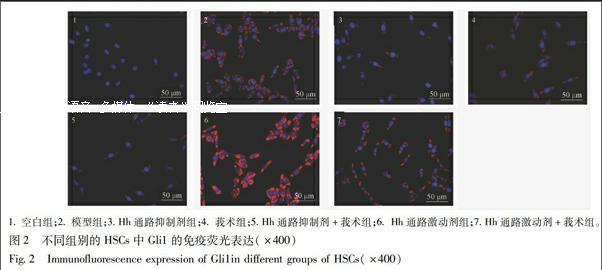
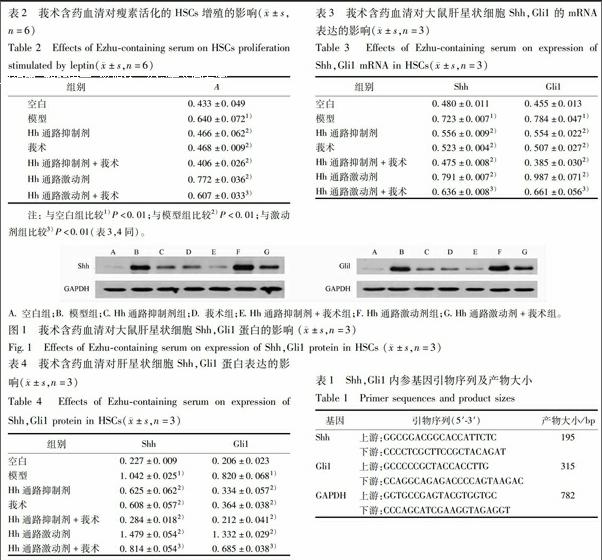
[摘要]研究莪術含药血清抑制活化的大鼠肝星状细胞(hepatic stellate cells,HSCs)中Hedgehog(Hh)信号通路关键因子Shh(sonic hedgehog),Gli1(glioma-associated oncogene homolog-1)表达的机制。清洁级SD大鼠均分2组,分别给予莪术水煎剂、生理盐水灌胃取血制备含药血清。体外培养大鼠HSCs,分为7组:空白组、模型组、Hh通路抑制剂组、莪术组、Hh通路抑制剂+莪术组、Hh通路激动剂组、Hh通路激动剂+莪术组。除空白组外,其余各组均给予100 μg·L-1瘦素诱导后,各组再予以相应药物干预24 h,经MTT法检测HSCs增殖情况,RT-PCR法检测Shh,Gli1的mRNA表达,Western blot法检测Shh,Gli1蛋白表达及免疫荧光法检测Gli1蛋白表达。经瘦素活化的大鼠HSCs中Shh,Gli1的mRNA和蛋白表达均显著上调(与空白组比较P<0.01)。Hh通路抑制剂、莪术含药血清分别干预后,Shh,Gli1的mRNA和蛋白表达显著下调(与模型组比较P<0.01);莪术含药血清与Hh通路抑制剂协同干预后,Shh,Gli1 mRNA和蛋白表达显著下调(与模型组比较P<0.01);Hh通路激动剂干预后,Shh,Gli1 mRNA和蛋白表达显著上调(与模型组比较P<0.01)。用莪术含药血清干预Hh通路激动剂组后,Shh,Gli1 mRNA和蛋白表达显著下调(与Hh通路激动剂组比较P<0.01)。莪术含药血清可通过抑制瘦素诱导活化的HSCs中Shh,Gli1的表达,参与Hh信号通路抑制HSCs的活化,发挥抗肝纤维化的作用。
[关键词] 莪术; 肝星状细胞; Shh; Gli1; Hedgehog信号通路; 肝纤维化
[Abstract] To explore the mechanism of Ezhu-containing serum in inhibiting the expression of sonic hedgehog(Shh) and glioma-associated oncogene homolog-1(Gli1) in hepatic stellate cells(HSCs) induced by leptin. Twenty sprague-dawley (SD) rats were randomly divided into 2 groups (N=10), and given Ezhu-decoction and physiological saline by gavage for 10 days to prepare drug-containing serums. The HSCs during the exponential growth phase were divided into 7 groups: blank control group, model group, hedgehog pathway inhibitor(cyclopamine) group, Ezhu group, Ezhu and cyclopamine group, hedgehog pathway agonost(pumorphamine) group, Ezhu and purmorphamine group. HSCs were cultured in vitro and induced with 100 μg·L-1 leptin(except for the blank control group), then treated separately with the corresponding drugs for 24 hours. After the cells were collected, HSCs proliferation was detected using MTT colorimetric assay; the expressions of Shh and Gli1 were determined by PT-PCR, Western blot and immunofluorescence, respectively. The expressions of Shh and Gli1 were significantly increased after the HSCs of rats were induced by leptin (compared with the blank control group, P<0.01). After being interfered with Hh pathway inhibitor (cyclopamine) and Ezhu-containing serum, the expressions of Shh and Gli1 were decreased significantly(compared with the model group, P<0.01). After Ezhu-containing serum was used to interfere the Hh pathway inhibitor group, the mRNA and protein expressions of Shh and Gli1 were decreased significantly(compared with the model group, P<0.01). After Ezhu-containing serum was used to interfere the purmorphamine group, the mRNA and protein expressions of Shh and Gli1 decreased significantly(compared with the purmorphamine group, P<0.01). Ezhu-containing serum plays an important role in inhibiting HSCs activation by taking part in hedgehog signaling pathway, so as to regulate the expression of Shh and Gli1 in leptin-induced HSCs and then inhibit liver fibrosis.
[Key words] Ezhu; hepatic stellate cell; sonic hedgehog; glioma-associated oncogene homolog-1; hedgehog signaling pathway; hepatic fibrosis
肝纤维化(hepatic fibrosis,HF)是肝组织慢性损伤后的修复反应,可进一步发展为肝硬化,甚至肝癌[1-2]。目前已经证实HF是可逆的[3],但肝硬化却不可逆。因此,阻断和逆转肝纤维化具有重要的意义。HF主要由细胞外基质(extracellular matrix,ECM)异常增多和降解不足引起。活化的肝星状细胞(hepatic stellate cell,HSCs)是ECM的主要来源,其过度增殖是肝纤维化形成的关键[4-5]。抑制HSCs活化增殖,可促进ECM降解,从而逆转肝纤维化[6-7]。因此,抑制HSCs活化增殖已成为目前抗肝纤维化的主要策略[8-9]。
研究表明,过度或持续激活的Hedgeheg(Hh)信号通路可促进HSCs的活化增殖,从而加速肝纤维化的进程,通过干预Hh信号通路抑制HSCs的活化增殖被认为是抗肝纤维化的潜在靶点[10-11]。目前临床上尚无明确有效的抗纤维化西药[12],因此开发具有Hh阻断效应的中药具有重要意义。莪术在临床中常被用于防治肝纤维化,但目前对于莪术抗肝纤维化的基础研究,报道尚少。……