右美托咪定联合表面麻醉在小儿支气管异物取出术中的应用
2017-01-03欧阳爱平刘诗文李
欧阳爱平++++++刘诗文++++++李优春++++++李莉++++++黄毅生++++++李以平++++++郭丽丽

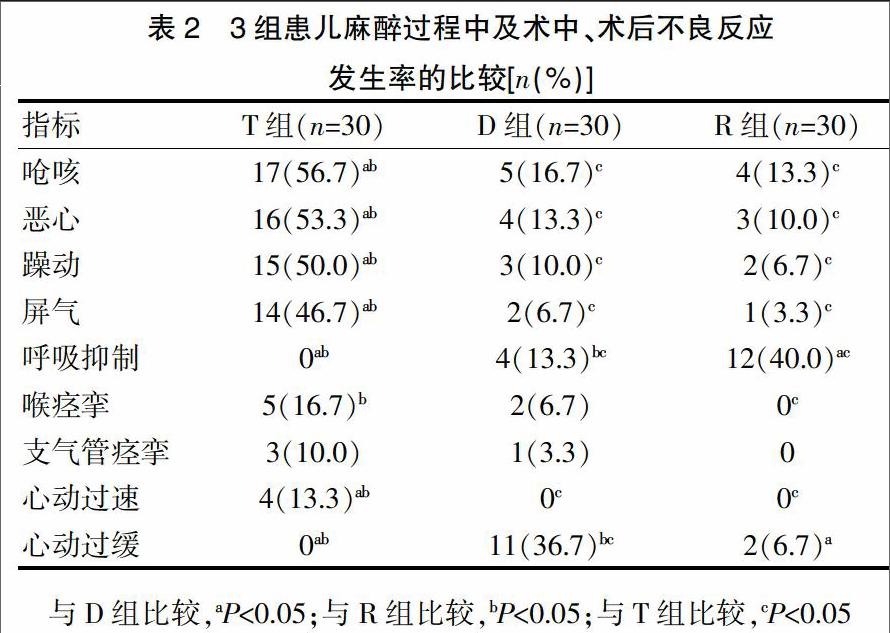
[摘要]目的 评价右美托咪定联合表面麻醉用于小儿支气管异物取出术的效果。方法 选取本院2015年1月~2016年8月接收的90例拟行硬质支气管镜检查术患儿,将其随机分为3组:右美托咪定+丙泊酚+表面麻醉组(D组)、单纯表面麻醉组(T组)、瑞芬太尼+丙泊酚+表面麻醉(R组),每组30例。所有患儿吸入七氟醚诱导后表面麻醉(利多卡因2 mg/kg)。D组持续静脉泵注丙泊酚0.15 mg/(kg·min)并静脉泵注右美托咪定4 μg/kg负荷剂量(10 min),继以4 μg/(kg·h)持继泵注直至手术结束,持续吸入七氟醚至手术开始前;R组持继静脉泵注丙泊酚0.10 mg/(kg·min)+瑞芬太尼0.1 μg/(kg·min)直至手术结束;T组于表面麻醉后持续面罩吸入七氟醚15 min。整个麻醉过程所有患者均保留自主呼吸。记录吸入麻醉前(T0),表面麻醉后15 min(T1),支气管镜置入后1 min(T2)、置入后5 min(T3)的心率(HR)、呼吸频率(RR)、脉搏氧饱和度(SpO2)、平均动脉压(MAP);观察记录麻醉用药后及支气管镜检过程中、手术后不良反应及麻醉处理等情况。结果 D组与T组、R组比较,HR、RR、MAP总体变化相对更稳定,SpO2不如T组稳定,但吸氧后可维持在可接受范围内;其恶心、呛咳、屏气、躁动、呼吸抑制、喉痉挛、支气管痉挛不良反应相对较少,易出现心动过缓,但可用阿托品预防纠正。结论 右美托咪定联合表面麻醉用于小儿支气管异物取出术时是一种安全可行的小儿支气管异物取出术麻醉方法。
[关键词]右美托咪定;小儿麻醉;硬质支气管镜检查术;气道异物;瑞芬太尼;丙泊酚
[中图分类号] R726.5 [文献标识码] A [文章编号] 1674-4721(2016)10(b)-0097-04
[Abstract]Objective To evaluate the effect of Dexmedetomidine combined with topical anesthesia used for airway foreign body removal in children.Methods Ninety pediatric patients undergoing rigid bronchoscopy examination received by our hospital from January 2015 to August 2016 were selected and randomly divided into three groups:Dexmedetomidine+Propofol+topical anesthesia group (group D),simple topical anesthesia group (group T) and Remifentanil+Propofol+topical anesthesia group (group R),and there were 30 cases in each group.All patients inhaled Sevoflurane for anesthesia induction and then given topical anesthesia (Lidocaine of 2 mg/kg).In group D,Propofol of 0.15 mg/(kg·min) for continuous intravenous infusion and Dexmedetomidine of 4 μg/(kg·h) for intravenous infusion for loading dose,and then 4 μg (kg·min) were continuously infusion until the end of surgery,the patients inhaled Sevoflurane until before surgery.In group R,Propofol of 0.10 mg/(kg·min) for intravenous infusion and Remifentanil of 0.1 μg/(kg·min) were administered until the end of surgery.In group T,the patients given Sevoflurane for continuous mask inhalation for 15 minutes.In the whole process of anesthesia,all patients kept their own breathin.HR,RR,SpO2,MAP were recorded at four time point:before inhalation anesthesia (T0),at 15 min after topical anesthesia (T1),at 1 and 5 min after inserting bronchoscope (T2,T3).Adverse reaction after anesthesia,in the process of bronchoscopy and after operation,and anesthesia handle and so on. Results Compared with group R and T,HR,RR and MAP was more stable in group D,SpO2 is not as stable as group T,but it could be acceptable level after inhaling of oxygen.Compared with group R and T,the complications such as nausea,cough,holding breath,respiratory depression,laryngospasm,bronchospasm and restlessness throughout the procedure was less in group D.The occurrence rate of bradycardia is higher in group D,but it can be prevention and treatment by Atropine injection.Conclusion Dexmedetomidine combined with topical anesthesia used for airway foreign body removal in children is a safe and feasible method.
[Key words] Dexmedetomidine;Pediatric anesthesia;Rigid bronchoscopy;Airway foreign body;Remifentanil;Propofol
支气管镜有……
