Clinical analysis of fetal malformation
2016-11-24,,,
, , ,
(Department of Ultrasonography, Chongqing Health Center forWomen and Children, Chongqing 400013, China)
Clinical analysis of fetal malformation
YANGZhengchun,RANSuzhen,TANLifang,SHENJie*
(DepartmentofUltrasonography,ChongqingHealthCenterforWomenandChildren,Chongqing400013,China)
Objective To investigate the etiology, incidence, classification and teratogenic risk factors of fetal malformation, and provide a theoretical basis for effective intervention. Methods Clinical data of 1 467 fetuses with malformations in our hospital were collected, and fetal malformations and teratogenic risk factors were analyzed retrospectively. Results Totally 31 500 fetuses were examined, and 1 467 fetuses were diagnosed fetal congenital malformations (1 787 fetal malformation in total). The incidence of fetal malformation was 4.66% (1 467/31 500). Malformation incidence of age <20 years or ≥35 years old of pregnant women were higher than the pregnant women aged 20—<35 years (bothP<0.05). The average age of pregnant women of infant deformity was higher than pregnant women of normal fetuses (P<0.05). The most common abnormality were heart and skeletal deformities (constituent ratio respectively was 20.76% and 9.84%). Early pregnancy colds, fever, medication, high-risk work were the major risk factor for fetal malformations. Conclusion Strengthen preconception and prenatal care for pregnant women, early detection of fetal malformations, early termination of severe fetal deformity pregnancy, can improve the quality of the birth of the fetus.
Fetus; Abnormalities; Risk factors;Intervention
胎儿先天畸形又称出生缺陷,是指胚胎或胎儿在发育过程中,由于各种内外因素的影响导致胎儿形态结构或功能发生异常[1]。胎儿先天畸形是围产儿死亡的主要原因[2]。导致胎儿出生缺陷的因素较多,如遗传、环境、饮食、药物、病毒感染等[3]。随着产前超声技术的发展,大部分胎儿畸形可通过产前超声诊断发现,并尽早对严重及多发畸形胎儿的出生加以干预。本研究重点回顾性分析31 500胎接受产前超声检查的胎儿中1 467胎畸形胎儿(共1 787处畸形)的临床资料,旨在探讨胎儿畸形的种类分布及发生的危险因素,以最大限度降低畸形胎儿的出生率,达到优生目的。
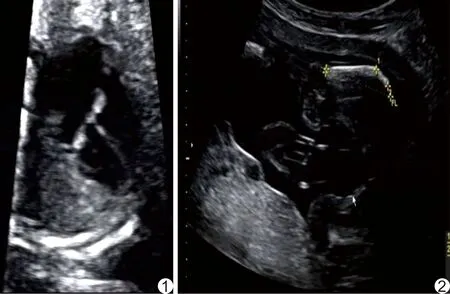
图1 胎儿单心房畸形声像图 图2 胎儿一侧股骨弯曲声像图
1 资料与方法
1.1一般资料 回顾性分析2014年1月—12月于我院接受产前超声检查的31 500胎资料,孕妇年龄16~51岁,平均(27.3±13.3)岁。其中1 467胎确诊为畸形胎儿,共1 787处畸形,孕妇年龄16~48岁,平均(28.6±12.6)岁;余30 033胎为正常胎儿,孕妇年龄16~51岁,平均(26.4±13.6)岁。
超声诊断胎儿畸形后,记录相关信息(孕妇姓名、年龄、职业、病史、孕产情况、超声诊断、诊室、检查医师)并交归本科室随访小组进行随访(对引产胎儿进行拍照及尸体解剖;对未放弃妊娠的孕妇于生产后进一步检查)加以证实。
1.3统计学分析 采用SPSS 16.0统计分析软件,计数资料的比较采用χ2检验,以P<0.05为差异有统计学意义。
2 结果
本组胎儿畸形发生率为4.66%(1 467/31 500)。1 467胎畸形胎儿中,本院诊断畸形1 155胎,外院转诊畸形312胎;单系统畸形1 198胎,2个系统存在畸218胎,3个系统存在畸形51胎;共计1 787处畸形。
2.1不同孕妇年龄胎儿畸形发生率对比 孕妇年龄<20岁胎儿畸形发生率5.46%(55/1 007),孕妇年龄20~<35岁胎儿畸形发生率3.12%(1 159/25 991),孕妇年龄≥35岁胎儿畸形发生率5.62%(253/4 502)。孕妇年龄<20岁、≥35岁均与孕妇年龄20~<35岁胎儿畸形发生率差异有统计学意义(P均<0.05);孕妇年龄<20岁与≥35岁胎儿畸形发生率差异无统计学意义(P>0.05)。……
猜你喜欢
杂志排行
中国介入影像与治疗学的其它文章
- Comparative analysis of ultrasonographic and pathologic findings of uterine lipoleiomyoma
- Ultrasound-guided histology biopsy in diagnosis of benign and malignant thyroid nodules: Meta analysis
- MRI findings of cerebral autosomal dominant arteriopathy with subcortical infarcts and leucoencephalopathy
- Application of Orem self-care theory on nursing for patients with hepatocellular carcinoma after transcatheter arterial chemoembolization
- Application of transjugular intrahepatic portosystemic stent shunt combined with chemotherapy in treatment of hepatocellular carcinoma with portal vein tumor thrombosis
- Preparation and characteristic comparison of two phase-transition multifunctional nanoparticles