硬膜外麻醉下剖宫产产妇应用
2016-11-19刘淑香李国芳苏江涛等
刘淑香 李国芳 苏江涛 等
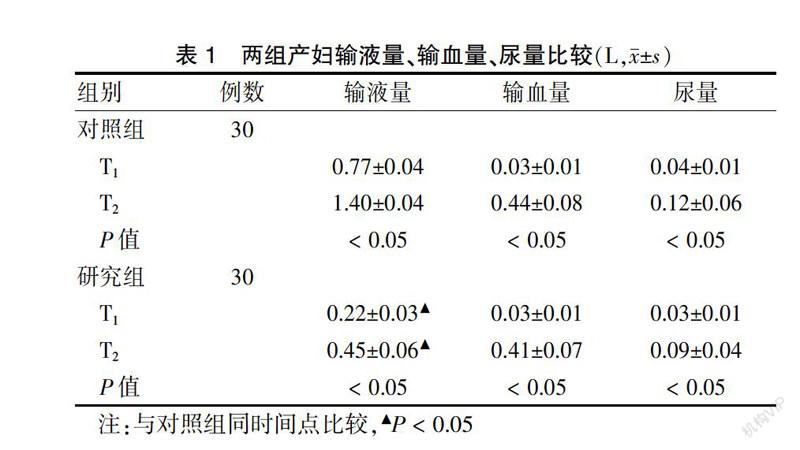
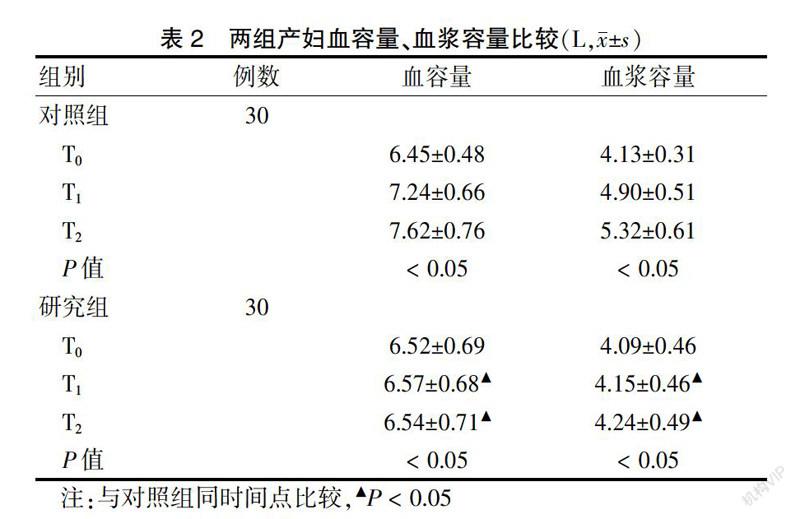
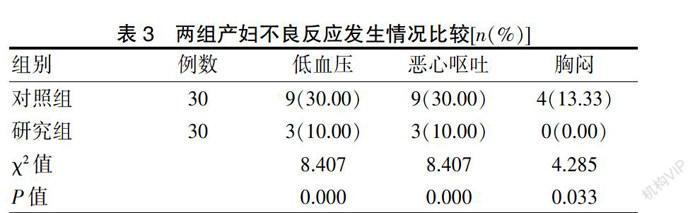
[摘要] 目的 研究硬膜外麻醉下剖宮产产妇应用小剂量去氧肾上腺素对产妇容量的影响。 方法 选取2014年1月~2015年1月石家庄市第四医院生产时出现低血压的60例ASAⅠ~Ⅱ级足月妊娠产妇为研究对象,将所有患者按照随机数字表法分为对照组和研究组,每组各30例。对照组产妇在发生低血压时给予6 mg盐酸麻黄碱注射液至手术结束,研究组产妇在血压连续两次测得下降时给予研究组产妇稀释后浓度为20 μg/mL的去氧肾上腺素150 μg,泵入速度6 μg/(kg·h),并根据产妇心率指标随时适当调节,手术结束前20 min结束输注。比较两组产妇不同时间点[入室(T0)、切子宫时(T1)、手术结束时(T2)]输液量、输血量、尿量、血容量、血浆容量以及不良反应发生情况。 结果 研究组30例产妇在T1、T2时点输液量分别为(0.22±0.03)、(0.45±0.06)L,明显低于对照组[(0.77±0.04)、(1.40±0.04)L],差异有统计学意义(P < 0.05),各指标不同时间点组内比较,差异有统计学意义(P < 0.05);研究组产妇血容量及血浆容量在T1时点分别为(6.57±0.68)、(4.15±0.46)L,在T2时点分别为(6.54±0.71)、(4.24±0.49)L,均明显低于对照组产妇[(7.24±0.66)、(4.90±0.51)、(7.62±0.76)、(5.32±0.61)L],差异有统计学意义(P < 0.05),血容量及血浆容量不同时间点组内比较,差异有统计学意义(P < 0.05);研究组产妇低血压、恶心呕吐、胸闷发生率分别为10.00%、10.00%、0.00%,对照组产妇发生率分别为30.00%、30.00%、13.33%,研究组明显低于对照组,差异有统计学意义(P < 0.05或P < 0.01)。 结论 硬膜外麻醉下剖宫产产妇应用小剂量去氧肾上腺素,可以有效维持产妇容量的稳定,降低产妇低血压、恶心呕吐和胸闷的发生率。
[关键词] 硬膜外麻醉;剖宫产;去氧肾上腺素;胶体液
[中图分类号] R714.3 [文献标识码] A [文章编号] 1673-7210(2016)02(a)-0081-04
Effect of low-dose of phenylephrine on maternal capacity of cesarean section under epidural anesthesia
LIU Shuxiang1 LI Guofang1 SU Jiangtao1 SHAO Xian1 XU Hong2 AN Li3▲
1.Department of Anesthesiology, the Fourth Hospital of Shijiazhuang, Hebei Province, Shijiazhuang 050010, China; 2.Department of Laboratory Medicine, the Fourth Hospital of Shijiazhuang, Shijiazhuang 050010, China; 3.Department of Anesthesiology, Shijiazhuang Hospital of TCM, Hebei Province, Shijiazhuang 050010, China
[Abstracts] Objective To study the effect of low-dose of phenylephrine on maternal capacity of cesarean section under epidural anesthesia. Methods 60 cases of grade ASAⅠ-Ⅱ term pregnancy women in the Fourth Hospital of Shijiazhuang from January 2014 to January 2015 were selected, all patients were divided into control group and study group in according to random number table, with 30 patients in each group. Control group was given 6 mg ephedrine hydrochloride injection in the event of hypotension to the end of surgery; study group was given 20 μg/mL of Phenylephrine after dilution when maternal blood pressure measured decreased twice continuously, pump rate 6 μg/(kg·h), and adjusted the rate by the maternal heart rate indicator, ended the infusion before 20 minutes of the end of surgery. Transfusion, blood transfusion, urine, blood volume and plasma volume of two groups at different time points [entrance time (T0), cutting the uterus (T1), the end of surgery (T2)] were compared. Results The fluid volume and of study group were (0.22±0.03), (0.45±0.06) L respectedly at T1 and T2, these were significantly lower than those of the control group [(0.77±0.04), (1.40±0.04) L], the differences were statistically significant (P < 0.05), indicators at different time points in each group were compared, the differences were statistically significant (P < 0.05); blood volume and plasma volume of study group were (6.57±0.68), (4.15±0.46) L respectively at T1, and (6.54±0.71), (4.24±0.49) respectively at T2, these were significantly lower than those of the control group [(7.24±0.66), (4.90±0.51), (7.62±0.76), (5.32±0.61) L], the differences were statistically significant (P < 0.05), the blood volume and plasma volume in each group at different time points were compared, the differences were statistically significant (P < 0.05); the rates of hypotension, nausea and vomiting, chest tightness of study group were 10.00%, 10.00%, 0.00% respectedly, and these of the control group was 30.00%, 30.00%, 13.33%, these of study group were significantly lower than thoses of the control group, the differences were statistically significant (P < 0.05 or P < 0.01). Conclusion Applying low-dose phenylephrine in cesarean section under epidural can reduce the degree of increase in maternal blood volume and plasma volume, reduce the incidence of maternal hypotension, nausea, vomiting and chest tightness.
[Key words] Epidural anesthesia; Caesarean section; Phenylephrine; Colloid
近年来,硬膜外麻醉已被广泛应用于下肢手术中,因硬膜外麻醉对新生儿的影响力较小,同时成为剖宫产手术中常用的麻醉方式[1-2]。但是硬膜外麻醉因其低血压的概率较高,虽然目前临床上普遍使用胶体液或者麻黄碱来尽量避免产妇出现低血压,但使用胶体液会明显增加产妇的循环血量,而麻黄碱会增加产妇心肌氧耗甚至导致胎儿发生酸血症[3-4]。近年来,去氧肾上腺素(phenylephrine)被证实在提升血压并降低患者恶心呕吐方面具有明显优势,且可以防止新生儿出现酸中毒[5]。……