中国重庆大足石刻:对一个世界遗产地保护问题的个人经历和严格评估
2016-07-12ERNESTOBorrelli国际文物保护与修复研究中心罗马意大利
ERNESTO Borrelli(国际文物保护与修复研究中心,罗马 意大利)
中国重庆大足石刻:对一个世界遗产地保护问题的个人经历和严格评估
ERNESTO Borrelli
(国际文物保护与修复研究中心,罗马 意大利)
摘 要:大足石刻位于重庆市,是一处具有重要宗教及历史价值的世界遗产地。大足石刻同云冈石窟、龙门石窟一起构成了中国特有的、表现形式极为丰富的文化形式之一,但同时也是保护上最具挑战的文化遗产之一。文章对该遗产地的问题提供了严格的评估,从现状维护、科技研究、环境及地质几个角度回顾大足石刻过去、现今的保护措施。文章的特点是科学的,但更是一位西方观察者、保护者面对中国文化遗产时所经历的一个专业的、令人着迷的经历的故事。
本文在参考《中国日记》的基础上做了进一步调查,该书的著者切萨雷·布兰迪曾写作闻名世界的《文物修复理论》,并于1939年创立了意大利文化遗产保护修复协会。
关键词:中国;大足石刻;保护;世界遗产地
1 Introduction
The first time I became aware of these enormous Buddhist statues carved out of the rock was while reading the description by the art historian Cesare Brandi1 who,after visiting several of themost important Chinese cultural sites at the invitation of theministry of Culture of the People's Republic of China in the 1980s,included an interesting chapter in his publication“The Chinese Diary”①Cesare Brandi(1906—1988)founded and directed the Istituto Centrale per il Restauro(1939—1961).on the Yungang Grottoes.Unfortunately I had not had the opportunity of visiting the Yungang Grottoes that Brandi describes as being“ofmysterious solemnity”but after reading his diary when I first joined the Institute Istituto Centrale per il Restauro in Rome,I would never have imagined that years later,first in 2006 and subsequently in 2008(under the auspices of the Italianministry of Foreign Affairs),I would be invited to China to collaborate on a project to set up a“Stonemonuments Conservation Centre”at the sites of Longmen on the banks of the River Yi to the south of the ancient capital of Luoyang in Henan Province,and at Dazu in Sichuan province(Chongqingmunicipality):two sites on the World Heritage List whosemajestic rock carvings are as impressive as those of the Yungang Grottoes②Zhou Hua,(2013),“Evaluation of surface cleaning technology for Yun gang Grottos”,in Science ofConservation and Archaeology,Vol.25,March,Shanghai.near the city of Datong in the province of Shanxi.
I had already been to China twice,but in both cases it involved a brief stop in Beijing,in transit,however it was sufficiently long enough to instil inme the desire to return in the not too distant future.My journeys to China now number almost ten,for relatively long periods and to different areas,but with every departuremy feelings always remain constant:“……and yet this life touches your heart:you will remember it forever,you will have lived outside your time in your time,as if it were an enclave,almost like in a setting for a film,and instead it has been your real life”③Brandi C.,op.cit.,pag.5..
I find that these words that Cesare Brandi wrote in his diary,reflectmore than anythingmymemories of“Chinese journeys”.
2 The site
I arrived at Dazu in the spring of 2006 by virtue ofmy experience in the conservation of ancientmonumental works.Before leaving I had acquired some historical data from various publications on China and from the appropriate WHC(Word Heritage Center-UNESCO)web page,having only vague and limited notions of Taoist and Buddhist doctrine and their representations,and likewise of Confucianism:diverse religious sentiments and spirituality that I was able to become acquainted with(later and never enough),literally exploring those immensemajestic carved rock walls.
On arriving at Dazu,we were received by the local authorities and Chinese experts in conservation of cultural heritage with great ceremony.At the entrance to the Artmuseum of Dazu Rock Carving,we were pleasantly surprised to find a banner welcoming the Italian and Chinese experts for the project to set up the Dazu Stonemonument Conservation Center.There we were immediately invited to an introductorymeeting in which the terms for the Italy-China cooperation programme were clarified for the establishment of a centre aimed at performing actions to safeguard the site through a continuing process of scientific studies,and conservation and restoration works.
In order to better understand what was being discussed we were taken on a guidedtour inside the site and introduced to the history and significance of the rock carvings with a wealth of detail and explanations.My amazement at themagnificence of those carvings accompaniedme for the entire visit.How can one not remain astonished when confronted with the figures of the“nine protectors of the law”(Fig.1)Dharmapalas or that of the“Sleeping Buddha”(Fig.2).
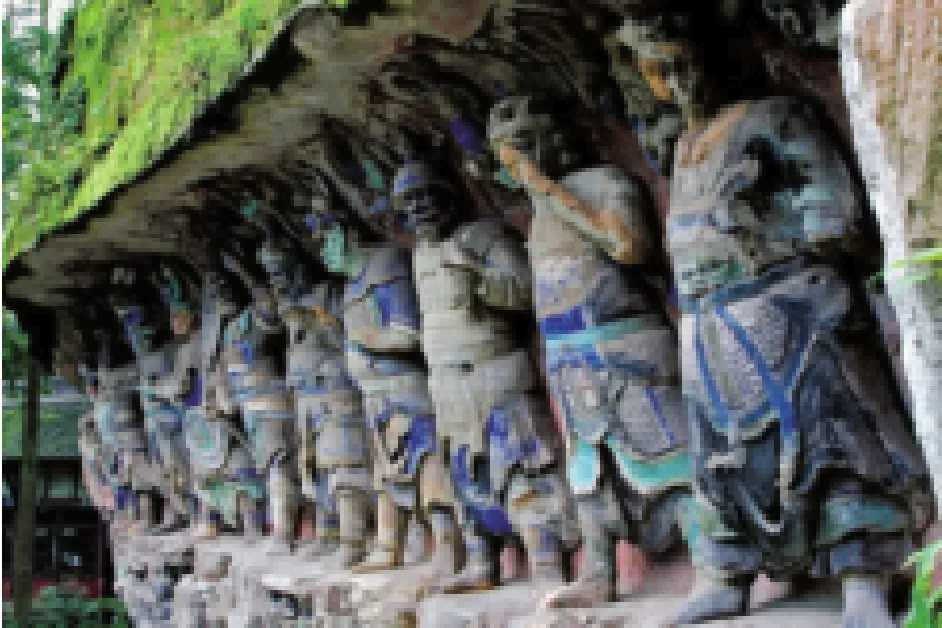
Fig.1 Dharmaplas

Fig.2 Sleeping Buddha
How can one not be surprised to find somany similarities with our culture such as the allegorical representations of“filial piety”or even“parental love”,but the image that leftme truly astounded was the one that I beheld in the presence of the goddess Guanyin,(Fig.3 and Fig.4)the divinity with the thousand golden hands outstretched to receive the requests of devotees④Dazu Rock Carvings of China(1991),Dazu Rock Carvingsmuseum in Chongqing,Publisher Wan Li Book Co..
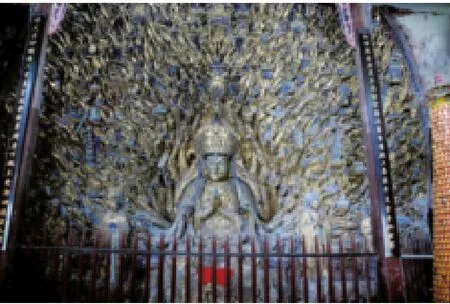
Fig.3 The guanyin
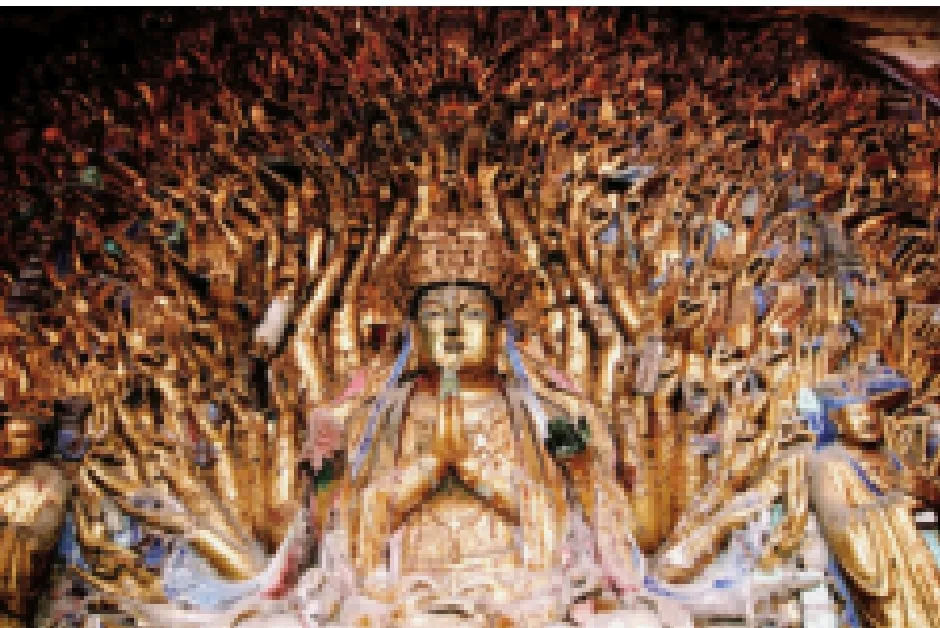
Fig.4 Detail of The guanyin
Obviously on that particular site the planning of a highly scientific specialist centre,such as the one we had been asked to contribute towards,could not have any other objective than that of setting up a whole series of studies and activities aimed at recovering and safeguarding themagnificent sculpted heritage that we encounter along the rock walls of the Dazu site.
3 Conservation Problems
At the time ofmy visit,however,my astonishment was accompanied by serious concerns regarding the evident signs of alteration and deterioration clearly visible onmany sculpted surfaces.
My task on that occasion involved the provision of technical expertise for the setting up of a scientific restoration laboratory,but clearly this assignment would also have to be based on other considerations linked strictly to the general context of the site and its conservation and environmental conditions.It was,in fact,necessary to take note of every visible conservation problem,though only from a simple visual inspection.In this way I was able to ascertain at close quarters,the problem of the swelling and loss of the gold leaf on the hands of the Guanyin(but generally onmost of the golden surface).Other forms of deterioration weremore easily evident to the naked eye:the growth of calcareous concretions;the loss of substantial pieces of the carvings(as on the faces of some of the nine Dharmapalas Fig.5);the loss of polychrome layers;the formation of salt efflorescences(Fig.6),particularly in the area of the Sleeping Buddha;or the evident biological growth over the extensive damp surfaces as well as a widespread presence of vegetation.
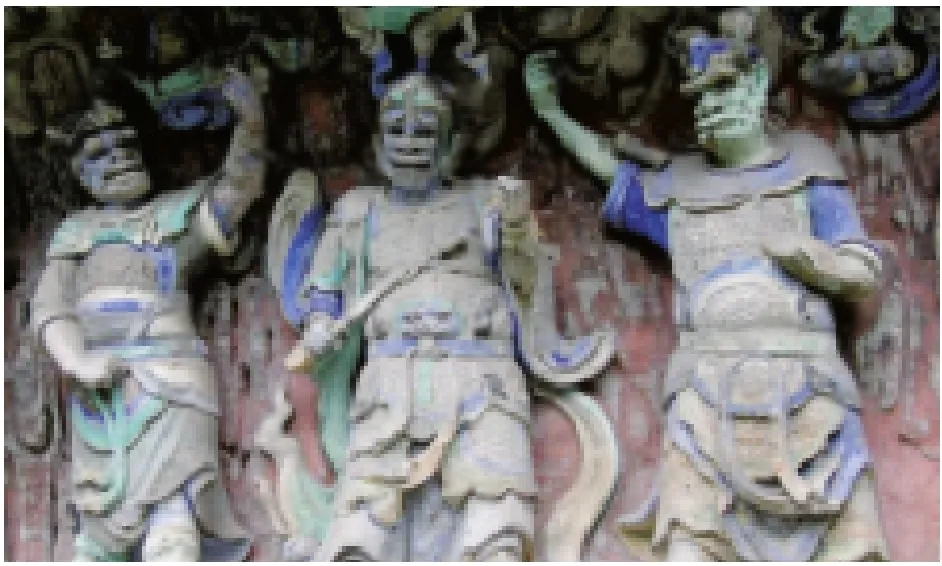
Fig.5 Loss ofmaterial
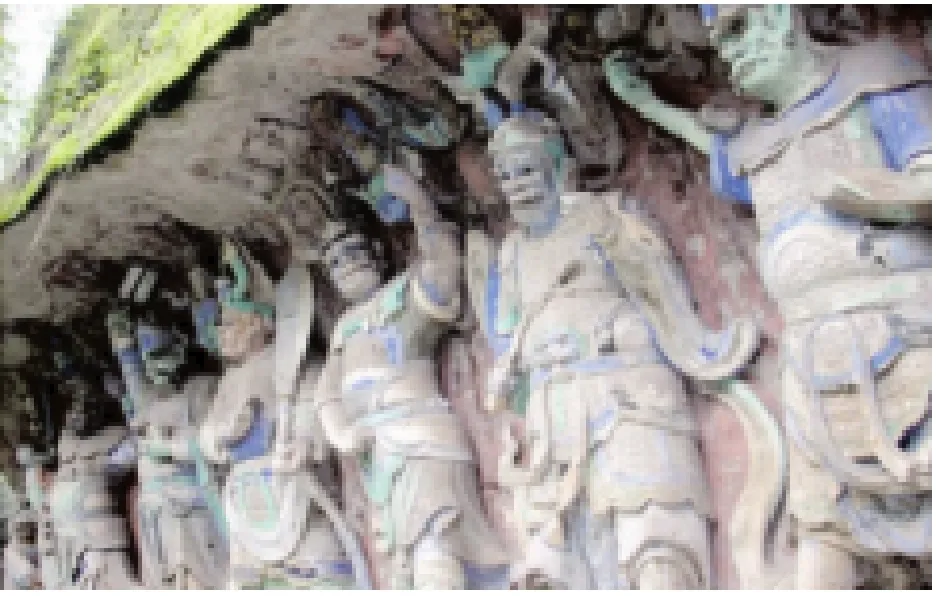
Fig.6 Formation of salt
efflorescences The analogy with this extract again recorded by Cesare Brandi in his Diario with reference to the bas-reliefs of Yungang is curious:“The winds have caused evenmore damage andmany of the wall carvings are corroded:you can also see an attempt at restoration that-as often happens-has donemore harm than good”.And strangely it continues:“Under the Qing dynasty,in fact,the grottoes were taken care of and they tried to restore them under the illusion that they could replace themissing parts,and for this reason they were peppered with large holes in order to apply a fillingmaterial,a thick plaster,I imagine.The plaster has disappeared and the holes remain”⑤Brandi C.,op.cit.pag.60..
It would not be incautious to think that the carved surfaces with evident losses of parts of the rock that show clear evidence of holes also present at Dazumay well be the same as those observed and recorded in detail by Brandi.In this case I refer,in particular,to one of the figures under the“flute player”or to the ensemble of figures of the“ritual site of buffaloes”(Fig.7 and Fig.8).

Fig.7 Ritual site of buffaloes(evidence of biological growth)

Fig.8 Detail of the holes in the rock
During that visit the necessity for a programme of intervention that would embrace works of extreme urgency,maintenance,restoration and conservation soon became apparent,but the task that I emphasised asmore urgent than anything else was that of analysing the hydrodynamic conditions of the whole cliff:a study of the soil and the effectivemanagement of the flow of water,both on the surface and from rainfall.With regard to this,it is extremely interesting to read what is written in the text drawn up in 1998 for the registration of the site in the Unesco World Heritage List in the chapter relating to“key indicators formeasuring state of conservation”in which the following extract comes under the title of“Permeation”:“Permeation has occurredmainly in the niches of carvings at Beishan and Boadingshan.Although numerous projects have been launched since 1950s to improve them and good results have been achieved,permeation is still very serious due to the complicated structure and crisscrossing crevices of the rocks of some niches.We plan to complete improvement of these niches by stages in about 10 years”⑥World Heritage Convention(1998),nomination of cultural heritage:Dazu rock carvings,Beijing,China:StateBureau of Cultural Relics,“key indicators formeasuring state of conservation”..
In other words,before embarking on any recovery or restoration work,it would be necessary to devise amanagement plan for the site as a whole or,what in technical terms would be defined also in this case as an extensive programme of“preventive conservation”.Some interventions of this nature appear to have been implemented for the Longmen site in 2010 according to a project published by Zhang Bing-feng,which refers to the rock structure of the Qianxi temple where in fact they conducted exploratory geophysical investigations to define themechanisms and damage due to the effects of water⑦Zhang Bing-feng(2010),“Analysis of Quianxi temple's rock body structure,Longmen Grottoes,Henan province”,in Science of Conservation and Archaeology,Vol.22,Nov.,Shanghai..
It is known that the phenomena of the formation of calcareous concretions,especially in caves(Fig.9),or of the freeze-thaw action of water result in disruptivemechanical actions in rockmaterials and the destructive action due to the crystallisation of salts is strictly linked to the spread of damp fronts and water evaporation cycles.It is also known that biological growth and its consequent disfiguring action of painted surfaces is particularly fertile in damp environments;and likewise the growth of vegetation.If we direct our attention on phenomena that regard the above-mentioned carved surfaces,it is not difficult to be persuaded that themost serious problem to address in sites such as that ofDazu,as in any other hypogean environment,is that ofmanaging as far as possible the hydrogeological features of the surrounding environment!(Fig.10)
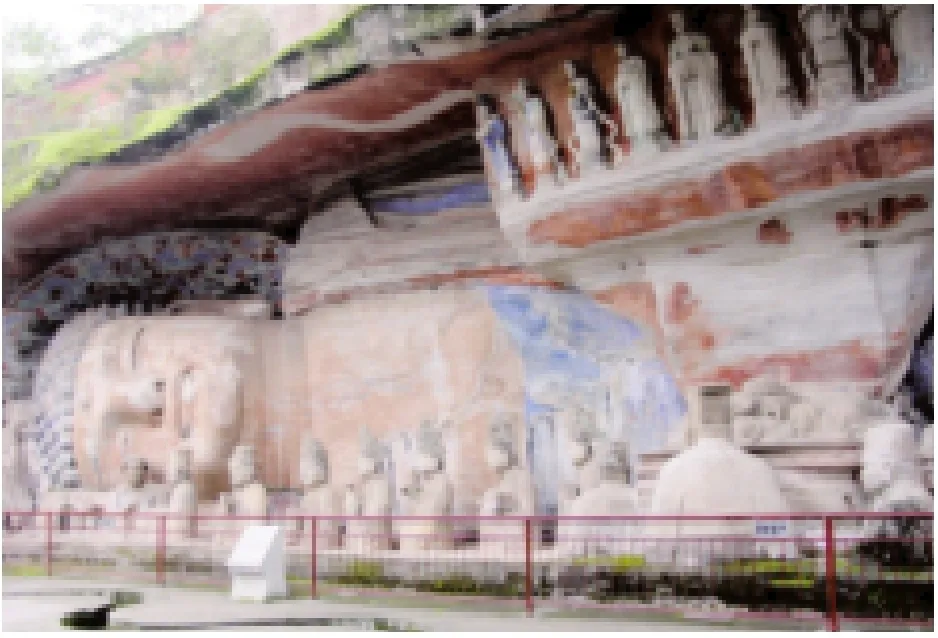
Fig.9 Formation of calcareous concretions
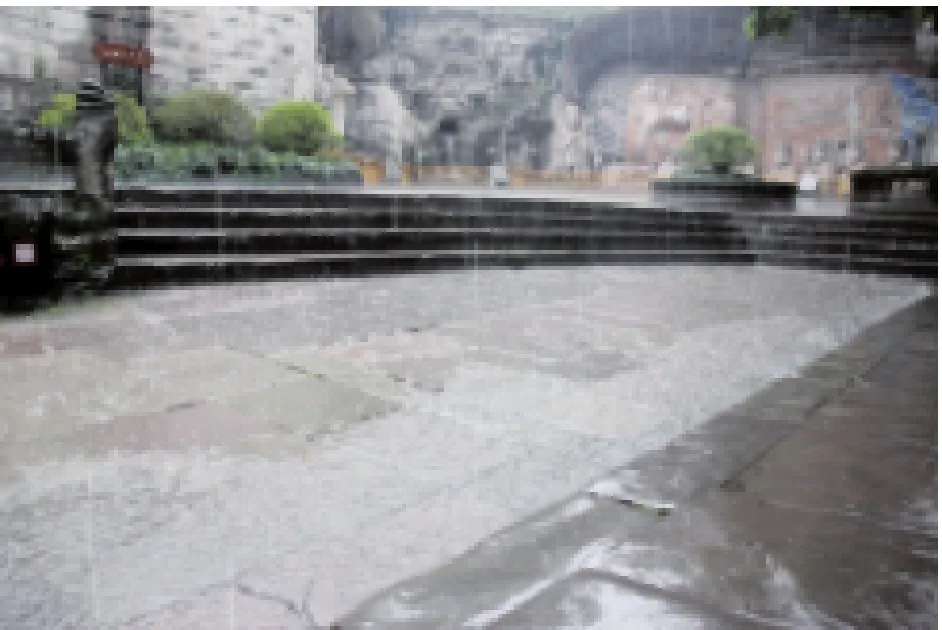
Fig.10 The surrounding environment
The above listed observations correspond to those recorded also in works published in 2011 by experts from the Chinese Academy of Cultural Heritage(CACH),Beijing,such as Yuan Hu et alii in“The Deteriorationmechanism Study for sandstone of Avalokitesvara Sculptures on the Dazu Rock Carvings”⑧“Sustainability of traditional constructionmaterials inmodern society”(2011)Geophysical Research Abstracts Vol.13,EGU2011-5360.from which this extract has been taken.
“The Sculpture has been seriously decayed in the past 800 years.Now it is in very dangerous condition.Because better understanding of the deterioration processes andmechanism could help tomake preventivemeasures and remedial treatments,investigation and survey has been done since 2002.Micro-environmentmonitoring was also carried out in 2006.Themain types of sandstone deterioration and its distribution were studied.Themain deterioration is powdering which occurs not only on the surface but also inside the sandstone.It is found that the sandstone is less decayed on the area covered by gold leaf than that painted with pigments and the deterioration condition of the lower part and the upper part is different on the cliff”
4 The Remedial
It will not pass unnoticed thatmy observations refer to the period ofmy last visit to Dazu that dates back to summer 2008 and is therefore too long ago for them to be of use;nevertheless they are still valid.And it was precisely in 2008 that a booklet⑨A preliminary study on rescue conservation project of the statue of Avalokitesyara Bodhisattva in Da Zu rock carvings(2008).was published which,among other things,mentions a“detailed investigation on geotechnical engineering geology and study onmonitoring and analysis on condensation water”followed by an international symposium in 2009 by the Academy of Dazu Rock Carvings(although skimming through the proceedings of this event it is apparent in this case that all the attention was focused exclusively on subjects of an iconographic nature⑩Proceedings of the International Symposium on Dazu rock carvings,Chongqing(2009),Academy of Dazu Rock carvings--A series of Dazu Studies,2012 [Chongqing].).Fortunately thanks to other works published it is evident thatmany positive events have occurred in these years! Proof of this is another article published in 2011“Rescue Conservation and Restoration Project of the Statue of Avalokitesvara Bodhisattva in Dazu Rock Carvings”(11)Sharing Conservation,Several approaches to the conservation of artmade with differentmaterials.Atti del convegno(2011),a cura di Stefania Pandozy.Edizionimusei Vaticani Città del Vaticano.,on the occasion of the International Conference Sharing Conservation organised by the Vaticanmuseums from which this significant extract was taken:“……Avalokitesvara that ismainlymade from sandstone,plaster,painting,andgold foil,is suffering from severe irreversible weathering caused by various natural and human factors.This processing is accelerating in recent years……In order to better conserve the statue of Avalokitesvara Bodhisattva,Chinese Academy of Cultural Heritage,……has invited Dunhuang Academy,Peking University,China University of Geosciences,and Tsinghua University to carry out joint scientific research,……Technicians havemade system survey on preservation condition of statue of Avalokitesvara Bodhisattva since June,2008:they adopted griddingmethods tomakemanual and computer drafting and summary of thousand hands and faqi one by one,to systematically comprehend diseases conditions of bed rocks,gold foils and colored paintings;then they organized amultidisciplinary team composing of hydrology,geology,environment,chemistry,physics,and biology,to discuss working plans,detail research content……”
Personally I cannot help but feel gratified when I read the last line(underlined above)of this extract that bears close similarities to the observations I was able tomake duringmy surveys and to which I have previously referred.Although very recent works such as that published with the article“Application of portable X-Ray Radiography to assess the weathering condition of the
Avalokitesvara Sculpture in Dazu rock carvings”(12)Zhou Hua.(2012),in Science of Conservation and Archaeology,Vol 24,Nov.,Shanghai.,also of considerable scientific importance,indicate a constant effort to preserve the cultural patrimony of Dazu or that of the cult of Guanyin.
5 Conclusion
The works reported alwaysmention on each occasion actions aimed at the recovery of one of themost prestigious sculptures of Dazu,namely that of the cult of Guanyin.Now that,lastmay 2015,the restoration was completed and presented to experts and local authorities I am sure,that the attention was not focused on“one part”instead of“the whole”and the announced hydrological,geological,environmental and biological studies have found solutions for the overallmanagement of the site with its numerous and complex conservation problems.I sincerely hope so,for the importance that this site has had and has in Chinese culture,for its universal nature,for thememory of the professional experience,for the work dedicated to it and for its historical significance.
Finally,in order to show a clear sign of how pleasant this experience was,I would like to conclude with a personal note referring once again to the early pages of the already frequentlymentioned“The Chinese Diary”:“the visitor arouses curiosity,of course,and all themore so as you travel south,where they crowd round you,along the street,in the shops,but always smiling…”(13)Brandi C.(1982),op.cit.Pag.6.
The visitor arouses curiosity,of course,and all themore so as you travel south,where they crowd round you,along the street,in the shops,but always smiling…”
1 简介
我第一次了解到大量石刻佛教造像是在艺术史学家切萨雷·布兰迪的描述中,他在20世纪80年代受邀访问中华人民共和国的多处文化遗产之后撰写了《中国日记》(The Chinese Diary)①切萨雷·布兰迪(1906—1988),创建并指导中央修复研究所(1936—1961)。,其中非常有意思的一章是对云冈石窟的描写。遗憾的是,在我看完他的日记后,直到刚刚加入罗马的中央修复研究所时,都没有机会参观被布兰迪描述为“神秘庄严所在”的云冈石窟。我永远想不到
