问道岭南
2016-06-15Peter,Leo,VCG等
问道岭南
All ROADS LEAD TO LINGNAN
Text by Peter Translation by Leo Photos by VCG & IC Illustration by Sandy
Ancient stone-paved roads And footprints of horses told of the long history of Lingnan.
Said to be the land of “Southern barbarians”, oldtime Guangdong, part of Lingnan (South of the Five Ridges), was not as isolated from the rest of China as many people imagined. Best evidence for this argument is the many historic trails that have been excavated and restored across the region. Historical data and remains show that more than 2,000 years ago the region was connected by multiple ancient roads to the North, West and East sides of the Five Ridges.
Like today's highways, these routes were important lines of communication through which tradesmen, travellers, migrants and materials in ancient times moved from Lingnan to the rest of China or vice versa. Some experts hold that, in those times, it was far easier to travel around the region along waterways than on roadways. Therefore, water channels like the South China Sea, along with the ancient roads, formed a network of transportation that thrived for more than 1,000 years.
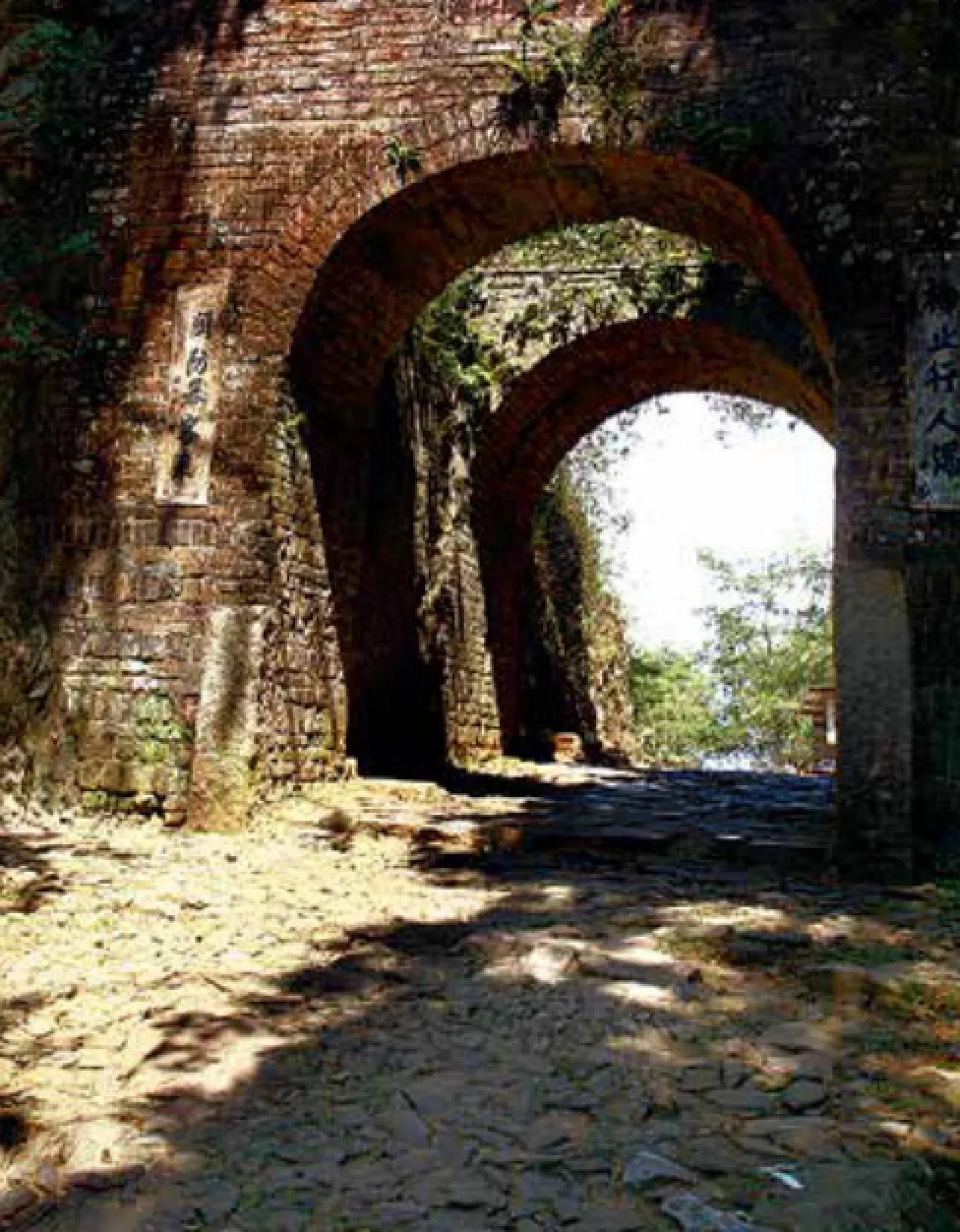
The Meiguan Ancient Road that connects the Yangzi River and Pearl River systems is typical of all ancient trails in the region. It is a golden passage through which the north and the south of the Five Ridges communicated both economically and culturally.
Meandering from the city of Dayu in Jiangxi Province to the city of Nanxiong in Guangdong Province, the trail was uniquely positioned as one of the few gateways into Guangdong from the north of the Five Ridges. A pass was set up for military purposes on the Meiling Mountain at the border between Jiangxi and Guangdong in the Qin dynasty (221-206 BC), but years of war made it barely passable. In the Tang dynasty (618-907), then Prime Minister Zhang Jiuling was charged with the construction of a road that pierced the mountain barrier. In just two months, he cut an opening into the mountain and built a 3-metrewide and 15-km-long artery connecting Central China and South China.
As a Chinese saying goes, “A road is the fi rst step to fortune.” It is said that thousands of people travelled the route each day following its construction. Commercial taxes collected by the governments of nearby towns such as Nanxiong, Nan'an Jun and Qianzhou increased throughout the Northern Song dynasty (960-1127), indicating a boom in trade and commerce in the areas along the route. For this reason, the road has been well maintained since the Song dynasty.
Some famous poems were composed by poets when they passed by the Meiguan Pass. On his way to a new off i ce in Lianzhou (Guangdong) following his demotion, great poet Su Dongpo wrote, “The fading of plum blossoms is followed by the blooming of hundred fl owers; you didn't show up before all passers-by were gone.” Tang Xianzu (1550-1616), a highly successful playwright of the Ming dynasty (1368-1644), wrote The Peony Pavilion in his retirement, a play based on a romantic story that he heard of when he travelled along the route to Zhejiang Province in East China for a new off i cial post.
The ancestors of most native residents in today's Pearl River Delta region migrated by way of the Meiguan Ancient Road. One of the earliest settlements along the route was the town of Zhujixiang, which was home to thousands of households and merchants in its heyday in the Southern Song dynasty (1127-1279). These immigrants belonged to one of the 141 clans whose ancestral halls can still be seen today across the town and which attract many tourists.
In the last 100 years, the role of the ancient route has been replaced by modern means of transportation (railways, high-speed railways, motorways, etc.). Though postal stations and caravansaries are nowhere to be seen, the stone-paved path survives and continues to be trodden by tourists who come to see the plum blossoms. When plum trees in the south of the mountain begin to wear green buds in the warm month of March, those in the north start to blossom. A few months later, these trees will be heavily laden with fruits, which can be made into plum wine.
石板古道上,马蹄行进的哒哒声与留下的深浅印记,伴着岭南走过漫长岁月。
虽有南蛮之地的说法,但古时的广东并非人们认为的那样封闭,逐渐被挖掘、复原的古道便是最好的证据。从历史资料和现存遗迹中可发现,早在2000多年前,这里就有多条道路沟通五岭南北,和东西两翼的交往也从未中断。
作为古时的“高速公路”,古道上承载着南来北往的如梭商旅,物资云涌,氏族迁徙。有专家认为,古代的岭南一带,水道交通在很多时候要远远便捷于陆道。因此,广东古道不仅限于陆路,以南海通道为代表的水上交通,与陆上古道一同,构成了畅通千年的交通网络。
连接着长江与珠江的梅岭古道是岭南古道的代表,它是中国古代经济往来中水陆与陆路的枢纽对接点,也是南北文化交流的黄金通道。
南入广东南雄,北进江西大余,特有的地理位置让梅岭成为古代沟通五岭南北的咽喉。梅岭设关始于秦,秦代开的山道用于军事,历经战乱后不堪行走。至唐代,张九龄奉诏在此劈山开道,用了不过两个多月的时间,打通了一座大山坳,开设了一条宽一丈余,长三十多华里的山间大道,成为南北交通的大动脉。
路通财通,沿途的经济得以发展。自梅关古道修建以来,南来北往的商旅挑夫“日有数千”。北宋前期至中后期,梅岭道附近的南雄州、南安军、虔州等地商税都有增加,说明道路上商品交易的繁荣。因其重要,从宋代开始历朝历代都有修路之举。……