Paleocene faunal evolution at Polecat Bench in the northern Bighorn Basin of Wyoming, USA
2016-03-29PhilipGINGERICH
Philip D. GINGERICH
(Museum of Paleontology,University of MichiganAnn Arbor, Michigan 48109-1079, USA gingeric@umich.edu)
Paleocene faunal evolution at Polecat Bench in the northern Bighorn Basin of Wyoming, USA
Philip D. GINGERICH
(Museum of Paleontology,University of MichiganAnn Arbor, Michigan 48109-1079, USA gingeric@umich.edu)
Polecat Bench and McCullough Peaks in the northern Bighorn Basin of Wyoming have yielded major discoveries leading to understanding both mammalian biostratigraphy of the North American Paleocene, and the pattern and cause of continental faunal turnover at the Paleocene-Eocene thermal maximum. In 1910, Princeton and American Museum paleontologists showed that mammals of the Paleocene were distinctly different from those of the Eocene. This soon led to acceptance of the Paleocene as an epoch different from the Eocene. Eighty years later, Michigan and Carnegie Institution paleontologists showed that the continental Paleocene-Eocene boundary was marked by abrupt faunal turnover and dwarfing associated with a major carbon isotope excursion. This led to recognition of the Paleocene-Eocene thermal maximum or ‘PETM’as a greenhouse warming event that was truly global. A young scholar involved in paleontology in 1950, Minchen Chow, was introduced to fi eld work on Paleocene mammals in Wyoming. There he developed the experience and expertise that led to parallel exploration of the Paleocene in China. The challenge now is to understand how the parallel Paleocene histories of the North American and Asian continents fi t together.
Polecat Bench, McCullough Peaks, Paleocene, Eocene, biochronology, dwar fi ng, carbon isotope excursion, PETM
1 Introduction
Major advances in paleontology were made in the last century, and the Paleocene history I review here spanned most of the twentieth century, from 1910 to the end. It is a story of exploration, persistence, and good fortune involving four leaders (Fig. 1) and many active followers.
The northern Bighorn Basin is important to the history of Paleocene research for fourreasons: 1) this is the area where the Paleocene was fi rst shown effectively to be different from the Eocene; 2) this is the area where a succession of Paleocene mammalian faunas enabled some of the North American Paleocene land-mammal ages to be subdivided into biochrons based on superposition and evolutionary succession; 3) this is the area where the Paleocene-Eocene transition was fi rst shown to be a sharp boundary, with dwar fi ng of some mammalian lineages at the boundary; 4) this is the area where the carbon isotope excursion marking the Paleocene-Eocene Thermal Maximum (PETM) was fi rst found on land, showing that (a) the greenhouse warming event marking the end of the Paleocene and beginning of the Eocene was global, and (b) linking continental and marine Paleocene-Eocene time scales. Each of these is described in turn.
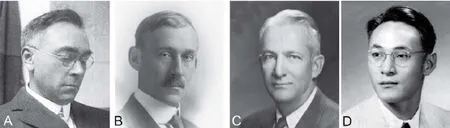
Fig. 1 Leaders in early research on the Paleocene mammals of western North America and China:William J. Sinclair, Walter Granger, Glenn L. Jepsen, and Minchen Chow A. William Sinclair (1877-1935) of Princeton University in Princeton, New Jersey; photograph courtesy of the Department of Geosciences, Princeton University. B. Walter Granger (1872-1941) of the American Museum of Natural History; photograph courtesy of the Vertebrate Paleontology archives, American Museum of Natural History in New York, New York. C. Glenn Jepsen (1903-1974) of Princeton University; photograph courtesy of the Department of Geosciences, Princeton University. D. Minchen Chow (1918-1996) of Lehigh and Princeton universities, and the Institute of Vertebrate Paleontology and Paleoanthropology, Chinese Academy of Sciences in Beijing; photograph courtesy of the Chow family, from Mulzet Studio, Bethlehem, Pennsylvania, circa 1950
The Bighorn Basin and the Clarks Fork Basin are distinct river basins separated by the ‘Clarks Fork Divide,’ which includes Polecat Bench (Fig. 2). The Clarks Fork River is a tributary of the Yellowstone River farther north in Montana, while the Shoshone River south of the divide is a tributary of the Bighorn River (which also eventually joins the Yellowstone River in Montana). Both drainage basins are part of a larger Bighorn structural basin, and I will refer to both as the northern Bighorn Basin.
3.5.3 间苗补苗 为培养充足优质壮苗,根据苗木生长状况要及时间苗和补苗。间苗的原则是“留好去坏,留稀去稠”。间苗对象为病苗、受伤苗、弱苗和非常稠密的苗木。补苗要选在阴雨天或傍晚进行。补苗后应及时浇水,使苗木根系与土壤密结,必要时可适当遮阴。
Early explorers involved in Paleocene research in the Bighorn Basin came from American institutions, but the in fl uence was broader. A young Chinese scholar involved in the research returned to China with experience that led to parallel investigation of mammalian evolution in Asia. This review complements one published earlier (Gingerich, 2010). Here I focus on North America and Asia, but the European Paleocene has its own rich record (Russell, 1964), as does the Paleocene of South America (Clyde et al., 2014; Woodburne et al., 2014) and that of Africa(Gheerbrant, 1992; Gheerbrant and Rage, 2006).

Fig. 2 Map of Paleocene and Early Eocene strata in the northern Bighorn Basin of northwestern Wyoming, U.S.A., showing the distribution of University of Michigan fossil localities, which include sites visited by earlier American Museum of Natural History and Princeton University expeditions Open symbols are fossil localities yielding Paleocene mammals of the Puercan (Mantua Quarry square), Torrejonian (Rock Bench Quarry square), Tiffanian (squares), and Clarkforkian (triangles) land-mammal ages. Solid symbols are fossil localities yielding Wasatchian mammals of the earliest Eocene Wasatchian zones Wa-M and Wa-0 (black diamonds), and Wasatchian zones Wa-1 through Wa-6. Note that the basin axis runs through the area diagonally, from northwest to southeast, and beds on both sides dip toward the basin axis. Dips are shallow north and east of the axis, and steeper south and west of the axis. The drab carbonaceous-shale-rich Fort Union Formation includes Puercan through Clarkforkian fossil mammal localities (Early to Late Paleocene). The red-banded fl uvial Willwood Formation includes Clarkforkian and Wasatchian fossil mammal localities (Late Paleocene and Early Eocene). Qt marks sands and gravels of Quaternary terraces. Terraces near the towns of Powell and Ralston are now irrigated farmland. Individual fossil localities mentioned in the text are labeled (MP-1, SC-2, etc.)
2 A Paleocene epoch different from the Eocene
The geological time scale has gone through a long history, starting with terms that re fl ected time in some sense, but principally the composition, fabric, layering, and coherence of rocks on the earth’s surface: Primary (crystalline), Secondary (layered), Tertiary (consolidated fl uvial sediments), and Quaternary (alluvium). Charles Lyell (1833) subdivided Tertiary time(his ‘Tertiary epoch’) into Eocene, Miocene, and Pliocene intervals. John Phillips (1840) grouped these into the ‘Kainozoic’ or Cenozoic, which we now recognize as an era (Eocene, Miocene, and Pliocene are now ‘epochs’ of the Paleogene and Neogene periods within the Cenozoic Era).
因了一个“怹”,因了满目深情跃然的“怹”,那篇貌似寻常的怀念师长的文章不再寻常,而那个“怹”——常驻于心上的他,一个与“您”同样厚重的字眼,成为牢牢攫住我心的罗盘。
The paleobotanist Wilhelm Schimper (1874) inserted a ‘Période paléocène’ at the beginning of the ‘Époque Tertiaire’ to re fl ect a grade of evolution in European fossil fl oras. Almost immediately, the vertebrate paleontologist Paul Gervais (1877) proposed a new‘Orthrocène’ to re fl ect overlap of European Cretaceous and Eocene vertebrate taxa. Neither proposal was readily accepted. In North America, Edward Drinker Cope (1888) proposed a‘Puerco’ series for strata bearing vertebrate fossils intermediate between and distinct from those of the underlying Cretaceous and overlying Eocene faunas, but this too failed to gain wide acceptance.
生源地为城市的大学生内隐自杀意念得分显著高于生源地为农村的大学生,与之前一些研究者通过外显问卷测量得到的结果相一致[37],原因可能在于与生源地为农村的大学生相比,家住城市的大学生抗挫折能力相对不够,情绪易受外界影响而产生自杀意念.本研究发现,不同家庭类型大学生的自杀意念存在显著差异,普通家庭类型大学生内隐自杀意念得分显著高于多代家庭类型的大学生,原因可能在于多代家庭类型大学生家庭成员较多,可以获得情感上的沟通、交流与支持,因而更加积极乐观.
Bowen G J, Clyde W C, Koch P L et al., 2002. Mammalian dispersal at the Paleocene/Eocene boundary. Science, 295:2062-2065
On July 29 a nice collection of Clarkforkian mammals was made in Sand Coulee, north of SC-188 (Fig. 2), showing again that automobiles made it possible to range widely when collecting. This included the type specimen of ClarkforkianPlesiadapis cookei, named for James W. Cooke. Rock Bench Quarry (Fig. 2) of Torrejonian age was discovered on the east side of Polecat Bench on August 6, when a number of jaws were collected including the type ofPlesiolestes problematicus. Then on August 14 the Mantua Quarry (Fig. 3) of Puercan age was found at a lower stratigraphic level a little south of Rock Bench Quarry. The fi rst fossil discovered at Mantua Quarry was the holotype ofLoxolophus nordicus. The following day several blocks of matrix were removed from Mantua Quarry, and Sinclair, Jepsen, and crew headed back to Princeton.
由于高校教学模式与高中差异较大,学生与教师在课外接触时间少,教育主客体之间的沟通交流时间也少,加之大学生多为“90后”,甚至“00后”,他们的性格特点:敏感、叛逆、羞怯,高校思想政治教育主客体之间的代沟加深,致使思想政治教育的主客体之间的信任度缺乏。依托新媒体平台,有助于转化教育主体的身份……