手术室造成医院内感染的原因分析与控制措施
2015-12-08姚英
姚英
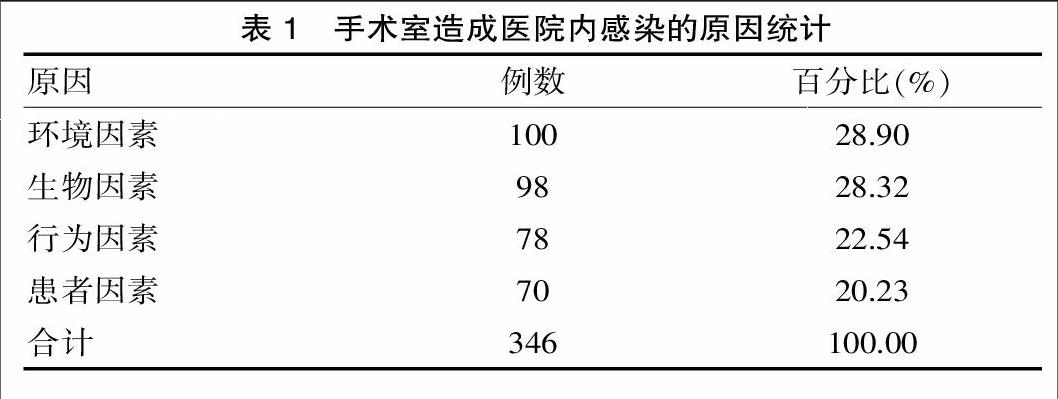
[摘要] 目的 探究与分析手术室造成医院内感染的原因并制定有效的控制措施。方法 回顾性分析该院自2011年9月—2014年9月发生的手术室医院感染的资料,分析其中感染原因并制定有效的控制措施。 结果 在2011年9月—2014年9月期间,共发生手术室造成医院内感染346例,其中环境因素100例,占28.90%,生物因素98例,占28.32%,行为因素78例,占22.54%,患者因素70例,占20.23%,组间比较差异无统计学意义(P>0.05)。 结论 临床医师只有认识到医院感染工作的重要性,才可制定可靠的控制措施,显著提高手术室感染控制水平,从根本上降低手术室感染的发生率。
[关键词] 医院手术;感染因素;控制分析
[中图分类号] R197.32 [文献标识码] A [文章编号] 1674-0742(2015)09(c)-0047-02
[Abstract] Objective To explore and analyze the causes of nosocomial infection in operating room and formulate the corresponding control measures. Methods A retrospective analysis was conducted on the data of nosocomial infection in the operating room of our hospital from September 2011 to September 2014. The causes of nosocomial infection were analyzed and effective control measures were developed. Results There were a total of 346 cases with nosocomial infection in operating room from September 2011 to September 2014, of them, 100 cases(28.90%) were due to environmental factors, 98 cases(28.32%) were due to biological factors, 78 cases (22.54%) were due to behavioral factors, 70 cases(20.23%) were due to patients factors, and no obvious difference was found between the groups(P>0.05). Conclusion In order to essentially reduce the incidence of infection in operating room, clinical physicians should recognize the importance of hospital infection and formulate reliable control measures for significantly improving the operating room infection control level.
[Key words] Hospital surgery; Infection factors; Control analysis
随着医疗科室技术的迅速发展,传染病的发生及流行得到了较大的控制,这就使得法定传染病以外的感染病包括机会性感染及医院内感染逐渐成为临床各项工作中的重要课题。医院感染主要是指患者在入院时并不存在且未处于潜伏期,而是在医院接受就诊期间诱发的感染或在医院期间获得而在出院后发病的感染[1]。大量研究资料显示,院内感染的发生不仅为患者及医院增加了经济上的负担,为患者的身心健康造成影响,严重时可导致患者死亡,同时阻碍了医疗卫生事业的深入发展,增加医患纠纷的发生率[2]。因此,医院内的临床工作人员需对其中存在的感染问题进行综合的研究分析,以制定积极有效的控制措施。手术室作为临床工作中较为重要的科室之一,极易造成医院内感染。该……
