人性化护理在产科产妇分娩护理工作中的应用效果观察
2015-12-02李锐
李锐
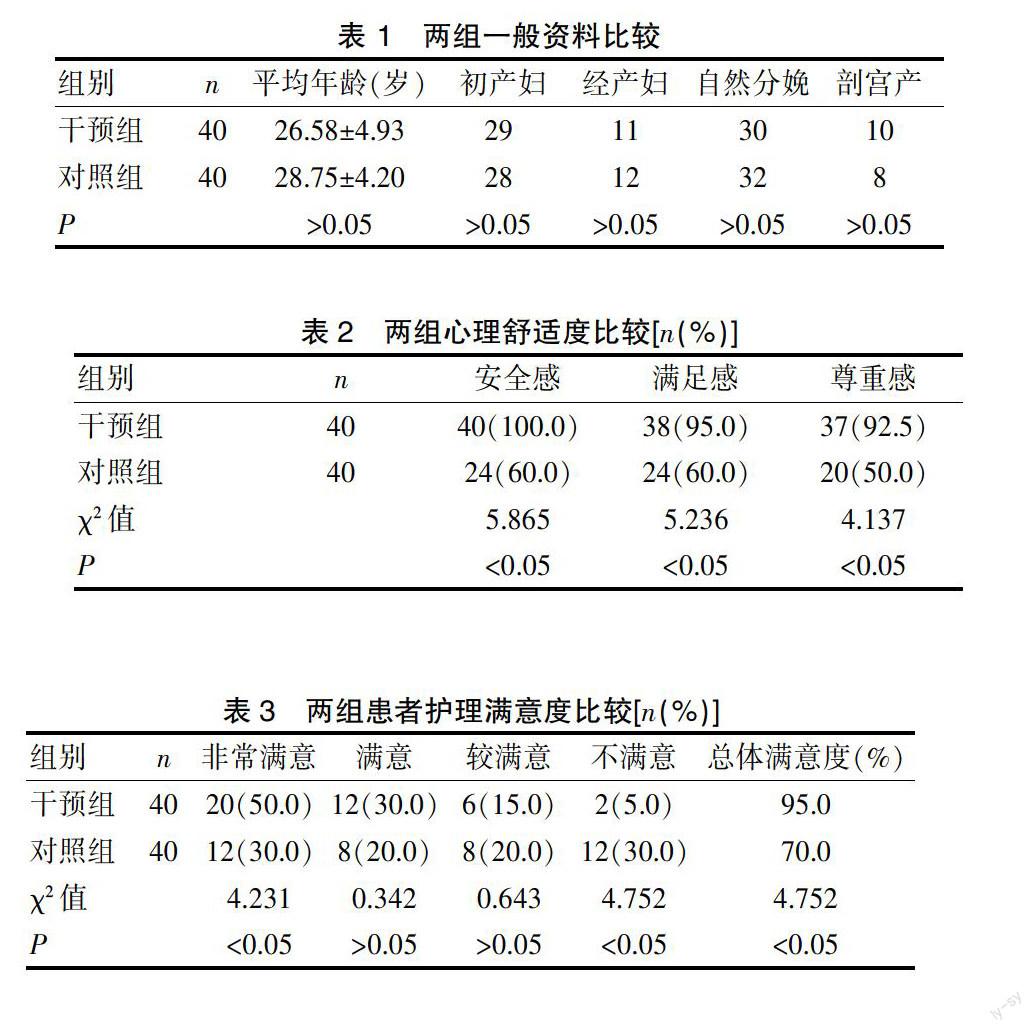
[摘要] 目的 观察人性化护理在产科产妇分娩护理工作中的应用效果。 方法 将纳入我院2013年6月~2014年6月的80例产科住院分娩产妇按照随机分组原则分为对照组(n=40)和干预组(n=40),对照组采用常规护理,干预组在常规护理基础上实施人性化护理干预,比较两组心理舒适度、护理满意度。 结果 干预组产妇的心理安全感、满足感及尊重感分别显著高于对照组,组间比较,差异有统计学意义(P<0.05)。干预组的非常满意率达50.0%、总体满意度达95.0%;对照组非常满意率达30.0%,总体满意度达70.0%,组间比较,差异有统计学意义(P<0.05)。 结论 在产科产妇分娩护理工作中实施人性化护理,有利于提高患者的心理舒适度及提高护理满意度,为提高产科护理服务质量提供了参考依据。
[关键词] 产科;分娩;人性化护理;心理舒适度;护理满意度
[中图分类号] R473.71 [文献标识码] B [文章编号] 1673-9701(2015)29-0150-03
Application effect of humanized nursing in maternity nursing
LI Rui
Department of Obstetrics, Qingdao Haici Medical Group,Qingdao 266033, China
[Abstract] Objective To observe the effect of humanized nursing in maternity nursing Obstetrics. Methods A total of 80 cases of obstetric hospital delivery in our hospital from June 2013 to June 2014 were randomly divided into control group (n=40) and intervention group(n=40). The control group was treated with routine nursing, the intervention group was based on conventional nursing intervention,the comfort in mind and nursing satisfaction were compared. Results The psychological safety,satisfaction and respect of the intervention group were significantly higher than those in the control group,the difference was statistically significant(P<0.05). The satisfactory rate of the intervention group was 50.0%, the overall satisfaction rate was 95.0%,the control group was 30.0%,the overall satisfaction was 70.0%,the difference was statistically significant(P<0.05). Conclusion The implementation of humanized nursing in maternity nursing work can shorten delivery time and improve nursing satisfaction, and provide a reference for improving the quality of nursing service.
[Key words] Obstetrics; Labor; Human nature nursing; Comfort in mind; Nursing satisfaction
产科是非常重要的临床科室,担负着产妇和新生儿的双重责任[1]。制定合理正确的护理模式,有利于提高产科护理服务的质量。人性化护理是一种创造性的、个体化的、整体而有效的护理模式,其通过对患者的心理状态及个体化需求给予人性化的护理支持,将“以患者为中心”的服务理念融入到护理服务中,使患者在就医过程中在心理、精神、生理及社会上处于舒适、满足状态[2]。人性化护理的核心在于整个护理过程中要始终坚持以患者为核心、围绕患者展开全方位的护理工作。本研究旨在探讨人性化护理在产科产妇分娩护理工作中的应用效果,现报道如下。
1 资料与方法
1.1 一般资料
本研究共纳入我院2013年6月~2014年6月的80例产科住院分娩产妇,年龄22~36岁,平均(27.17±4.57)岁,按照随机分组原则分为对照组(n=40)和干预组(n=40)。干预组产妇年龄22~36岁,平均(26.58±4.93)岁;文化程度:初中及以下文化水平8例,高中及中专14例,大专及以上文化水平18例。……