心搏骤停患者不同心肺复苏程序的预后及病因分析
2015-08-29王利剑何光辉
王利剑 何光辉
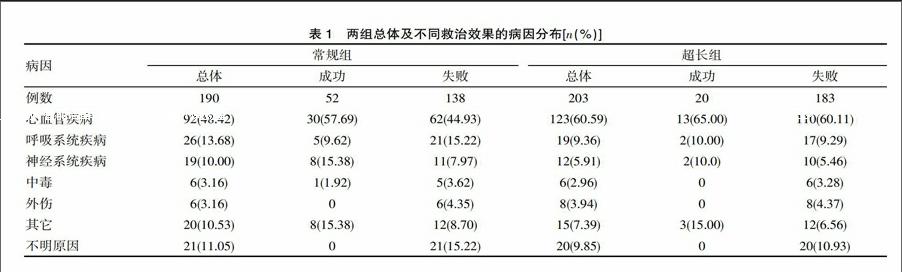

[摘要] 目的 比较常规心肺复苏(CPR)与超长CPR对心搏骤停患者的救治效果。方法 根据CPR程度将该院2011年1月—2014年12月救治的共393例心搏骤停患者分为常规组(190例)和超长组(203例),分别给予常规程度CPR和超长程度CPR,收集两组的一般资料(性别、年龄、发生地点、第一目击者及首次心率),回顾两组的CPR救治情况(到达现场的时间、停搏时间、复苏时间、肾上腺素用量及成功率)、预后(30 d存活率和出院存活率)及病因情况。结果 超长组的复苏时间、肾上腺素用量分别为(60.1±26.2)min和(16.3±8.7)mg,均高于常规组的(25.1±8.2)min和(8.4±4.9)mg,超长组的救治成功率为9.9%(20/203),低于常规组的27.4%(52/190),以上差异有统计学意义(P<0.05);常规组救治成功的52例患者中出院存活14例、30 d存活12例,而超长组救治成功的20例患者中出院存活3例、30 d存活1例,超长组的出院存活率(1.5% vs. 7.4%)和30 d存活率(0.5% vs. 6.3%)均低于常规组(P<0.05)。两组的主要首要病因均为心血管疾病,其余病因分布较少,包括呼吸系统疾病、神经系统疾病、中毒、外伤、其它及不明原因。 结论 超长CPR的复苏时间长、肾上腺素用量多,但救治成功率较低且预后较差,可能与病情较严重有关。
[关键词] 心肺复苏;心搏骤停;预后;病因分析
[中图分类号] R71 [文献标识码] A [文章编号] 1674-0742(2015)06(c)-0031-03
[Abstract] Objective To compare the treatment effects of conventional cardiopulmonary resuscitation (CPR) and prolonged CPR on patients with cardiac arrest. Methods According to the degrees of CPR, 393 patients with cardiac arrest in our hospital from 2011 January to 2014 December were assigned into routine group(n=190) and super-long group(n=203), either receiving conventional CPR and prolonged CPR. The general data, such as sex, age, place of occurrence, the first witness and first heart rate, were collected in both groups. The treatment effect (time arrived at the scene, arrest time, recovery time, the dosage of epinephrine and the success rate), prognosis (survival rates at day 30 and hospital discharge) and etiology were retrospectively analyzed in both groups. Results The recovery time and dose of epinephrine in super-long group were (60.1±26.2) min and (16.3± 8.7) mg, higher than (25.1±8.2) min and (8.4±4.9) mg of routine group (P<0.05). There was a higher success rate of CPR in routine group versus in super-long group (27.4% vs. 9.9%, P<0.05). Among 52 patients after successful CPR in routine group, 14 cases survived at hospital discharge and 12 cases survived at day 30 post-CPR, while 3 cases survived at hospital discharge and 1 case survived at day 30 post-CPR among 20 patients after successful prolonged CPR in super-long group. There were higher survival rats at hospital discharge (1.5% vs. 7.4%) and day 30 post-CPR (0.5% vs. 6.3%) in routine group versus in super-long group (P<0.05). The major cause of both groups was cardiovascular disease, and the rest included respiratory system disease, nervous system disease, poisoning, trauma, other and unknown causes. Conclusion The patients receiving prolonged CPR took long time to recover and needed more epinephrine. Prolonged CPR presented a relative low success rate and poor prognosis, possibly due to the serious illness.
[Key words] Cardiopulmonary resuscitation; Cardiac arrest; Prognosis; Etiological analysis
心搏骤停是一种常见的危急重症,也是急诊科救治中的棘手问题[1]。心搏骤停者经心肺复苏(CPR)后成功救治率和院存活率均较低,未能达到满意的效果[2]。目前CPR的关注重点为影响CPR救治及预后的因素,当CPR持续时间超过30 min时即为超长CPR,通过超长CPR可成功挽救生命[3]。为提高CPR的救治效果,该研究2011年1月—2014年12月分析心搏骤停患者经常规CPR与超长CPR救治的预后情况,现报道如下。
1 资料与方法
1.1 一般资料
病例来源于该院共救治的393例心搏骤停患者,根据CPR程度分为常规组(190例)和超长组(203例),两组的性别比、年龄、心搏骤停发生地点、第一目击者及首次心率的差异无统计学意义(P>0.05)。常规组:男性129例,女性61例,平均年龄为(65.5±18.4)岁;心搏骤停发生地点:院内75例,院外115例;第一目击者:医务人员78例,非医务人员112例;首……