辣椒素对人大细胞肺癌NCI—H460细胞侵袭能力及E—钙黏蛋白、Snail蛋白表达的影响
2015-05-30任公平等
任公平等
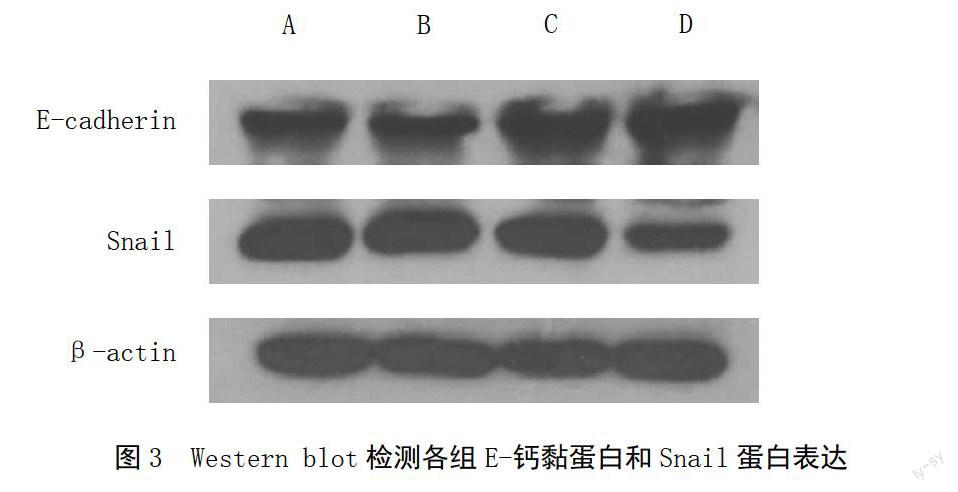


摘要:目的 观察辣椒素对人大细胞肺癌NCI-H460细胞侵袭能力及E-钙黏蛋白(E-cadherin)和Snail蛋白表达的影响,探讨其抗非小细胞肺癌的可能机制。方法 体外培养NCI-H460细胞,以不同终浓度辣椒素进行处理,未加辣椒素为对照组。采用Hoechst33342核染色分析、Transwell小室细胞侵袭实验及Western blot检测,观察辣椒素对NCI-H460细胞凋亡、侵袭能力及E-cadherin、Snail蛋白表达变化的影响。结果 与对照组比较,Hoechst33342核染色分析表明,辣椒素各浓度组可明显诱导NCI-H460细胞凋亡(P<0.05);Transwell体外侵袭实验结果显示,辣椒素可显著抑制侵袭穿膜细胞数(P<0.05);Western blot检测结果表明,辣椒素各浓度组E-cadherin表达水平明显升高、Snail表达水平明显降低(P<0.05)。结论 辣椒素能明显诱导NCI-H460细胞凋亡;降低Snail表达、刺激E-cadherin的表达从而抑制NCI-H460细胞侵袭能力,可能是其抗非小细胞肺癌的机制之一。
关键词:辣椒素;非小细胞肺癌;侵袭;E-钙黏蛋白;Snail蛋白
DOI:10.3969/j.issn.1005-5304.2015.08.015
中图分类号:R285.5 文献标识码:A 文章编号:1005-5304(2015)08-0055-04
Effects of Capsaicin on the Invasion Ability of Human Large Cell Carcinoma NCI-H460 and Expressions of E-cadherin and Snail REN Gong-ping1, LV Zheng-xin2, LIU Hong-yang3, LIANG Guo-ying4 (1.Hongqi Hospital Affiliated to Mudanjiang Medical College, Mudanjiang 157011, China;2.Jiamusi Hospital of TCM, Jiamusi 154002, China;3.Qiqihaer Hospital of TCM, Qiqihaer 161000, China;4.The First Affiliated Hospital to Heilongjiang University of Chinese Medicine, Harbin 150040, China)
Abstract:Objective To investigate the effects of capsaicin on the invasion ability of human large cell carcinoma NCI-H460 and the expressions of E-cadherin and Snail;To discuss the possible mechanisms of anti-non-small cell lung cancer. Methods NCI-H460 cells were cultured in vitro and treated with capsaicin at various concentrations, and no capsacin-treated group was set as control group. Effects of capsaicin on NCI-H460 apoptosis, its invasion ability, and the changes in protein expressions of E-cadherin and Snail were evaluated by Hoechst33342 nuclear staining assay, Transwell chamber invasion assay, and Western blot respectively. Results Compared with the control group, Hoechst33342 nuclear staining assay showed that capsaicin could induce NCI-H460 cell apoptosis (P<0.05);Transwell invasion in vitro results showed that capsaicin could significantly inhibit invasion of penetrating cells (P<0.05);Western blot analysis showed that E-cadherin expression level was significantly elevated and snail expression level significantly decreased (P<0.05). Conclusion Capsaicin can induce NCI-H460 cell apoptosis. Decrease the Snail expression and stimulate E-cadherin expression so as to inhibit the invasion ability of NCI-H460, which may be one of its mechanisms of anti-non-small cell lung cancer.
Key words:capsaicin;non-small cell lung cancer;invasion;E-cadherin;Snail
通讯作者:梁国英,E-mail:lianggy1976@163.com
据预测,到2020年,中国将有550万新发肺癌病例,死亡人数将达400万[1]。在肺癌病理学分型中,80%为非小细胞肺癌(non-small cell lung cancer, NSCLC),包括腺癌、鳞状上皮细胞癌和大细胞癌,其侵袭和转移能力是导致患者死亡及复发的主要原因,并使其成为当今世界上对人类健康和生命危害最大的恶性肿瘤之一[2]。近年来,关于辣椒素(capsaicin)抗癌作用的研究在国内外日益受到学者的高度重视。辣椒素是红辣椒中的一种活性成分。有研究表明,辣椒素可以抑制癌症细胞增殖、促进凋亡,因此,可作为一种药物或传统化疗药物的辅助用药[3-5]。虽然辣椒素具有抗癌症作用,但其有关NSCLC的研究鲜见报道。本实验研究辣椒素对NCI-H460细胞侵袭能力及E-钙黏蛋白(E-cadherin)、Snail蛋白表达的影响,探讨其可能的作用机制,以期为NSCLC治疗提供新思路,为临床用药提供实验基础。
1 实验材料
1.1 细胞
人大细胞肺癌NCI-H460细胞,购自中国科学院上海细胞库。……