脑肿瘤术后并发风险和护理对策解析
2014-06-11宋潇
宋潇
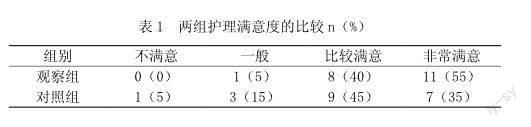
【摘 要】目的:解析脑肿瘤术后并发风险和护理对策。方法:选取我院2011年11月至2013年10月收治的脑肿瘤患者40例进行分析,随机分成观察组和对照组两组,每组20例。其中,观察组采用对症的综合护理方法进行护理,对照组采用常规护理方法进行护理,观察两组术后病发风险差异及患者的满意度差异。结果:观察组术后病发风险低于对照组,观察组患者对护理的满意度明显高于对照组。P<0.05,说明具有统计学意义。结论:对症的综合护理能够有效地降低脑肿瘤术后并发风险,提高患者的满意度,对于脑肿瘤患者给予对症的综合护理具有重要的意义。
【关键词】脑肿瘤;术后并发风险;护理对策
Postoperative risk of brain tumors and nursing strategies to resolve
Xiao Song
First Peoples Hospital of Shangqiu City, outside the two families Shangqiu 476000
[Abstract] Objective: To resolve the risk of brain tumors and postoperative nursing. Methods: Patients with brain tumors in our hospital from November 2011 to October 2013 were treated 40 cases analyzed , were randomly divided into observation group and control group , 20 cases in each group. Among them, the observation group were symptomatic comprehensive nursing care, control group using conventional methods of nursing care were observed difference in risk of postoperative morbidity and patient satisfaction differences. Results: The postoperative disease risk than the control group ,The patients satisfaction with care was significantly higher. p <0.05, statistically significant explanation . Conclusion: Symptomatic of integrated care can effectively reduce the risk of brain tumor surgery concurrency , improve patient satisfaction , for brain tumor patients symptomatic of integrated care has important significance.[key words]brain tumor ; postoperative risk ; Nursing Strategy
脑肿瘤即颅内肿瘤,可以分为原发性颅内肿瘤和继发性颅内肿瘤两种。其中,前者是指直接发生自脑、脑膜、脑血管、脑垂体、颅神经以及胚胎残余组织的肿瘤,后者则是指由身体其它脏器组织的恶性肿瘤转移到颅内的肿瘤。脑肿瘤是颅内占位性病变的一种,目前主要采用手术方法进行治疗[ 1 ]。但是,脑肿瘤手术具有一定的复杂性,术后并发风险较大[2]。选择我院2011年11月至2013年10月两年期间进行脑肿瘤手术的患者40例,对其护理情况进行分析,现将结果报告如下。
1 资料与方法
1.1 一般资料 选取我院自2011年11月至2013年10月两年内收治的脑肿瘤患者40例,随机分为两组。观察组20例,男12例,女8例;年龄(28~73)岁,平均54.12岁;对照组20例,男15例,女5例;年龄(27~75)岁,平均年龄54.24岁。其中,脑膜瘤患者19例,胶质瘤患者15例,髓母细胞瘤患者3例,星形细胞瘤患者2例,室管膜瘤患者1例。所有患者均进行手术治疗。两组患者在性别、年龄等方面没有明显的差异,不具备统计学意义(P>0.05),具有可比性。
1.2 方法