白血病骨髓抑制期患者采用护理干预对肛周感染发热的影响解析
2014-06-11聂莹莹
聂莹莹
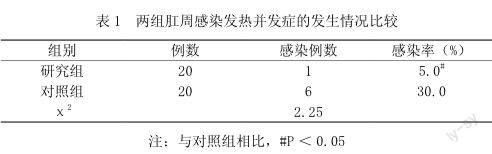
【摘 要】目的:分析探讨护理干预对白血病骨髓抑制期患者肛周感染发热的影响。方法:选取40例白血病骨髓抑制期患者作为研究对象,按照数字抽签法将其随机分为研究组与对照组,每组20例,研究组患者行系统的护理干预,对照组患者仅行常规护理,比较两组患者肛周感染发热的发生率。结果:研究组肛周感染发热并发症的发生率为5.0%,对照组发生率为30.0%,研究组患者肛周感染发热并发症发生率明显低于对照组(P<0.05),组间比较差异有统计学意义。结论:对白血病骨髓抑制期患者行系统的护理干预可以提高患者的机体免疫力,降低肛周感染发热并发症的发生率,提升患者生活质量。【关键词】白血病;骨髓抑制期;护理干预;肛周感染;发热
Leukemia patients with bone marrow suppression nursing intervention
on perianal infection resolved fever
Nie Yingying
Department of Hematology, First Peoples Hospital of Shangqiu City, Henan 476000
[Abstract] Objective: To investigate the effects of leukemia bone marrow suppression in patients with perianal infection, fever nursing intervention. Methods: 40 cases of leukemia in patients with bone marrow suppression as the research object , according to the digital ballot method randomly divided into study group and control group 20 cases , the study group underwent systematic nursing intervention , the control group received only routine care of patients compared two groups of patients the incidence of perianal infection fever . Results: The study group perianal infection fever complication rate was 5.0%Incidence of 30.0% in the control group, the study group of patients with perianal infection, fever complication rate was significantly lower than the control group (P <0.05), the difference between groups was statistically significant. Conclusion: leukemia bone marrow suppression line system of patient care interventions can improve the patient s immunity, reduce heat perianal infection incidence of complications , improve quality of life for patients.
[key words]Leukemia ; bone marrow suppression ; nursing intervention ; perianal infection ; fever
白血病骨髓抑制期患者機体常伴有白细胞损伤或缺乏,极易发生全身性感染并发症[ 1 ],对患者健康影响极大。肛周感染并发症作为白血病患者化疗期间常见、多发并发症,发生后会对患者生理及心理方面造成极大痛苦。本文选取我院近年来收治的40例白血病骨髓抑制期患者作为研究对象,着重分析探讨了白血病骨髓抑制期护理干预对肛周感染并发症的影响,具体分析如下。
1 资料与方法
1.1 一般资料 选取我院2011年11月至2013年11月收治的40例白血病骨髓抑制期患者作为研究对象,按照数字抽签法将其随机分为研究组与对照组,每组20例,研究组男14例,女6例,年龄为14~65岁,平均年龄为(41.6±5.2)岁,对照组男13例,女7例,年龄为15~64岁,平均年龄为(42.8±4.7)岁。两组患者在年龄、性别、病情等一般资料方面无显著差异(P>0.05),有可比性。
1.2 护理方法 对照组患者行常规护理指导,研究组患者行针对性的护理干预,具体护理措施包括:①卫生护理与指导:指导患者勤换内衣,尤其注重每日更换内裤,引导患者养成良好的卫生习惯;每……