作家是怎样炼成的——麦克斯·柏金斯致年轻人
2014-01-02byRichardNordquist
by Richard Nordquist
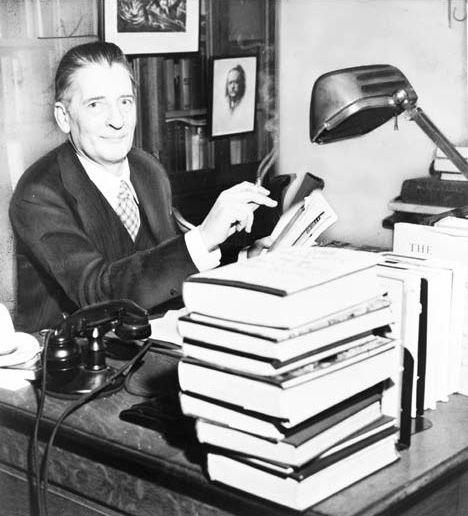
The next time you run into problems with a writing project, imagine the sort of help a great editor might provide:
“Max Perkins…was famous for his ability to inspire an author to produce the best that was in him or her. More a friend to his authors than a taskmaster[工头], he aided them in every way. He helped them structure their books, if help was needed; thought up titles, invented plots; he served as psychoanalyst[心理分析师], lovelorn[失恋的] adviser, marriage counselor[顾问], career manager, money-lender. Few editors before him had done so much work on manuscripts[手稿], yet he was always faithful to his credo[信条], ‘The book belongs to the author.” (A. Scott Berg, Max Perkins: Editor of Genius, 1978)
From 1910 until his death in 1947, Scribners legendary editor Maxwell Perkins nurtured[培养] and inspired such notable[著名的] authors as Ernest Hemingway, F. Scott Fitzgerald注1, Marjorie Rawlings注2, Ring Lardner注3, and Thomas Wolfe注4.
Yet somehow, even near the end of his life, Perkins found time to counsel would-be writers as well. In May 1945, he responded to a young serviceman who had sought his advice about a writing career:
“I think, in truth, that the best writing of all is done long after the events it is concerned with, when they have been digested[消化] and reflected upon unconsciously[无意识地], and the writer has completely realized them in himself. It is good journalistic writing that is done quickly while everything is still new, but not the best writing…
As to perhaps a couple years of college, I should think that might be of great advantage, in a general sense, but dont try to learn about writing there. Learn something else. Learn about writing from reading. That is the right way to do it. But then it can only be done by those who have eyes and ears, by seeing and listening…
The way they teach literature and writing in college is harmful. It results in one getting into the habit of seeing everything through a kind of film of past literature, and not seeing it directly with ones own senses…
I would say that a couple of years in the newspaper business was much better for one who wanted to be a writer than a couple of years in college. But there are, of course, other advantages that come from college.” (Editor to Author: The Letters of Maxwell E. Perkins, edited by John Hall Wheelock, 1979)
Perkins, of course, was writing in a different era—years before the proliferation[扩散] of creative writing programs and the decline of the newspaper industry. Yet the heart of his message still rings true.
In a letter to another hopeful young author, Perkins said, “What really makes writing is done in the head, where impressions are stored up[积聚], and it is done with the eye and the ear. The agony[痛苦] comes later, when it has to be done with the hand, and that part of it can gain greatly from seeing how others do it, by reading.”
下一次当你在写作任务上遇到困难时,不妨想象一下一位优秀的编辑可以给你提供的帮助:
“麦克斯·柏金斯……以其善于引导作者尽展所长的能力而著称。对作者来说,他与其说是一个工头,不如说是一个在方方面面都能提供支援的老友。如有需要,他会帮助作者设计故事架构,构思书名,设计情节;他可以充任心理分析师、失恋专家、婚姻顾问、职业经理人以及放贷者。在他之前,极少会有编辑在手稿上花费那么多工夫,而他一直坚守着自己的信条:‘书是属于作者的。”(A.斯科特·伯格,《麦克斯·柏金斯:天才编辑》,1978)
自1910年起,直至其于1947年逝世,斯克里布纳出版社的传奇编辑麦克斯威尔·柏金斯启蒙并培养出众多著名作家,如欧内斯特·海明威、F.斯科特·菲茨杰拉德、玛乔丽·劳林斯、林·拉德纳以及托马斯·沃尔夫等。
然而,即便在其生命的最后几年,柏金斯依然抽出时间给未来的作家提供意见。1945年5月,一名年轻的军人询问他对写作职业的想法,他这样回答:
“事实上,我认为最好的作品应该是在其谈及的事件结束以后很长一段时间才写出来的,那些事件此时已经被彻底消化,让人不由深思,并且作者对此已经有一套自己的完整认识。优秀的新闻写作是在所有东西还新鲜的时候一挥而就,但那并不是最好的作品……
至于谈到去大学读几年书,我的看法是,在一般层面上,这会大有裨益;
