英语文化随身带
2013-08-01byCathyManson
by Cathy Manson
The economy might be depressed[萧条的], but the British are still splashing out on wellies. One shoe company has reported sales of the boots are up 673% this year—theyre selling 15 pairs a minute. They thank the snow for our enthusiastic[热情的] welly-buying. Its true we have had a few cold winters in recent years, but our love of wellingtons[高筒靴] probably has more to do with fashion sense than common sense.
Ten years ago, wellies came in black or dull[(颜色等)暗淡的] green. Farmers wore them. But now shops are selling wellingtons of every colour, decorated with[以……来装饰] stripes, spots, flowers, animals and even fake[假的] diamonds.
Thats because the wellington boot has been fashionable since around 2004, when fashionistas in New York were spotted wearing them. British model Kate Moss made a splash in 2005 when she wore wellies to the Glastonbury Festival注1.
But the welly has been fashion-forward before. It began in 1817 when the Duke of Wellington注2 started wearing a narrower, simpler boot. Being a famous war hero, men were quick to copy his style and the wellington boot was soon all the rage. It went out of fashion at the end of the 19th century, but farmers, workers and dog walkers carried on wearing them.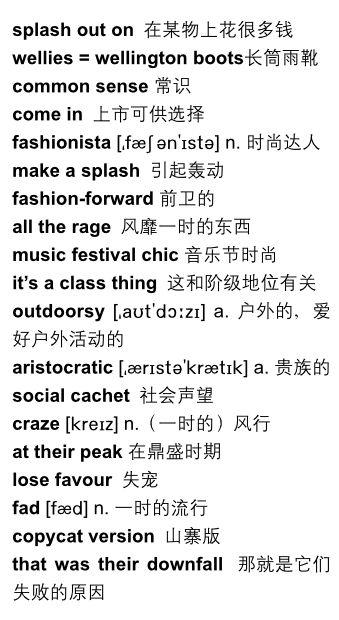
So why have they become fashionable again? Its part of a general trend[趋势] for big boots: biker boots, cowboy boots and Doc Martens are all popular. Wellies also benefit from music festival chic, with models and music stars being photographed in them at muddy outdoor events. But surely its a class thing too. The British upper classes have an outdoorsy image—often seen with waterproof coats, dogs and wellington boots. This aristocratic connection gives wellies a certain social cachet which trainers[软运动鞋] will never have.
But retailers should enjoy the welly craze while they can. Wellington boots are probably at their peak now, and will soon start to lose favour. The last big boot fad was UGG boots. Worn by the stars, they were soon so desirable that everyone had a pair—or a cheaper copycat version. And that was their downfall. Now everyone has them, theyre not special anymore and sales have fallen by a third.
经济可能不太景气,但是英国人仍然把钱大肆花在购买长筒雨靴上。一家制鞋公司报告说今年长筒靴的销售量上涨了6.73倍,意即他们每分钟卖出15双长筒靴。对于我们购买雨靴的热情,他们感谢大雪纷飞的天气。近年来我们确实经历了几个寒冬,但是我们对长筒雨靴的喜爱可能更多源于时尚感而非常识。
十年前,市面上出售的长筒雨靴是黑色或暗绿色的,供农民穿着。但如今,商店里卖各种颜色的长筒雨靴,用条纹、圆点、花朵图案、动物图案甚至水钻装饰。
这是因为大约从2004年开始,当纽约的时尚达人被拍到穿着它们,长筒雨靴就成为时髦了。英国模特凯特·摩斯2005年穿着长筒雨靴去格拉斯顿伯里音乐节时,引起了一时轰动。
可是长筒雨靴曾经就很前卫,自从1817年威灵顿公爵穿了一双更窄更简洁的靴子开始。作为一位著名的战斗英雄,人们立即模仿他的风格,于是长筒雨靴很快风靡一时,到十九世纪末才不再流行,但是农民、工人和遛狗者继续穿着它们。
那么它们为何再度流行起来了呢?这是大靴子趋势的一部分:机车靴、牛仔靴和马丁靴都很受欢迎。长筒雨靴还得益于音乐节风尚,因为模特和歌星穿着它们在泥泞的户外活动中拍照。但是当然这也和阶级地位有关。英国上流社会给人一种热爱户外活动的印象——常被看到身着雨衣,脚穿长筒雨靴遛狗。这种贵族背景让长筒雨靴有了某种运动鞋永远无法拥有的社会声望。
