目录
- Excavation-induced deep hard rock fracturing:Methodology and applications
- Soil-atmosphere interaction in earth structures
- Deformation-based support design for highly stressed ground with a focus on rockburst damage mitigation
- An operational approach to ground control in deep mines
- Physical model simulation of rock-support interaction for the tunnel in squeezing ground
- Effects of amygdale heterogeneity and sample size on the mechanical properties of basalt
- Convective heat transfer of water flow in intersected rock fractures for enhanced geothermal extraction
- Real-time prediction of rock mass classi fication based on TBM operation big data and stacking technique of ensemble learning
- Analytical computation of support characteristic curve for circumferential yielding lining in tunnel design
- A new estimation method and an anisotropy index for the deformation modulus of jointed rock masses
- Numerical analysis of slope collapse using SPH and the SIMSAND critical state model
- The use of the node-based smoothed finite element method to estimate static and seismic bearing capacities of shallow strip footings
- In fluence of anisotropic stress path and stress history on stiffness of calcareous sands from Western Australia and the Philippines
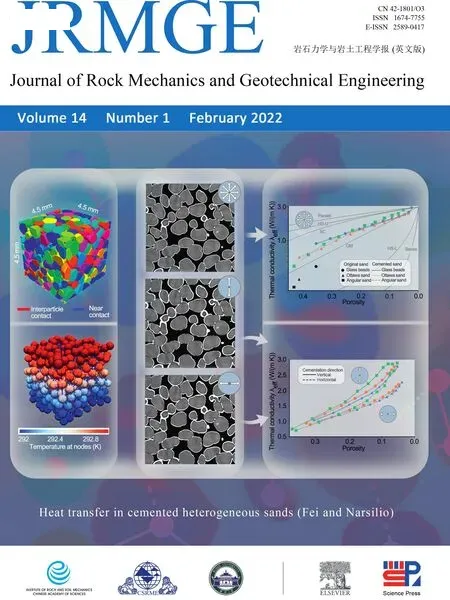
- Estimation of thermal conductivity of cemented sands using thermal network models
- A geometrically and locally adaptive remeshing method for finite difference modeling of mining-induced surface subsidence
- Surface reconstruction with spherical harmonics and its application for single particle crushing simulations
- Applicability of discrete element method with spherical and clumped particles for constitutive study of granular materials
- Intermittent swelling and shrinkage of a highly expansive soil treated with polyacrylamide
- Relating thermal conductivity of soil skeleton with soil texture by the concept of“local thermal conductivity fluctuation”
- Analysis of ground deformation development and settlement prediction by air-boosted vacuum preloading
- Application of wave equation theory to improve dynamic cone penetration test for shallow soil characterisation